

The total wealth of Russian billionaires has decreased by almost $20 billion
The overall wealth of Russian billionaires on the Bloomberg Billionaires Index has gone from rising to falling in the past three months. On June 1, The Insider reported that the 20 Russians on the list had gained $22 billion since the beginning of the year.
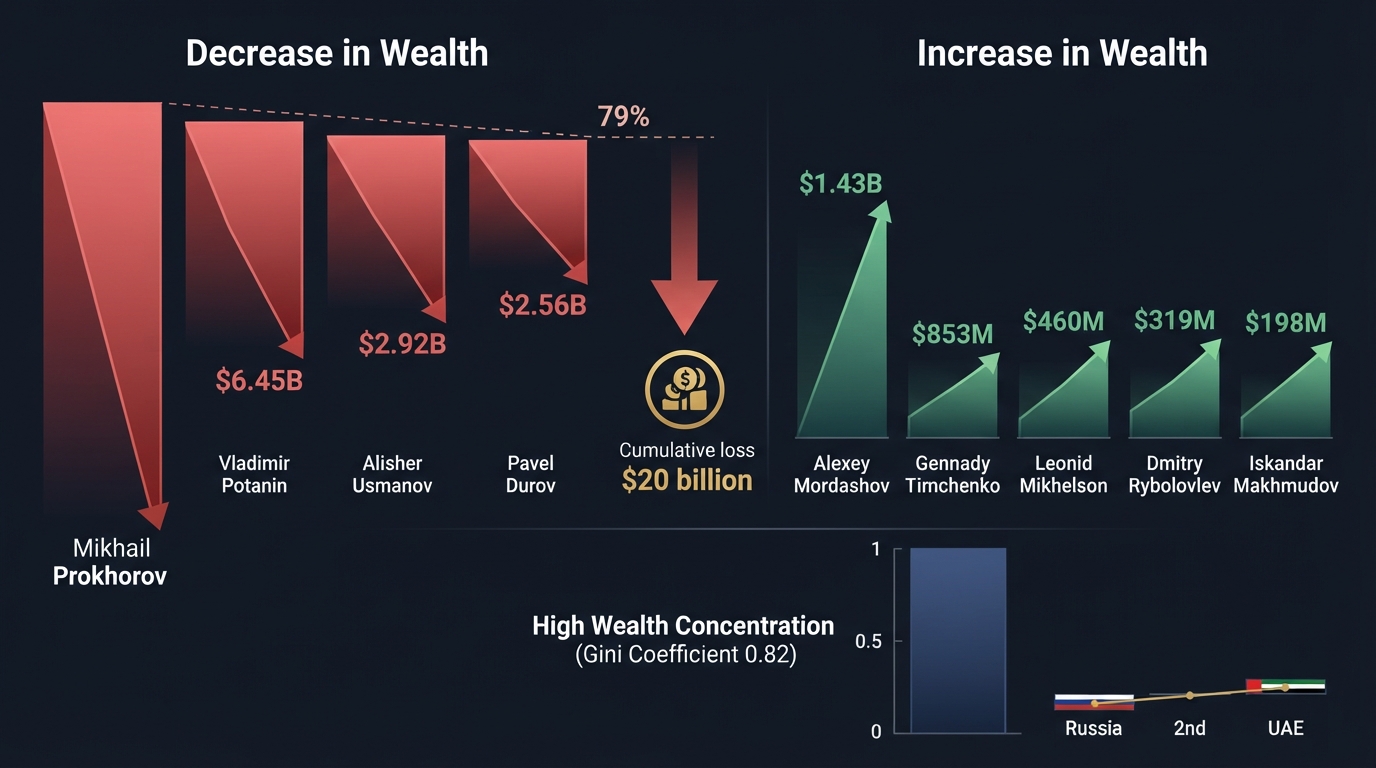
The combined wealth of Russian billionaires has fallen by nearly $20 billion.
According to Bloomberg, Mikhail Prokhorov accounted for almost a third of this total decline, with his fortune falling by $6.45 billion to $10.1 billion. Vladimir Potanin lost $3.73 billion, Alisher Usmanov lost $2.92 billion, and Pavel Durov lost $2.56 billion. According to The Insider, the combined wealth of these four businessmen has fallen by $15.66 billion, or 79 percent of the total decline.
The biggest gainer since the beginning of the year has been Alexei Mordashov, whose fortune has increased by $1.43 billion to $27.7 billion. Gennady Timchenko's fortune increased by $853 million to $15.1 billion, while Leonid Mikhelson's fortune increased by $460 million to $24.1 billion. Dmitry Rybolovlev, whose fortune was estimated by Bloomberg at $10.1 billion, added another $319 million to his account, while Iskander Makhmudov's fortune increased by $198 million to $8.07 billion.
Changes in the rating do not mean that its participants actually gained or lost the indicated amounts. The assessment can also be affected by changes in the value of shares, the ruble exchange rate, the revaluation of non-public businesses and changes in the composition of assets owned by billionaires.
Changes in the size of the largest fortunes are taking place against the backdrop of an excessively high concentration of wealth in Russia. In July, UBS ranked the country as the second most unequal in the world after the United Arab Emirates in terms of wealth inequality. The Gini coefficient, which measures the level of concentration of private capital, was 0.82 in Russia in 2025, with a maximum possible value of 1.