

The top 10 countries that produce the most nuclear power have been revealed
Nuclear energy continues to develop in the world. In 2025, global production reached a record level, while China recorded the largest growth among leading countries.
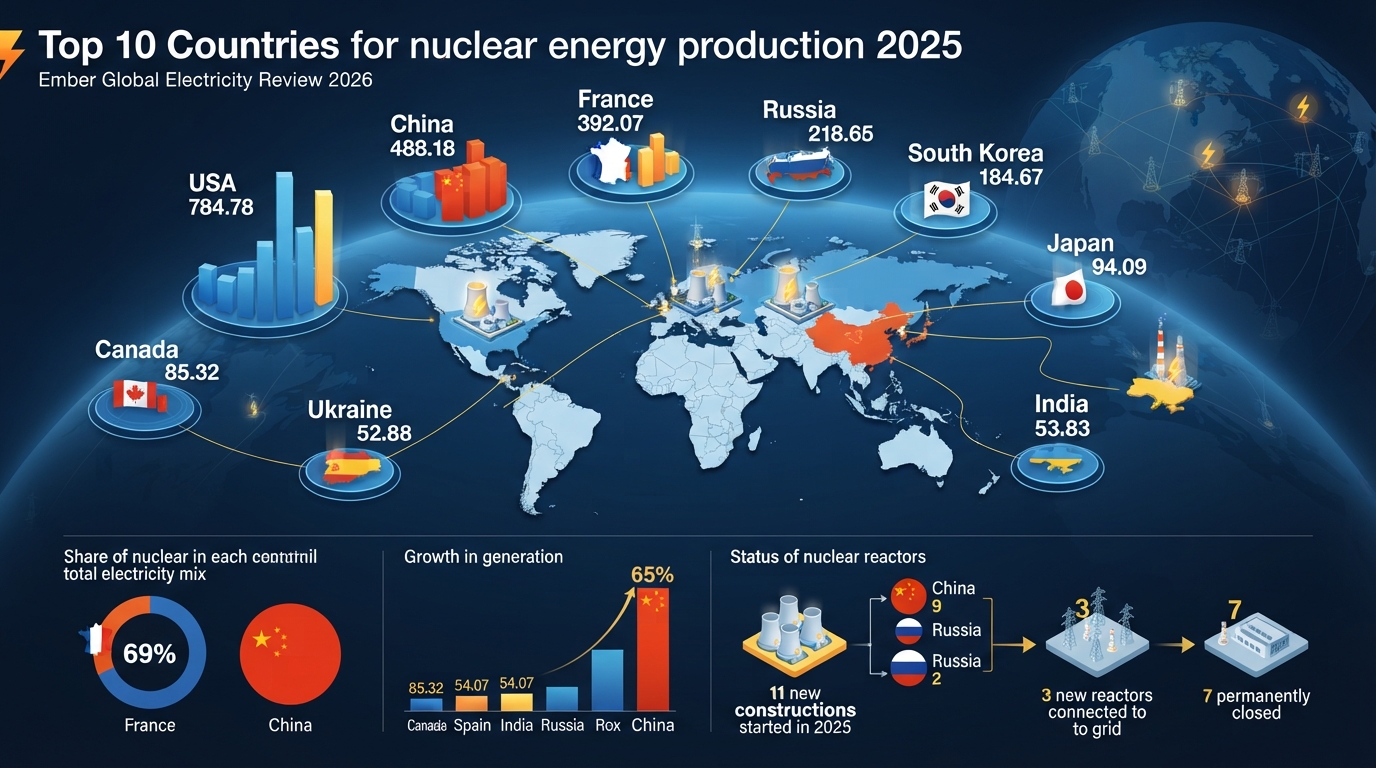
Top 10 countries generating the most nuclear electricity revealed
At the end of 2025, the US took first place in the world for nuclear electricity generation. The country's nuclear power plants (NPPs) generated 784.78 terawatt-hours of electricity during the year. This was reported in the Global Electricity Review 2026 report by the research center Ember.
China took second place on the list with 488.18 terawatt-hours, while France took third place with 392.07 terawatt-hours. Russia ranked fourth with 218.65 terawatt-hours, and South Korea ranked fifth with 184.67 terawatt-hours.
Top 10 countries that generated the most nuclear electricity:
US — 784.78 terawatt-hours;
China — 488.18;
France — 392.07;
Russia — 218.65;
South Korea — 184.67;
Japan — 94.09;
Canada — 85.32;
Spain — 54.07;
India — 53.83;
Ukraine — 52.88.
According to Ember, among the top five countries, the largest growth was observed in China. In 2025, NPPs in the country generated 37.33 terawatt-hours or 8.28 percent more electricity compared to the previous year.
This figure increased by 11.62 terawatt-hours in France, by 2.94 in Russia, and by 2.92 terawatt-hours in the US. In South Korea, on the contrary, it decreased by 4.08 terawatt-hours.
Despite this, the share of electricity generated at NPPs in the country's total electricity supply varies. For example, in France, 69 percent of total electricity in 2025 was generated at nuclear power plants. Although China ranks second in the world in nuclear electricity generation, NPPs account for only a small portion of the total electricity generated in the country.
The World Nuclear Outlook Report 2026, released by the World Nuclear Association in September, also noted that global nuclear electricity generation reached a record high. Construction of 11 new reactors began during the year. Nine of them are located in China and two in Russia. In addition, three new reactors were connected to the power grid, while seven ceased operations entirely.
According to the Association's estimates, if countries' current plans are realized, the total capacity of the world's NPPs could triple by 2050. However, this will require increasing the pace of commissioning new reactors by approximately six times compared to the present.