

France from nuclear, Norway from water: where do countries get their electricity?
In 2025, nearly 69 percent of electricity in France was generated at nuclear power plants, while in Norway, 90 percent came from hydroelectric power plants. Wind was the largest source in Denmark, and coal in China and India. Data from the Ember think tank shows that the electricity generation mix of countries varies drastically.
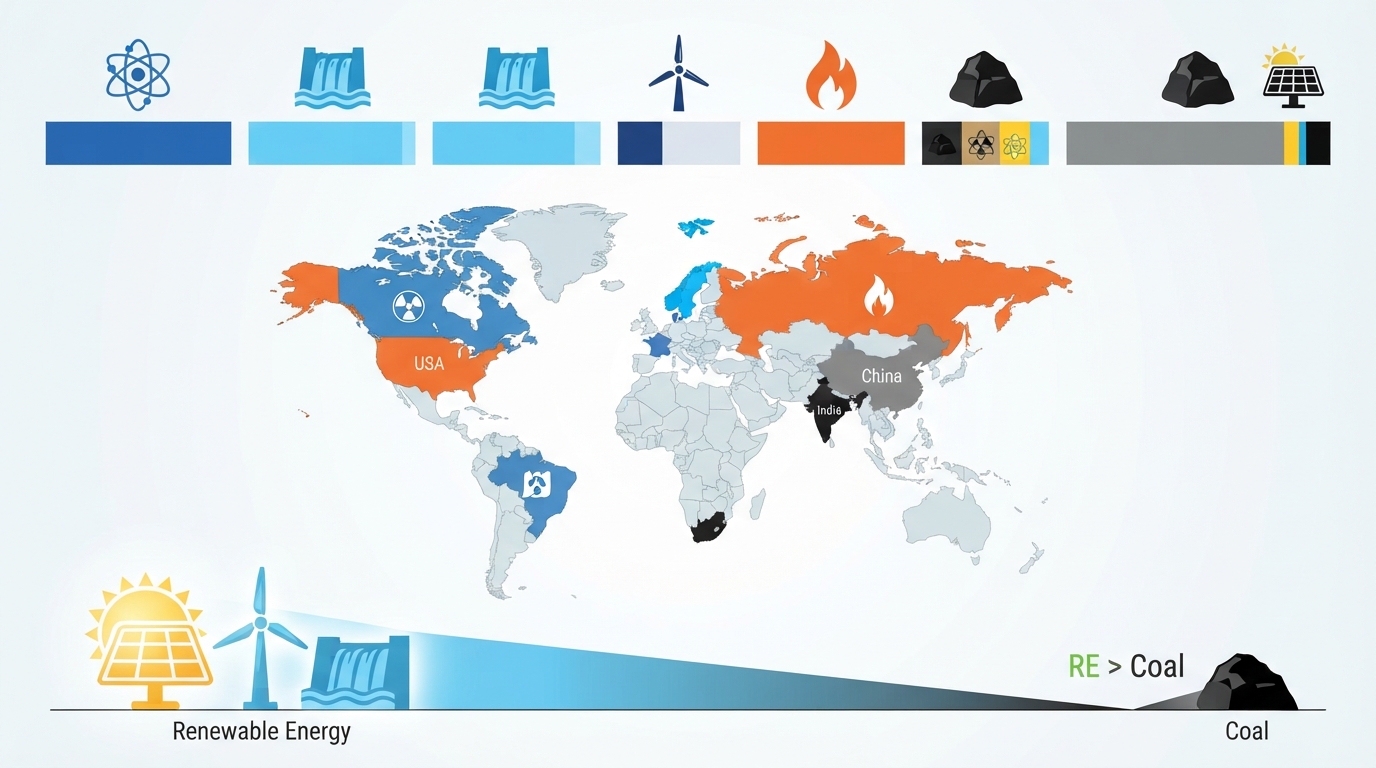
France from nuclear, Norway from water: where do countries get their electricity?
It compares the full 2025 results of 18 countries.
The indicators represent the share of each source in the electricity generated within the country. They do not mean the installed capacity of power plants or the country's overall energy consumption of all types.
Which country relies on which source?
In France, nuclear power plants provided 68.79 percent of total electricity. In Norway, the share of hydropower reached 90.03 percent.
HPPs also accounted for more than half of electricity generation in Canada and Brazil:
Canada — 52.84 percent;
Brazil — 51.78 percent.
In Denmark, the largest source was wind, with its share making up 57.69 percent.
In the US, gas provided 39.99 percent of electricity generation. In Russia, gas is also leading — 44.70 percent. The remaining major sources there were coal — 18.40 percent, nuclear power — 18.33 percent, and hydropower — 16.74 percent.
In China, the share of coal remained at 54.35 percent. At the same time, the combined share of solar and wind reached 21.81 percent.
In India, 70.82 percent of electricity, and in the Republic of South Africa, 81.36 percent was generated from coal.
Globally, renewable sources have surpassed coal. According to Ember data, in 2025, the total share of renewable sources in global electricity generation