

The Tax Committee clarified the rules for the sale of marked goods
The Tax Committee of Uzbekistan has clarified the requirements for the sale of marked goods, working with Data Matrix codes, and cash register receipts.
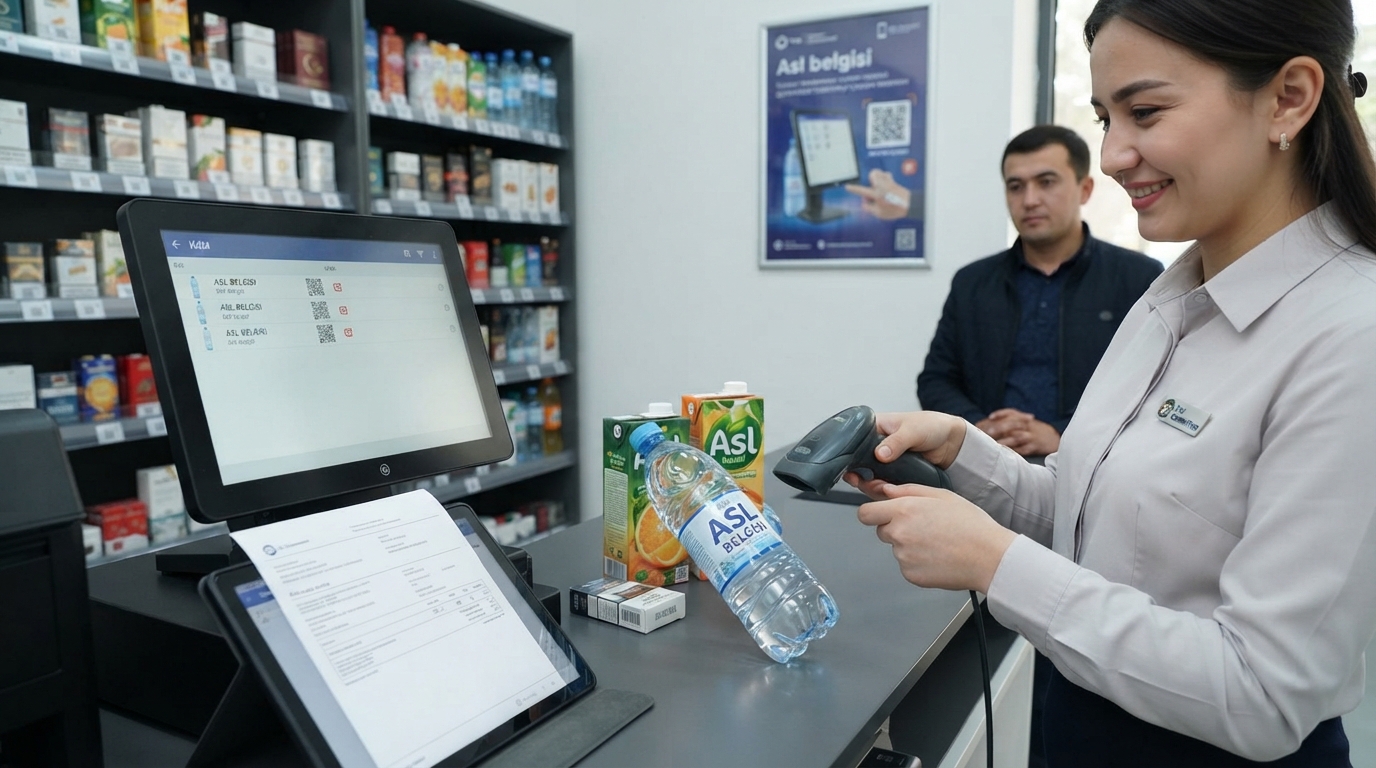
The Tax Committee clarified the procedure for selling marked goods
The Tax Committee of Uzbekistan has clarified the key requirements for the sale of marked products in retail trade. These include the availability of documents confirming the receipt of goods, the inclusion of marking codes in electronic invoices, scanning codes during sale, and reflecting them in the cash receipt.
Marked goods must arrive at the retail organization along with documents confirming their purchase. The electronic invoice (e-invoice) for the purchased marked products must specify the corresponding marking codes.
For producers of water and soft drinks, the obligation to specify marking codes in e-invoices will come into effect on April 1, 2027.
All products subject to mandatory marking must have a Data Matrix code obtained through the "Asl belgisi" information system. Upon sale, this code must be scanned using a 2D scanner, reflected in the cash receipt, and withdrawn from circulation.
Until January 1, 2027, retail entities may reduce their corporate income tax or turnover tax by the amount of expenses associated with purchasing devices for reading marking codes. The amount of this benefit is limited to four basic calculating values for each device. The corresponding norm is provided for by Resolution PQ-203 dated May 30, 2024.
For entrepreneurs providing hotel and public catering services, purchased alcoholic beverages, beer, and tobacco products, as well as water and soft drinks, are recognized as sold for final consumption. This is established by Decree PF-100 dated May 26, 2026.
Specific requirements are also set for the online cash registers (online-KKM) and cash register software in use. They must feature a mechanism to automatically block the issuance of a receipt if the marking code has not been scanned or if the system detects a duplicate code.
From July 1, 2026, when selling marked products, the marking code must be mandatory reflected in the online cash register receipt. Information about the MXIK (Product and Service Classification Code) associated with the code must be generated automatically. This requirement is established by Cabinet of Ministers Resolution No. 23 dated January 23, 2026.
When a product is returned, after the return receipt is processed in accordance with the established procedure, the marking code is automatically restored to circulation.
A separate procedure is provided for water and soft drinks in case the marking code is damaged. Wholesale and retail trade enterprises can obtain a temporary code through the "Asl belgisi" information system and sell the product using it.
The Tax Committee also reminded that in addition to the listed rules, it is necessary to comply with additional requirements established by legislation for specific types of activities and categories of goods.
To receive prompt assistance on digital marking issues, taxpayers can contact the authorized inspectorate through the "Work with Digital Marking" service in the taxpayer's personal account.
The agency emphasized that compliance with the established requirements is necessary for the correct tracking of the movement of marked products, protecting consumer rights, preventing illegal trade, and ensuring the transparency of trade operations.