

The taste of morning freshness
Seoul needs insurance against raw material risks in Central Asia. The states of the region hope to receive technologies, investments, and new markets
**The Taste of Morning Freshness**
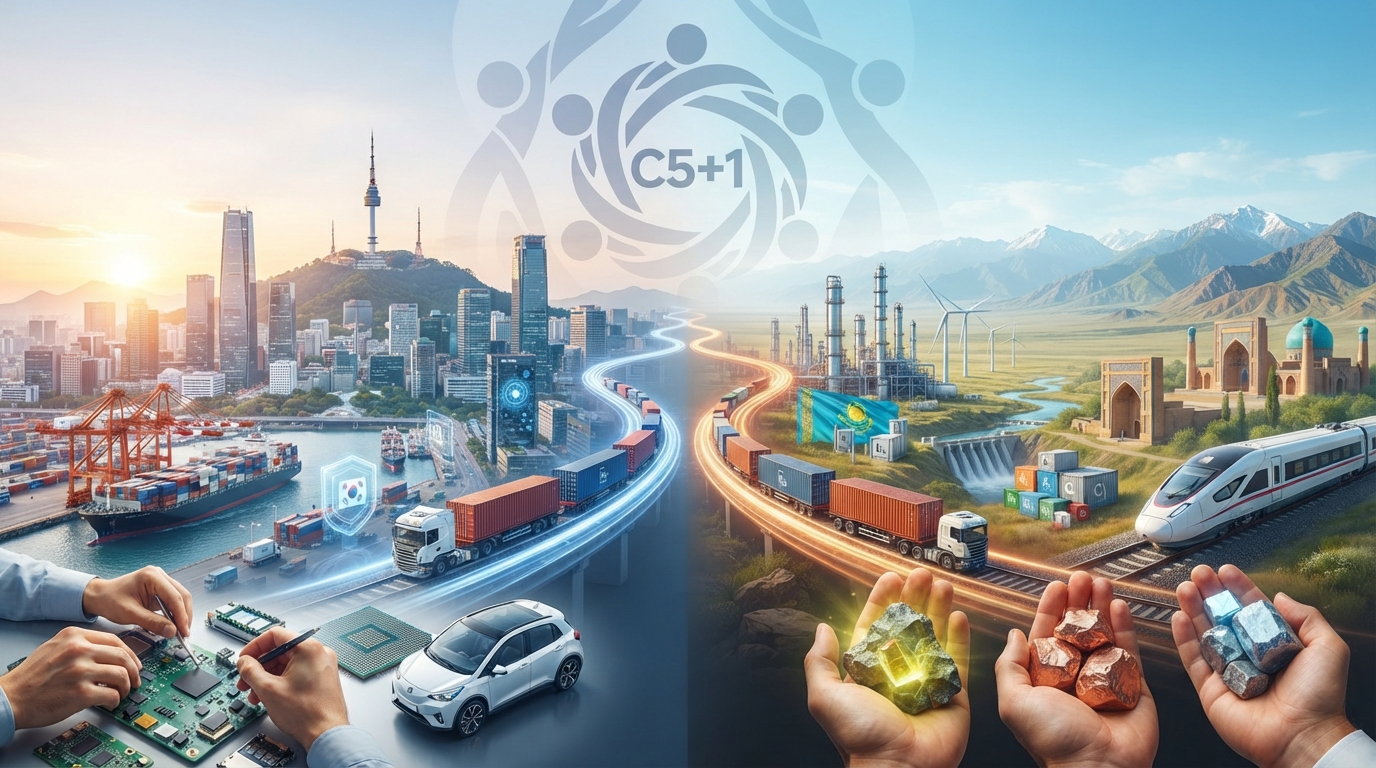
The first "C5+1" summit at the level of heads of state of South Korea and five Central Asian (CA) countries took place in Seoul. Following the summit, the Seoul Declaration was adopted. Seoul's calculation is that the region will help Korea reduce its raw material dependence on China, while Korean technologies will allow the CA countries to transition from exporting raw materials to processing them. However, the success of this course will depend on the emergence of enterprises, financing, and product export routes.
Prior to this, relations developed mainly at the ministerial level. Now, Seoul has elevated them to the level of heads of state. The timing is not accidental: supply chains have become less reliable, US-China rivalry is intensifying, and conflicts in the Middle East pose a threat to energy supplies. South Korea has almost no raw material base of its own, but its industry requires oil, uranium, lithium, copper, nickel, cobalt, and rare earth metals. Without them, it is impossible to produce batteries, semiconductors, cars, and equipment for nuclear power plants.
Central Asia is capable of offering many of these resources. Kazakhstan possesses oil, uranium, chromium, copper, and rare metals. Uzbekistan mines uranium and copper, and is also exploring lithium and tungsten reserves. Kyrgyzstan and Tajikistan possess gold and antimony, while Turkmenistan has gas and petrochemical products.
Seoul requires not just raw materials, but protection against excessive dependence on a few suppliers. By 2030, the government plans to reduce this dependence from approximately 80% to 50%, and to increase state stockpiles of critical minerals from 54 to 100 days of consumption.
The energy logic of the new course manifested itself even before the summit. In April, Seoul agreed on the delivery of 18 million barrels of Kazakh oil amid instability around the Strait of Hormuz. During the talks, Presidents Lee Jae-myung and Kassym-Jomart Tokayev signed a framework agreement designed for long-term cooperation.
At the meeting in Seoul, Tokayev, in addition to developing trade, economic, and investment cooperation, proposed revising the transport and logistics potential. In particular, he called for "ensuring the integration of the Middle Corridor with the TRIPP transport initiative." Korea carries out multimodal transportation to Central Asia through the Kazakh-Chinese logistics terminal in the port of Lianyungang. According to Tokayev, "it is possible to combine the potentials of these routes and form an end-to-end transport and logistics chain from Korea through Central Asia to Europe."
Central Asia also interests Seoul as a space between East Asia and Europe. "The summit should open a new path of economic and cultural cooperation leading to Europe and the Middle East," Lee Jae-myung stated. This primarily refers to the Trans-Caspian, or Middle, Corridor, the importance of which has grown since the start of the conflict in Ukraine.
The countries of the region expect to receive from Korea not only revenues from raw materials, but also processing enterprises, transport, digital systems, medicine, education, and jobs. This is the main bargain: Seoul needs reliable supplies, and Central Asia needs value-added production.
For now, economic relations are noticeably skewed in Korea's favor. In 2025, trade turnover exceeded $10 billion for the first time. Korean exports to the five countries reached $8.665 billion, while imports from the region were only $1.39 billion. For every dollar of Central Asian goods, there is more than six dollars of Korean exports. Korea's accumulated investments are estimated at $6.48 billion.
The main question is whether Central Asia will become a manufacturing partner for Korea or remain a market for its machinery and a supplier of raw materials. Seoul has developed the closest ties with Uzbekistan. "Over the past years, the Republic of Korea has become a reliable friend and one of the most important economic partners of our country," Shavkat Mirziyoyev stated. He called the Korean diaspora a "spiritual bridge" between the two peoples.
At the summit, the head of Uzbekistan put forward five initiatives: to develop a long-term partnership strategy, to establish an industrial-technological park and an investment alliance on critical minerals, to launch a climate partnership, and to strengthen cooperation in the field of AI.
With Turkmenistan, Korea is betting on gas chemicals, railways, shipbuilding, and new cities. The main outcome was an agreement on investment protection, negotiations on which had been ongoing for 16 years. It establishes rules for compensation in the event of property expropriation and the procedure for resolving disputes between the state and the investor. Unlike memorandums, this document provides capital with legal guarantees.
Relations with Tajikistan have been elevated to the level of a comprehensive partnership for the first time. Seventeen documents were signed on railways, energy, digitalization, and the fight against corruption and money laundering. President Emomali Rahmon called accelerated industrialization and job creation the country's main tasks. It is important for Dushanbe to turn Korean aid into investment projects.
Kyrgyzstan received 18 agreements and memorandums. A representative office of the KOTRA agency will open in Bishkek, and a Korea Desk will be established under the National Investment Agency. Mutual recognition of halal certificates could facilitate the entry of Korean food products and cosmetics into the region's markets.
The new course also has a human foundation. About 310,000 Koryo-saram live in Central Asia: 172,000 in Uzbekistan and 120,000 in Kazakhstan. About 150,000 people from the region study and work in South Korea. The year 2027 will mark 90 years since the mass resettlement of Koreans to Central Asia. Other external partners do not have such a connecting link here.
At the same time, the region is crowded. China offers loans, infrastructure, and a neighboring market. Russia maintains transport and labor ties. The EU promotes the Middle Corridor and green energy, while the US promotes security and critical minerals. Japan has promised to support projects worth 3 trillion yen over five years.
Korea's advantage lies in its technology, industrial experience, and the absence of a reputation as a power seeking to control the region. But the outcome of the summit will be determined not by the number of memorandums, but by the emergence of enterprises, financing, and delivery routes. The exchange looks attractive: resources in exchange for technology. The parties have yet to prove that this is an industrial partnership, rather than a new raw material dependence.
The "C5+1" alignment of positions at the level of heads of state will take place once every two years. In the intervals, the foreign ministers of the participating countries will monitor the implementation of the agreements reached and prepare the agenda for the next meeting.