

The sun rises in the Karakum
Tokyo bets on neutral Ashgabat. Japan and Turkmenistan extend cooperation beyond traditional gas chemistry
**The Sun Rises in the Karakum**
Tokyo and Ashgabat are beginning preparations for the next meeting of the joint committees on economic cooperation, as well as for the 35th anniversary of diplomatic relations, which the two countries will celebrate in 2027. This is the main outcome of the visit of Japanese Foreign Minister Toshimitsu Motegi to Turkmenistan. The Japanese minister's talks with President Serdar Berdimuhamedov became not the final point of another exchange of visits, but a bid for a new stage of cooperation.
As part of an overseas tour from August 29 to September 4, 2026, Japanese Foreign Minister Toshimitsu Motegi made a stop in Turkmenistan. This was the first visit by a Japanese foreign minister to the republic in nine years. In Ashgabat, Motegi met with Serdar Berdimuhamedov, and then spoke for almost three hours with his Turkmen counterpart Rashid Meredov — already in the format of talks and a working lunch.
From Ashgabat, Motegi took away a signed Cooperation Program between the foreign ministries for 2027–2029. This document will replace the current three-year plan and determine the schedule of consultations, mutual trips, and contacts at international venues. No billion-dollar agreements were signed during the visit. However, the list of topics discussed shows where new projects may emerge.
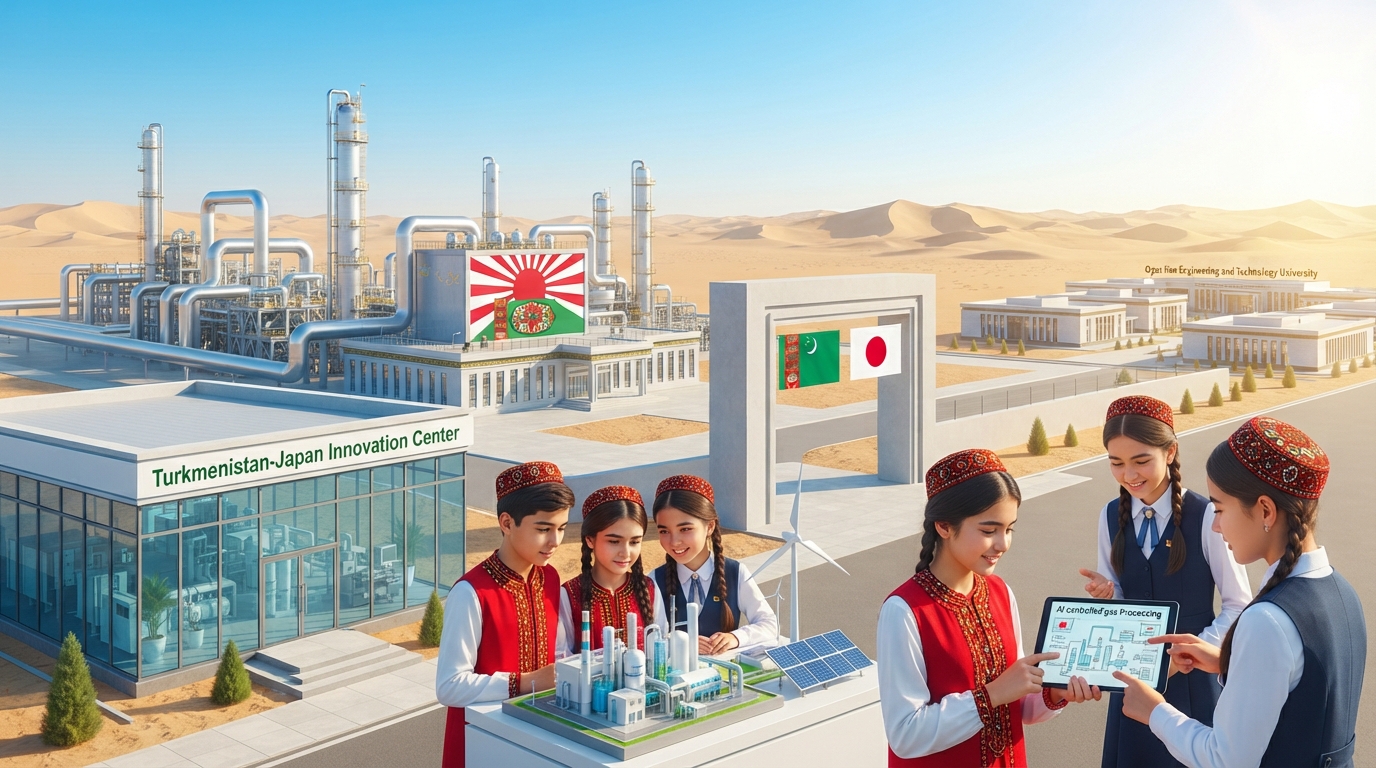
Until now, the Japanese presence in Turkmenistan has been associated primarily with the gas and chemical industries, with huge factory complexes in the middle of the desert. Now, artificial intelligence, waste recycling, and the circular economy have been added to this. In other words, Tokyo is proposing not to abandon the familiar model of cooperation, but to build a new technological level on top of it.
The parties have a solid foundation for such a transition. Kawasaki Heavy Industries, Mitsubishi, Itochu, Sojitz, and other Japanese companies participated in the construction of Turkmen enterprises for the production of mineral fertilizers and gasoline from natural gas. Japanese technologies allowed Ashgabat not just to export raw materials, but also to process them domestically. Now, the same approach is expected to be extended to resource conservation, digital production management, and environmental modernization.
The economic agenda of the visit did not arise by chance. A few days before Motegi's arrival, Rashid Meredov held video talks with Hiroyuki Tsubai, Chairman of the Japan-Turkmenistan Committee on Economic Cooperation. They discussed gas chemistry, transport, and the circular economy, as well as documents being prepared for the next joint meeting of the business committees. Thus, the diplomatic visit turned out to be embedded in the longer-term work of businesses and government agencies.
Bekdurdy Amansaryev, a researcher at the Center for Strategic Studies of the Institute of International Relations of the Ministry of Foreign Affairs of Turkmenistan, drew attention to the intensity of contacts between the two countries in an article published on the Orient.tm news portal. In 2025, Serdar Berdimuhamedov visited Japan twice. In April, he visited the National Day of Turkmenistan at the World Expo in Osaka, and in December, he took part in the first "Central Asia + Japan" summit. Motegi's trip was a reciprocal step and an attempt to translate the agreements reached then from the language of joint statements into the language of concrete projects.
The expert noted that the Japanese minister's route looks like a "diplomatic puzzle": Turkmenistan – Slovakia – Austria and Mongolia — countries that are difficult to combine on a geographical or political basis. "But Japanese diplomacy rarely plans such routes by chance. Each stop gave Tokyo access to a separate direction: Central Asia, the Visegrad Group states, international organizations located in Vienna, and mineral-rich Mongolia," Amansaryev emphasized.
According to him, in this structure, Turkmenistan plays the role of more than just another Central Asian republic. It is a neutral state with large gas reserves, a favorable position between Asia, the Caspian, and Europe, and many years of experience working with Japanese industrial corporations. Such a combination is difficult to find anywhere else in the region.
Of course, Japan cannot compete here with Central Asia's closest neighbors in terms of geography, trade volume, or political influence. On the other hand, it has other capital — high technologies, a reputation as a reliable partner, and no desire to drag regional states into military-political alliances. For Ashgabat, which has emphasized its permanent neutrality for decades, this is particularly convenient.
The political part of the visit, however, did not remain in the shadow of the economy. Motegi presented the updated concept of a "Free and Open Indo-Pacific" to the Turkmen leadership. On the map, Turkmenistan is located far from ocean routes, but the Japanese interpretation of this concept has long ceased to be limited to seas and straits. It is about an international order based on law, sustainable links between Asia and Europe, and the independence of states that do not wish to choose between competing centers of power.
Ashgabat treats such formulas with caution. It is ready to speak about the rule of international law and the role of the UN, but avoids structures that could be interpreted as joining one camp against another. Therefore, after discussing Ukraine, the Middle East, East Asia, and the North Korean issue, the parties limited themselves to the intention to continue cooperation in the international arena. For neutral Turkmenistan, even such a formulation is sufficiently meaningful.
Unexpectedly, education occupied a prominent place in the negotiations. According to Rashid Meredov, about 15,000 people study the Japanese language in Turkmenistan. It is taught in schools and universities, and the Oguz Han Engineering and Technology University is developing contacts with Japanese educational institutions. For relations that have long been held up by several large industrial construction projects, the emergence of thousands of people interested in the language and culture of the partner means a more reliable foundation than any single contract.
In the coming months, it will become clear which of the discussed areas will turn into real agreements. Gas chemistry remains the foundation of the Turkmen-Japanese partnership. But now the parties want to evaluate new projects not only by the amount of processed gas, but also by resource savings, environmental efficiency, and the level of digitalization.
Therefore, Motegi's visit opened the diplomatic season rather than summed up what has already been done. Japan is trying to secure its role as Turkmenistan's technological partner, while Ashgabat seeks to obtain new tools for modernization without changing its customary foreign policy distance. At a time when Central Asia is being increasingly urged to make a geopolitical choice, the opportunity to cooperate without making such a choice becomes a valuable proposition in itself.