

The Senate has approved the new law on the Constitutional Court
Senators have approved a new Constitutional Law on the Constitutional Court. It introduces electronic legal proceedings, the ability to submit appeals and participate in hearings online, as well as a 15-day deadline for the preliminary consideration of applications. Some of the provisions are already in force under the current law.
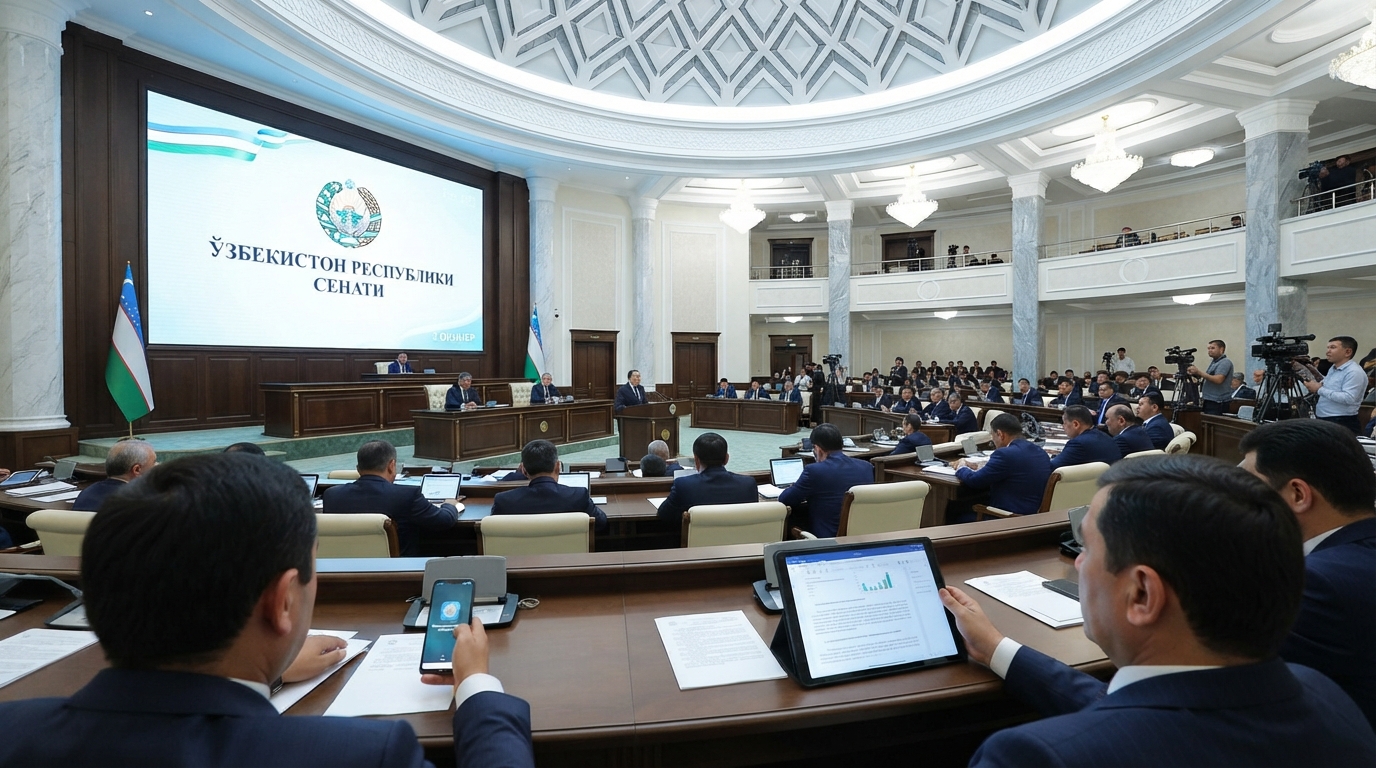
The Senate has approved a new law on the Constitutional Court
At a meeting on October 2, the Senate of the Oliy Majlis approved the new Constitutional Law "On the Constitutional Court of the Republic of Uzbekistan." For the document to enter into force, it must be signed by the president.
The law introduces full-fledged electronic legal proceedings, establishes a 15-day period for the preliminary consideration of appeals, clarifies the consequences of declaring a normative act unconstitutional, and provides for the creation of a reserve of candidates for judges of the Constitutional Court.
At the same time, some of the provisions discussed during the consideration of the law are already contained in the current 2021 law.
One of the main innovations will be the introduction of the Constitutional Court's information system.
Through it, it will be possible to submit appeals in electronic form, track their consideration, participate in hearings via videoconferencing and through a mobile application. The possibility of live broadcasting open hearings on the Internet is also provided.
Electronic procedural documents will have the same legal force as paper ones. Minutes of hearings can be drawn up in electronic form and certified with an electronic digital signature.
In the current law, there is no separate full-fledged regime for electronic constitutional legal proceedings. It regulates the traditional procedure for submitting and considering appeals and only allows the use of audio and video recording during hearings.
The new law introduces a separate stage of preliminary consideration of received appeals within 15 days. At this stage, the competence of the Constitutional Court, the powers of the applicant, and compliance with the requirements for the appeal will be verified.
If the issue does not fall within the competence of the Constitutional Court, the appeal can be forwarded to the authorized body or rejected.
The current law already provides for the registration of an appeal, its preliminary study by judges, acceptance for consideration, or rejection. However, a separate general 15-day period for this stage is not established.
The possibility for citizens and legal entities to appeal to the Constitutional Court with complaints is not in itself new.
The current law already allows challenging the constitutionality of a law applied by a court in a specific case if all other judicial remedies have been exhausted.
The new law regulates in more detail the procedure for filing such complaints, the list of attached documents, and confirmation that the applicant has used other methods of judicial protection.
The possibility of participation of a lawyer providing legal assistance at the expense of the state is also already provided for by current legislation and has been in effect since 2026.
A significant change concerns the period within which a state body must bring its normative legal act into compliance with the Constitution after a decision of the Constitutional Court.
Currently, no more than one month is allocated for this. The new law establishes a period of up to three months or another period determined by the Constitutional Court itself.
At the same time, the rule on reviewing within a month the decisions of state bodies adopted on the basis of an unconstitutional normative act is actually preserved: such a norm is already in the current law.
What is new is the direct consolidation in the law on the Constitutional Court of the procedure for reviewing judicial acts issued on the basis of a normative document subsequently declared unconstitutional.
At the Senate meeting, it was also noted that decisions and conclusions of the Constitutional Court must be published within three days after their adoption.
However, this requirement is already in force: the current law provides for the official publication of decisions and conclusions of the Constitutional Court within three days.
In this part, the new law mainly systematizes the types of court acts: decisions will be adopted on key issues, conclusions on others, and rulings on procedural matters.
Current legislation already provides for the preparation of information on the state of constitutional legality.
The new law describes this procedure in more detail: the Constitutional Court will annually prepare such information based on the generalization of judicial practice, consider it in the first quarter, and send it to the chambers of the Oliy Majlis and the president.
In addition, the court will be able to discuss the results of the consideration by state bodies of the proposals and recommendations contained in the document.
A separate innovation will be the formation of a reserve of candidates for the positions of judges of the Constitutional Court jointly with the Supreme Judicial Council.
The current law establishes requirements for candidates and the procedure for electing judges, but does not provide for a separate mechanism for such a personnel reserve.
The new law also regulates in more detail the work of the scientific advisory council and certain issues of financing the court.
Over the past ten years, the legislation on the Constitutional Court is being revised for the third time — in 2017, in 2021, and now. The development of the new law was announced in mid-August by the Chairman of the Constitutional Court of Uzbekistan, Mirza-Ulugbek Abdusalomov.