

The salt flat of Namibia, which looks like another planet, was photographed from space
The Sentinel-2 satellite captured an unusual image of the Etosha salt pan in Namibia. In the photo, cyan and blue areas are surrounded by red regions. However, these are not natural colors — false colors were applied to the image to highlight vegetation and land surface features.
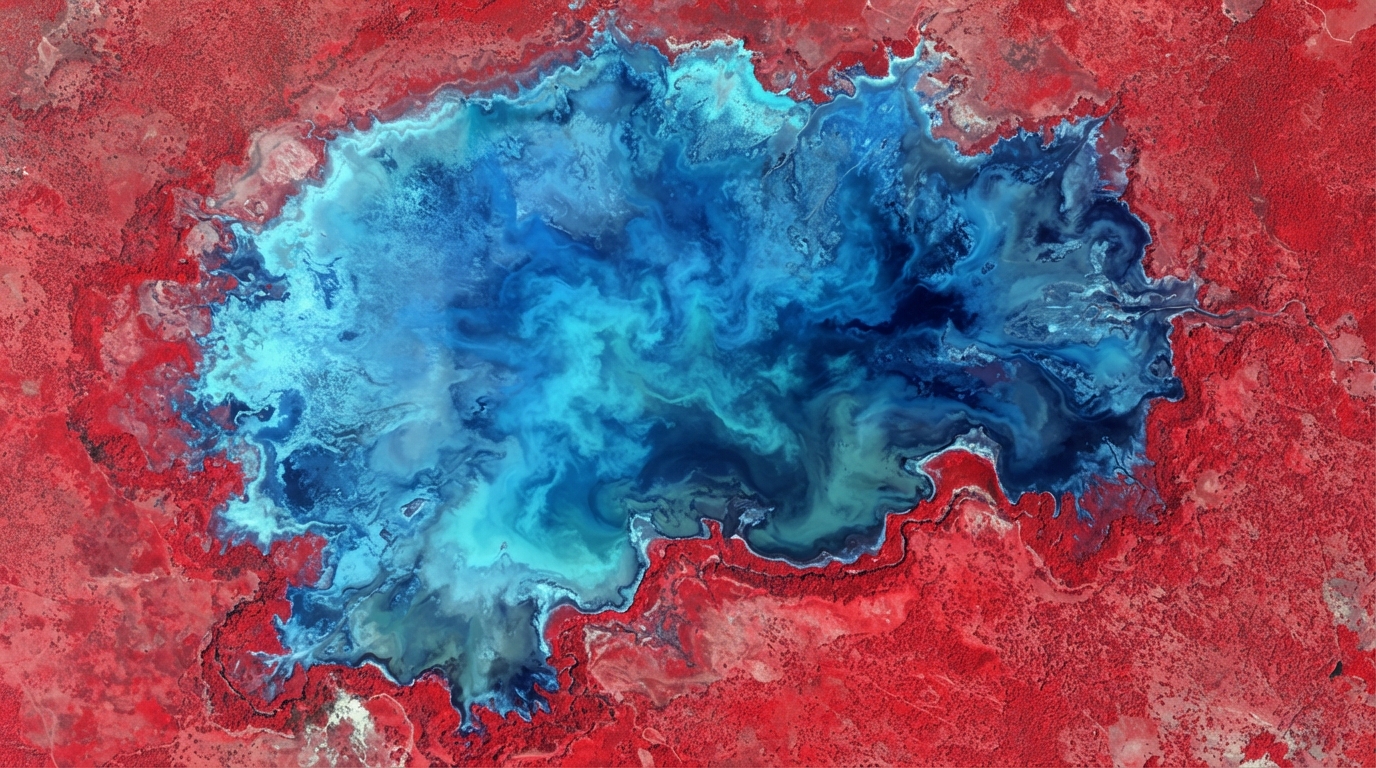
A salt flat in Namibia resembling another planet captured from space
According to information provided by the European Space Agency — ESA, the image was taken on April 5, 2026, as part of the Copernicus Sentinel-2 program
Etosha is located within the national park of the same name in northern Namibia. It is the largest salt flat in the country, its surface covered with salt and other mineral deposits.
The colors and shapes in the satellite image make it look like a distant planetary landscape. In reality, when viewed from the ground, Etosha appears mostly as a white plain.
The high-resolution multispectral instrument on the Sentinel-2 spacecraft captures images in 13 spectral bands. Combining data obtained across different bands helps reveal features that are difficult to distinguish in regular photographs.
In this image, the vegetation surrounding the salt pan is reflected in shades of red. On the flat itself, bright cyan, light blue, and dark blue patches are visible. The cloud-like shapes between them are accumulations of sediment particles suspended in the water.
The areas shown in red encompass grasslands, savannas, and mopane trees. Mopane is one of the characteristic trees of this part of the national park, forming an important part of the natural habitat home to elephants, giraffes, and leopards.
Such satellite images allow scientists to study the natural features of the region and monitor changes occurring over time.