

"The reverse effect." Do air conditioners actually heat up cities?
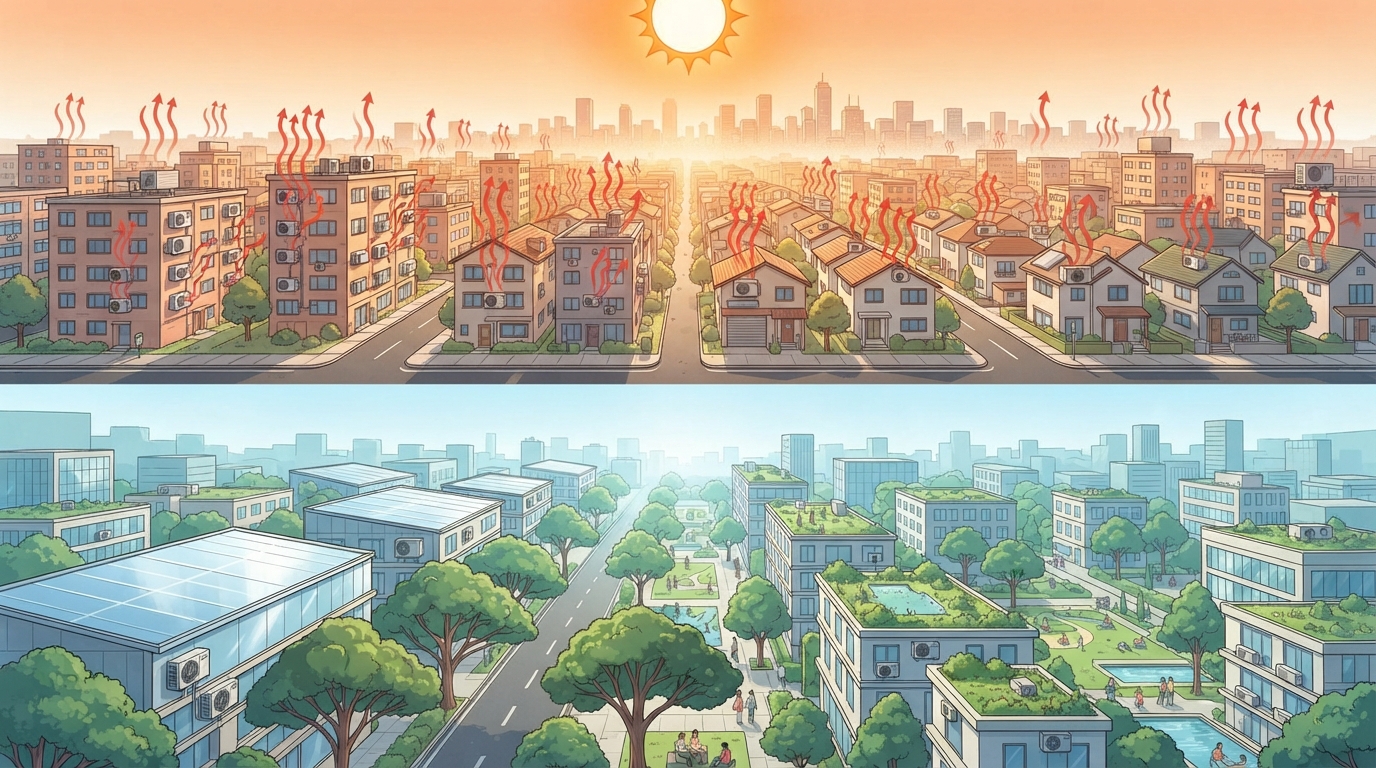
"The reverse effect." Do air conditioners heat up cities?
On hot summer days, air conditioners seem to be the easiest and most effective way to escape the heat for many. They cool the inside of buildings, protecting people from the heat, and thus becoming an integral part of everyday life. However, one serious problem with air conditioners is often overlooked: they cool the room, but heat the outside.
The fact is that air conditioners do not eliminate heat, but take it from the inside of the building and release it into the outside environment. With the increasing number of such devices, a "heat island" effect can appear in large cities, artificially increasing temperatures. The Paris experience has scientifically confirmed this.
The Paris experience
Almost a quarter of a century ago, the French capital experienced the hottest year in the history of its observations. The heatwave killed 1,500-2,000 people in the capital and 15,000 French people nationwide. At that time, researchers calculated the impact of the heat emitted by air conditioners on the city's temperature.
According to the study, air conditioners increased the temperature on the streets of Paris by an average of 0.5°C that year. If all the heat emitted by air conditioners were directly released into the air, this figure would reach about 1°C. However, this was observed in 2003. Given that cooling devices have become much more popular since then, scientists now estimate that the impact level will reach 2°C.
It is noteworthy that air conditioners can have a stronger effect on the external environment at night than during the day. This is because at night the lower layer of the atmosphere is much thinner. Therefore, the heat released to the outside cannot dissipate upwards as quickly. In other words, while people are waiting for the air to cool down, air conditioners are heating up the temperature.
This creates a kind of vicious circle: as the air warms, the use of air conditioners increases. As more air conditioners are installed, the amount of heat released outside increases. As a result, the city heats up even more. In a city that heats up, the demand for air conditioners increases even more.
Studies show that the impact of air conditioners on urban heat depends on the type of air conditioner and where it is released. For example, systems that release heat directly into the outside air increase the heat load of a city. Systems that release heat underground or into water, on the other hand, may have a much smaller impact on the outside temperature.
The problem is not just with air conditioners
However, air conditioners are not the only reason why cities are heating up. Concrete, asphalt, and dark roofs absorb a large amount of solar energy and re-emit it as heat. This is especially noticeable in densely built-up areas with few trees and green spaces.
Therefore, cooling the city is not just a matter of installing more air conditioning. Properly designing buildings and streets, using special coatings for roofs and roads, and increasing trees and green spaces are also important aspects.
For example, light-colored roofs and coatings can reflect more sunlight and reduce heat levels. Trees, on the other hand, naturally cool the air through their shade and evaporation. However, even such measures cannot completely eliminate the need for air conditioning. A study conducted on the example of Paris showed that measures such as large-scale greening of the city, insulation of buildings and rational use of cooling devices reduced the energy consumed by air conditioning by half.
However, it is worth noting that The Economist article does not advocate that air conditioning is harmful and therefore should be eliminated. The authors emphasize that cooling devices protect people from heat-related illnesses in hot conditions and call for their effective use. The authors also suggest increasing green spaces, installing solar-reflecting coatings, and insulating buildings.