

The residents of Yunusabad exhausted their treasure trove of unrefined expressions after putting the Ministry of Energy's promises to the test
The Ministry of Energy of Uzbekistan has assured that the autumn-winter period will pass without power supply interruptions. However, with a reservation: temporary outages are still possible if scheduled maintenance work is required. The latter, as the ministry explains, is needed to upgrade worn-out equipment and modernize the power grid infrastructure. Sounds encouraging. But residents of two blocks of Yunusabad (the sixth and seventh), judging by the power supply situation, are already […]
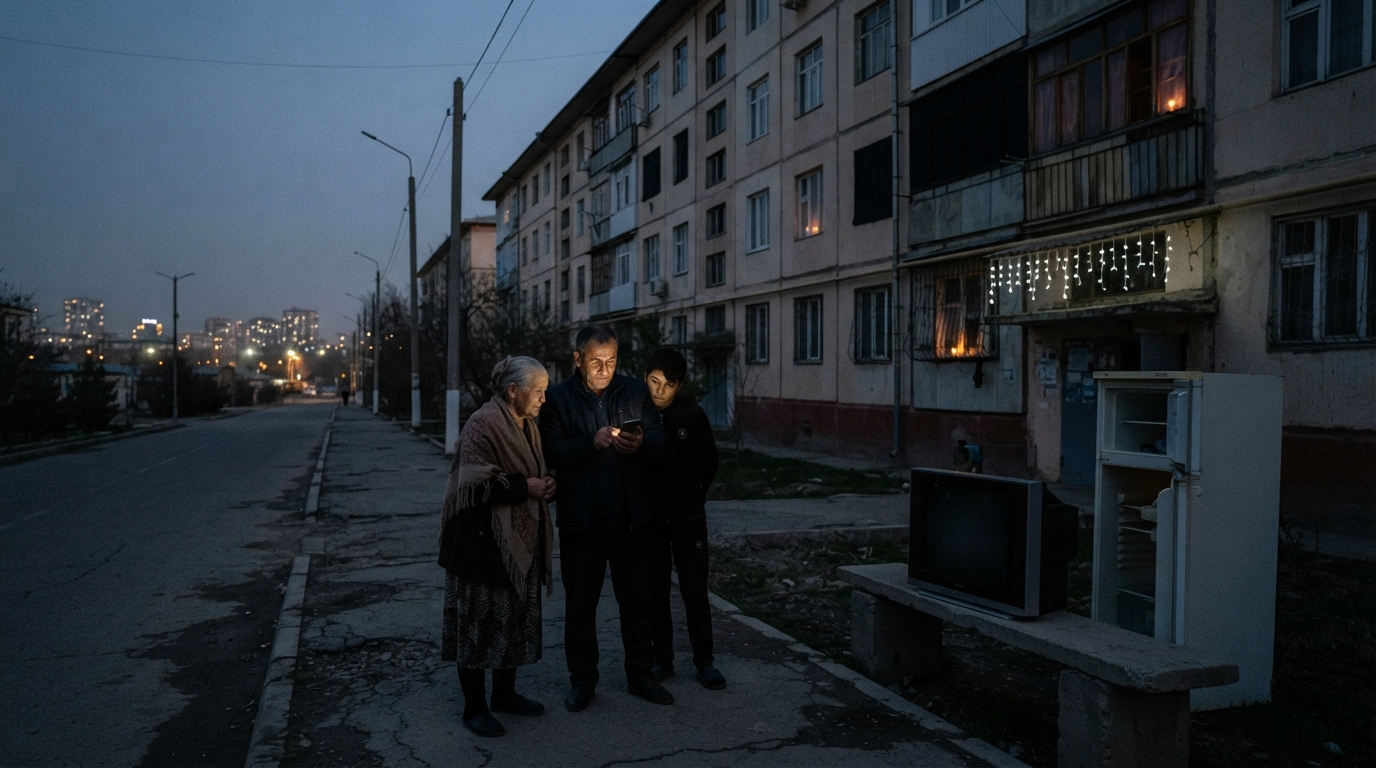
Residents of Yunusabad seem to have run out of strong language while testing the strength of the Ministry of Energy's promises
The Ministry of Energy of Uzbekistan stated that the autumn-winter period will pass without power supply disruptions. However, with a reservation: short-term outages are still possible if scheduled maintenance work is required. As the ministry explains, these are necessary to replace worn-out equipment and modernize the power grid infrastructure.
It sounds encouraging. But residents of two Yunusabad quarters — the sixth and seventh — seem to no longer know whether to cry or laugh about the power supply situation. Here, by all appearances, scheduled maintenance and emergency outages have long become a part of daily life.
According to local residents, a week without a power outage almost never happens here. The reason is the increased frequency of accidents at the Beshkurgan and Yablochny substations. Sometimes the electricity is cut off two or three times a day. Even holidays are no exception: residents were left without power on both September 1 and October 1.
Polite apologies from the regional electric power networks (RES), which are published in local groups, change nothing. They make things neither brighter nor calmer for the people: household appliances risk breaking down, the usual routine is disrupted, and another outage notification only adds to the frustration.
Meanwhile, back in 2023, residents were promised that they just had to be patient a little longer, and power supply problems would become a thing of the past.
It was then that a large-scale replacement of overhead high-voltage power lines with underground cable networks began in this area of Tashkent. The work was carried out as part of an emergency program to modernize the capital's power system following an abnormally cold winter.
Moving the power grids underground was supposed to protect the infrastructure from strong winds and precipitation, reduce accident rates, and lessen the load on overloaded substations.
However, judging by the ongoing outages, residents have not felt the expected effect. According to them, accidents are occurring more and more frequently, and power cuts are gradually being perceived as inevitable.
Why the situation has not improved after the modernization was carried out remains unclear.
According to the Ministry of Energy, the number of citizen appeals specifically regarding power outages decreased by 49.7% — to 14 thousand.
For departmental statistics, this is undoubtedly a positive indicator. But that makes it no easier for the residents of the two Yunusabad quarters. If electricity still disappears regularly, a drop in the total number of complaints does not solve the problem by itself.
People are not concerned with reports or polite apologies from power engineers. They need power — without sudden outages, damaged household appliances, and the need to find out every time when the power supply will resume.
Against the backdrop of promises to pass the upcoming winter smoothly, the questions remain the same: why do accidents recur in the same areas, what did the modernization yield, and when will residents finally be able to count on a stable power supply?
In the meantime, the main energy ministry should remember: confident statements about system reliability sound convincing only when they are confirmed in the sockets.