

The repression during the "Great Massacre". Why were women imprisoned there, and what was the fate of the children?
In the "Great Massacre" of the 1930s, more than 18,000 women, from intellectuals to housewives, were deported by the Soviet authorities. Some of these prisoners became pregnant in prison, and some were unable to find their children upon their return. There were also Uzbek women among these prisoners.
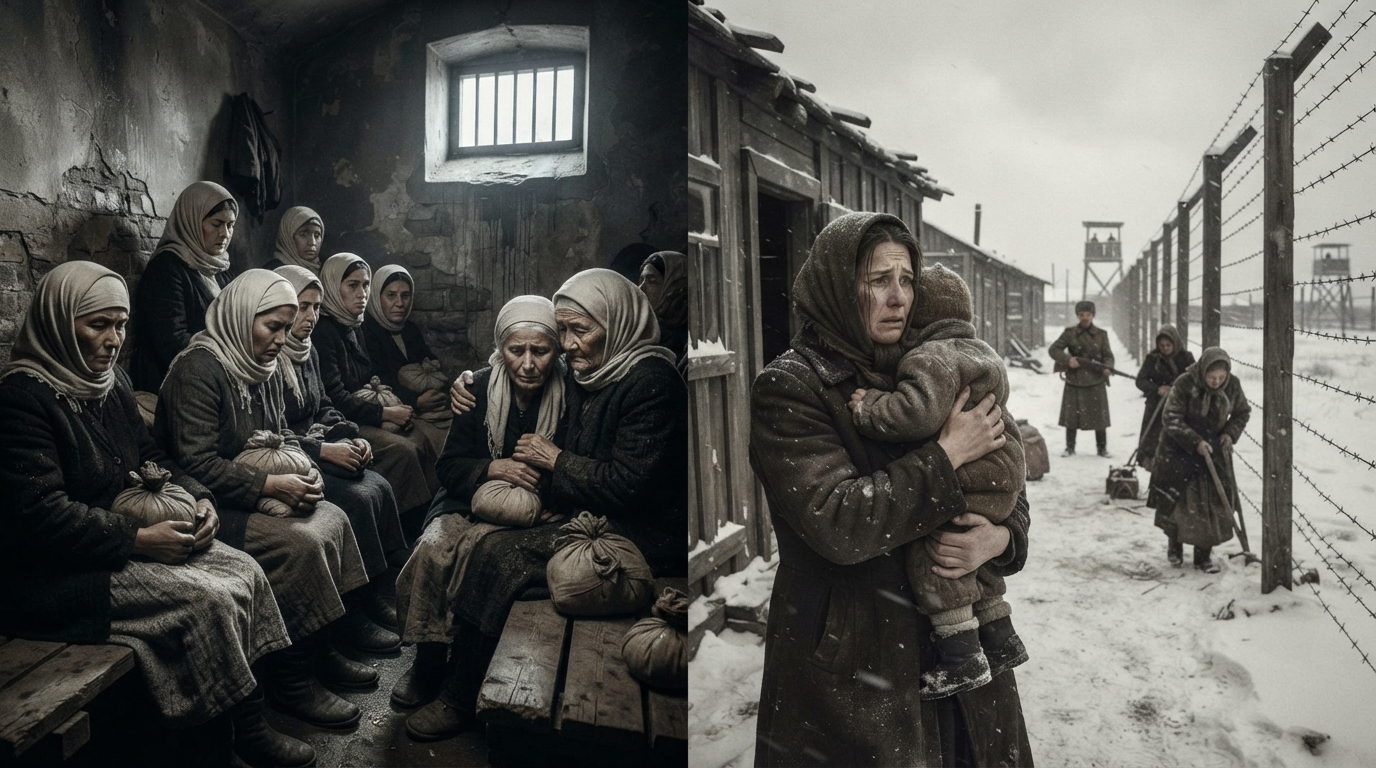
Repressions during the "Great Holocaust": Why were women imprisoned and what was the fate of children?
On March 8, 1938, the Soviet press published articles about the role and rights of women in society. The article, titled "The Zealous Patriotic Women of the Socialist Fatherland," noted that more than 9 million women worked in state agencies, about 100,000 female engineers and technicians in factories, and 18 million working women worked in socialist fields. It was also noted that more than 57,000 female tractor drivers worked on collective farms, and that it was common for women to be collective farm chairmen, board members, and foremen. The article emphasized that only in the USSR were women fully free, actively participating in governing the state and building a socialist society, that Stalin's Constitution granted women equal rights with men, and that these rights were secured by the entire wealth of the socialist country.
It is also stated that the doors of schools and universities were wide open for Soviet women, and in the 1936-1937 academic year, 13 million girls attended primary and secondary schools, and 41 percent of students in higher education institutions were women. It is noted that many female specialists worked in the field of national economy and culture, and in 1937, about 100 thousand female engineers and technicians worked in large industry, and about 50 thousand female doctors worked in the country. The article emphasizes that in the Soviet state, a woman is a full-fledged member of society, and a wide path of life is open to her, while in capitalist society, women are the most disenfranchised, exploited and oppressed part of the population, and in most European countries, 16 South American countries, Japan, China, Egypt and many colonial countries, women are deprived of all political rights.
However, on March 8, 1938, while the Soviet press was writing about women's rights and achievements, the "Great Pogrom" was in full swing. Among the victims of repression and exile were women. Most of the innocent women, whose civil and human rights were trampled on, spent the "holiday" in cold prisons and camps, far from their families and children.
The "Great Pogrom" of 1937-1938 was the most brutal and bloody of the repressions of the Lenin and Stalin eras, which lasted from the October Revolution to the collapse of the USSR. This massacre began on July 30, 1937 with Order No. 00447 "On the Operation to Repress Former Eavesdroppers, Criminals and Other Anti-Soviet Elements."
According to this order, those to be repressed were divided into two categories. The first category included the most ardent enemies of the "kulaks", criminals and other anti-Soviet elements. They were immediately arrested and sentenced to death by firing squad after their cases were considered by the "troikas" (territorial bodies of the NKVD with the power to issue extrajudicial sentences). The second category included all other individuals who were considered enemies, although their activities were relatively weak. They were arrested and sent to camps for a term of 8 to 10 years, and those among them who were considered the most ardent and socially dangerous were sent to prisons for the same term by decision of the "troika".
The Commission for the Declassification of Archives, established in 1992, found documents among the classified materials stored in underground metal bunkers that determined how many people were to be repressed by republics and regions. On this basis, the article "Shooting by Order, or How the Bolsheviks Did It" ("Rasstrelt po raznaryadke, ili Kak eto dele bolsheviki") was published in the June 4, 1992 issue of the newspaper "Trud".
According to the calculations provided by the People's Commissars of the NKVD of the republic and the heads of the regional and regional NKVD departments, the following number of persons subject to repression was confirmed for the territory of Central Asia:
- A total of 4,750 people from the Uzbek SSR were sentenced to repression: 750 in the first category, 4,000 in the second category.
- 100,990 people were sentenced, of which 14,305 people (175 in Uzbekistan) were sentenced.
- 248,244 people (6,566 in Uzbekistan) were arrested.
- 143,339 people (1,523 in Uzbekistan) were sentenced.
- 575,070 people (10,700 in Uzbekistan) were arrested.
- 584,899 people (10,700 in Uzbekistan) were sentenced.
- A total of 606,420 people (10,250 in Uzbekistan) were arrested. 612,472 people (10,700 in Uzbekistan) were sentenced.
- From October 1, 1936 to July 1, 1938, 1,420,711 people (32,413 in Uzbekistan) were arrested. 1,124,000 people were sentenced. Of those arrested, 21,880 were Uzbek.
An article by Nilufar Jorayeva, a candidate of historical sciences, associate professor, published in the journal "Social Sciences and Humanities Research Fundamentals", states that in 1937-1938, 41,000 people were arrested in Uzbekistan, 6,920 of whom were shot, and the rest were exiled to distant lands.
According to Azizakhon Ahrorova, a doctor of philosophy in historical sciences and head of the exposition department of the State Museum of Memory of Victims of Repression, thousands of innocent people from Uzbekistan - patriotic leaders, enlightened artists, freedom fighters who had come to terms with the wrongness of politics - were repressed, sentenced to death, and physically destroyed during the "Great Massacre". Among them were intellectual women, for example, women who were betrayed to the enemy for writing 4 lines of poetry or for studying in Germany, as well as housewives who were taken away without any evidence based on order No. 00486.
Order No. 00486 of the NKVD "On measures to repress the wives and children of traitors to the Motherland" was signed on August 15, 1937, as part of the "Great Massacre". It stipulated that the wives of those convicted of "traitors to the Motherland" were to be sent to camps for a period of no less than 5-8 years, depending on the degree of social danger. Aziza Ahrorova noted in her dissertation "Repression of Women in the Uzbek SSR" that some women returned from exile 25 years later, as the charges were not dropped even after the prescribed 8-year period. The age of the imprisoned women was mainly around 30-40.
According to incomplete information, from August 1937, when Order No. 00486 was issued, to October 15, 1938, more than 18 thousand wives of "traitors to the homeland" were repressed. Aziza Ahrorova explained that due to the existence of documents that have not yet been studied, the exact number of Uzbek women imprisoned and executed in Uzbekistan is still unknown.
Aziza Ahrorova said in an interview with Gazeta that when analyzing archival documents, it became clear that the women were asked almost the same questions - how long they had been living with their husbands, their acquaintances, who came to their house, and for what purpose. The women were accused of being complicit in their husbands' counter-revolutionary activities and hiding this from the authorities. However, most of them insisted that their spouse, with whom they had lived for so many years, had not acted against the government and did not believe in his counter-revolutionary activities.
The investigation process after the arrest of Sora Torabekova, the wife of the Deputy Chairman of the Council of People's Commissars of Uzbekistan, on October 2, 1937, can confirm Aziza Ahrarova's thoughts about the interrogation of women. An excerpt from Sora Torabekova's "criminal-archive case" record taken from the source "Tulips in the Snow" shows that statements were usually taken in Russian. An application written by Khudoyorkhan's granddaughter Saodatkhon Aminova from "Tashturma" gives an idea of how those who did not know Russian were interrogated. Saodatkhon was arrested on July 13, 1938 on suspicion of participation in a counter-revolutionary Kazakh nationalist organization and espionage.
Aziza Ahrarova notes that even if they knew Russian or had translators, women were forced to sign customized forms during the investigation under pressure. She illustrates this with the example of Maryam Sultanmurodova, who returned from studying in Germany. It turned out that Maryam Sultanmurodova was threatened with the removal of her 5-month-old daughter and signed the indictment.
Those declared "traitors to the Motherland" and "enemies of the people", as well as their wives, who were repressed under Order No. 00486, were sent to prison and forced labor camps. The GULAG (Main Directorate of Correctional Labor Camps) was the structure that managed the system of forced labor camps in the USSR.
The "GULAG History Museum" has developed an "Interactive Map of Soviet Camps" that reflects the history and geography of the Soviet camp system that operated in the USSR from 1918 to 1960. The "GULAG Map" shows that in 1937, during the "Great Holocaust", there were 820,881 prisoners in the labor camps, the total number of which is said to have been around 30,000, of whom 25,376 died. In 1938, there were 996,367 prisoners, of whom 90,546 died.
Nilufar Jorayeva's article states that as of January 1, 1939, 23,855 of those serving sentences in NKVD forced labor camps were Uzbeks, and by January 1, 1942, 26,907, or 2 percent, were Uzbeks.
According to the research of historians Arseniy Roginsky and Alexander Daniel, in July 1937, an order was issued to establish special camps for women in Western Siberia and Kazakhstan. However, since they were not ready in time, Order No. 00486 indicated the Temnikovsky correctional labor camp - "Temlag" - located near Moscow, in Mordovia, as the place to which the prisoners were to be sent.
By September 1937, the first special department for women who were family members of "traitors to the motherland" was established there. But since those sent to "Temlag" could not fit, additional camp sites began to be released. According to the recollections of female prisoners, about 7 thousand women who were family members of "traitors to the homeland" were kept in "Temlag". However, available information indicates that their number was actually slightly lower, about 4,500-5,000. After the special department of "Temlag", a similar department was opened in Tomsk, adjacent to the local prison. According to the situation at the end of 1937, about 4 thousand female family members of "traitors to the homeland" were serving their sentences there.
Aziza Ahrorova, a doctor of philosophy in history who confirmed that some of the women were indeed sent to a men's prison, for example, "Butyrka" (бутырская тюрьма), adds that most Uzbek women were sent to "Tashturma", while some intelligent women were sent to Siberia, Magadan.
"There was no attitude in prison that 'this is a woman, she is innocent' - the same thing happened to women as men were tortured. Children were also born through violence. Some of them were taken away from their mothers after they opened their eyes. The children were given 80 grams of milk at a time - many children died. Just imagine the mental state of the convicted women, whose husbands and children's fates were unknown and who were subjected to further oppression," says Aziza Ahrorova. She says that one of the women who returned from prison pregnant was Maksuda Iskhakova.
Usually, women sentenced to punishment were constantly transferred from one camp to another. For example, from the "Butyrka" prison alone, 1,600 women were brought to the "Akmolinsk camp of wives of traitors of the Motherland" - ALJIR in Kazakhstan. There were times when there were so many prisoners brought from various parts of the USSR - Central Asia, Moscow, Leningrad, Ukraine, Georgia, Armenia - that there was not enough space in ALJIR.
ALJIR (Акмолинский лагерь жён изменников родины) was a forced labor camp R-17 in the Akmola region of the Karaganda labor camp in the 20th century. This place was transformed into the "ALJIR Memorial Museum Complex" in 2007, dedicated to the memory of the victims of political repression and totalitarianism. As a symbol of the tragic events, the Mourning Arch, Memorial Signs installed by the embassies of foreign countries to immortalize the souls of representatives of 62 nationalities who were in ALJIR, the compositions "Despair and Powerlessness", "Struggle and Hope" can be seen in the outer territory of the museum. There is also the "Tears" stele, a building where women considered "socially dangerous and capable of anti-Soviet activity" were kept - a barracks, Alash Park, and a Wall of Memory with the names of 7,000 women who served their sentences in the camp.
About 8,000 women in ALJIR have served their sentences in full. Women whose "guilt" was to be the wife, mother, sister or daughter of "traitors to the homeland" were known as "krasnukha" transported in scarlet "Stalin carriages".
The description of the scarlet carriage, one of the exhibits in the museum, which can be visited virtually, reads: "The women were dressed beautifully, believing that they were going to meet their husbands, but the journey to the camp awaited them. The two-story rooms inside the carriage were heated by a 'burzhuyka'. The women wrote letters. On the way, they were given bread and herring wrapped in paper, and the women tore the paper into small pieces and wrote on one side with blood from their bitten fingers, "We are alive, everything is fine, we are being taken to Kazakhstan," and showed the address on the back.
The new prisoners in this forced labor camp built barracks for themselves in storms and snow, in scorching heat and rain, and installed wooden stoves inside. They were heated with reeds - although reeds were put in the stove every morning and evening, the temperature inside the barracks did not exceed 6-8 degrees. The prisoners worked in a sewing factory, and were engaged in the cultivation and sorting of agricultural products in the fields, melon-gardening, and livestock breeding.
Yes, the "Great Massacre" that made intelligentsia and ordinary people, men and women, old people and children bleed It was the ugliest and bloodiest of the repressions in the "architecture" of Lenin and Stalin. But that machine of repression would not have worked so vigorously without the officials who hid their personal interests behind the pretext of "for the state", and the "soldiers" who unquestioningly carried out whatever they were ordered. The unjust court that served the order given from above, the laws adapted to the whims of officials, not for the people, and the press that justified such excesses of the totalitarian system were the fuel for this machine.
The bitter lesson of these dark days is this - power, the individuals who ruled it for a certain period of time, in general, nothing is eternal. History does not forget either oppression or the oppressor. And the future generation will one day call everything by its name - just as we today recognize the actions committed under the slogan "for the motherland" as crimes, and most of those who were branded as "traitors to the motherland" as true patriots.