

Education is a woman's first right: from knowledge to political voice
A girl with a red ten-sum note in her hand and two braids of hair longer than her dress walked along the dusty streets of the village.
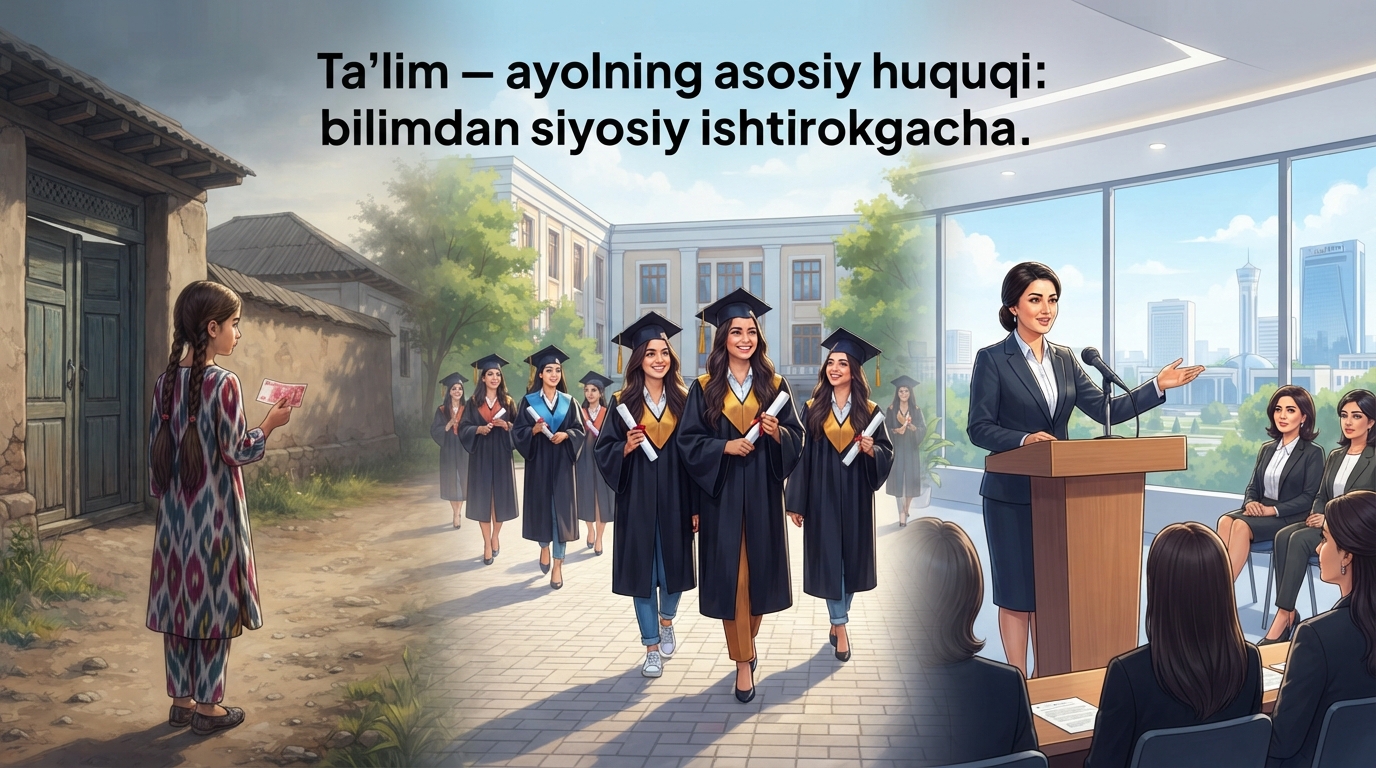
**Education is a woman's basic right: from knowledge to political participation**
**Starting point...**
With a red ten-sum note in her hand and two braids of hair longer than her shirt, a girl was hurrying along the dusty streets of the village. She secretly set out for the city of Samarkand to submit documents to the institute. But her father and brothers turned her away. At a meeting of the village council, she was discussed and humiliated as a girl who had rebelled against her father and brothers.
The reason was that at that time it was considered that a girl did not have to study. The only girl among five higher-educated sons in the family was thus deprived of the right to receive higher education.
This is my mother's story. But this was not just the fate of a woman of that time, but a small but very touching reflection of how girls were treated.
This incident became a lifelong dream for my mother. But some dreams do not break a person, on the contrary, they change the fate of future generations. Since my mother could not get a higher education, she repeatedly instilled one thing in us, three girls: “You must study.”
Thanks to my mother’s one dream, not only we girls studied, but also our daughters-in-law and grandchildren became owners of the professions they wanted.
**Education and understanding of rights**
A woman’s education will not solve all her problems at once. But education allows her to recognize her rights, think about her life, make decisions on her own behalf, and take responsibility for the consequences of her decisions. Of course, it is gratifying that the number of women who can make decisions is increasing in our country. The practical expression of this idea can also be seen in today's statistics: Of the 409.7 thousand students admitted to higher education institutions in the new academic year, 226.8 thousand, or 55.4 percent, are women. A number of privileges and opportunities have also been created for women in higher education. These include the allocation of 2 thousand state grants for women from needy families, the establishment of 500 quotas for women with five years of work experience but without higher education, and the possibility of admission on the basis of an additional state grant for winners of the "Zulfiya" award. A mechanism for the state to reimburse contract fees for women admitted to a master's degree has also been introduced.
**The right to education and independence**
A girl has gained the right to education, now how can she use her knowledge and work? This question naturally leads to the issue of women's economic independence. Because a woman's earning power also expands her opportunities to make decisions about her own life.
Therefore, new opportunities are being created in this area. Last year, 23.5 trillion soums of loans were allocated to support women's employment and entrepreneurship, thanks to which more than 425 thousand women were involved in entrepreneurship. This year, it is planned to make 1.5 million women profitable, of which 400 thousand will be involved in business. Because girls are not limited to just having a higher education, they are acquiring a profession, working, doing business, engaging in science, and finding their place in various spheres of society.
But now another question arises: does a woman's voice reach the decision-making level?
**From Education to Political Voice**
If a woman's education opens the first big door in her life, political participation is another important stage behind this door.
Because where are decisions that affect the present and future of society made, where are laws discussed? Of course, in parliament, local councils, state administration, political parties and other decision-making structures.
Therefore, it is no exaggeration to say that women's participation in these arenas is one of the important criteria that determines their place in society.
According to 2023 data, the share of women in political parties reached 47 percent, in higher education 40 percent, in business 37 percent, and in leadership positions 33 percent. Nearly 2,000 state and public organizations are headed by women. In 2021, the share of women in parliament reached almost 32 percent, and Uzbekistan rose to 37th place among 190 parliaments in the world in this indicator.
These numbers are certainly important, but the content behind the numbers is even more important.
**What does women's participation in politics change?**
Women's participation in politics is necessary, first of all, so that different life experiences and views are reflected in the decision-making process in society. A woman who knows about a problem in the field of education can talk about education policy. A woman who sees problems in the labor market can raise the issue of employment. A woman who knows firsthand about problems related to family and children can influence social policy.
There is another important point when talking about women's rights: having a right in law is not the same as having it implemented in life. The law may give a woman the right to education, but if she cannot get permission from her family to study, this right remains on paper.
The law may give a woman the right to work. But if there are obstacles to finding a job, receiving a decent salary, or advancing to a leadership position, the practical value of the right is different.
The law may give a woman the right to political participation, but if her opinion does not reach the decision-making body, representation alone is not enough.
Therefore, when talking about women's rights, the question should not be "what rights have women been given?" but "to what extent have these rights changed women's lives?"
**Women's rights and gender equality reforms**
Today, strengthening the position of women in society and state life has become one of the highest priorities of state policy in Uzbekistan. Systemic and institutional changes are being implemented in the country to ensure gender equality and increase the socio-political activity of women.
On the eve of International Women's Day, March 8, 2026, President Shavkat Mirziyoyev noted that a new system has been created to ensure the rights and interests of women: "We have created a completely new system in our country to ensure the rights and interests of women and solve their problems. Legal mechanisms have been created on gender issues when adopting all laws, decrees and decisions. Now no law will be adopted without assessing its impact on the rights and interests of women."
These words of the head of state indicate that legislative practice in the country has reached a completely new level. Now, each regulatory and legal document is subject to mandatory gender expertise, which serves to eliminate any legal gaps that contradict the interests of women or limit their opportunities in advance. This mechanism is aimed not only at providing social protection to women, but also at legally guaranteeing their participation in business, education and public administration.
These fundamental reforms being implemented and the changes in the lives of our women are also recognized by the world community.
In particular, Uzbekistan has risen 92 places in the Inter-Parliamentary Union’s “Women in Parliament” ranking, taking 36th place. This indicator indicates a sharp increase in the share of women at the decision-making level in the country. At the same time, our country has risen from 103rd to 52nd place in the “Gender Equality and Governance” index, which is the result of equal opportunities created for women in state and public administration. In addition, in the World Bank's Women, Business and the Law report, Uzbekistan improved its position by 43 places to 48th, which confirms the strengthening of women's economic freedom and rights in the field of entrepreneurship at the international level.
Such high international recognition clearly proves that gender policy in Uzbekistan is not just a declaration, but a life-giving reform that is aimed at concrete results and is being implemented steadily.
**Why should women have a place in politics?**
When answering this question, that girl comes to mind again. The girl who set off to study with ten soums in her hand. We cannot say that she had any intention of entering politics. She did not even have a political program in her hands, she just wanted to study.
But sometimes for the beginning of big changes, a person needs not a political platform, but an awareness of her rights.
An educated girl looks at her life differently, sees her opportunities, learns to express her opinion, evaluates her work. She becomes not indifferent to the problems of society. And in this process, she begins to make decisions not only about her own life, but also about the environment around her. Therefore, a woman’s participation in politics actually begins long before politics.
On June 23 of this year, the Head of the Presidential Administration, Saida Mirziyoyeva, spoke about the need to support girls’ education:
“Thousands of families who believe in their daughter’s education... Thousands of girls who choose a profession they are interested in... They are studying, searching, the self-confidence and enthusiasm of these girls are growing every day. An educated girl is able to change not only her life, but also her family, the environment around her, and the future of the entire country,” she said.
If we put this idea side by side with my mother’s life, its meaning becomes even deeper. My mother could not change her life through education, but her strong desire changed the lives of her daughters.
And through us, this influence passed on to our daughters. So, an educated girl can truly change not only herself, but also the next generation.
**The road is not over yet...**
Along with the results achieved, it is necessary to openly admit that there are issues in the field that are waiting for their solution.
Despite the expansion of women's educational opportunities, the gap between incomes in the labor market still persists. Although the participation of women in leadership and politics has increased, this is still not enough. Women's voices must be heard at every level of decision-making, only then will legal guarantees come into full force.
Therefore, today's task is not limited to "educating girls." The most important thing is to open the way for an educated girl to realize her potential, to create decent working conditions for a professional woman, to appreciate her work and support her initiatives in public life.
Because when it comes to women's rights, the main goal is not to pit a woman against someone. The goal is to ensure that she takes her rightful place in society as a person with full human rights, educated, independent-thinking and able to make independent decisions about her life.
Once upon a time, it seemed that a girl did not have to study. Today, education has become the beginning of the right to freely choose her future. The next destination of this path is manifested in a woman becoming an active citizen who makes decisions that affect not only her own life, but also the fate of the entire society.
I know very well that my mother's dreams and aspirations were limited at the time, that her path was blocked from the very beginning. But today we continue that unfinished path, and thousands of more girls are confidently walking towards this noble destination.
Barno Sultanova