

The ranking of the most dangerous countries for women has been announced. What place does Uzbekistan occupy?
The ranking of the most dangerous countries for women has been announced. What is Uzbekistan's rank?
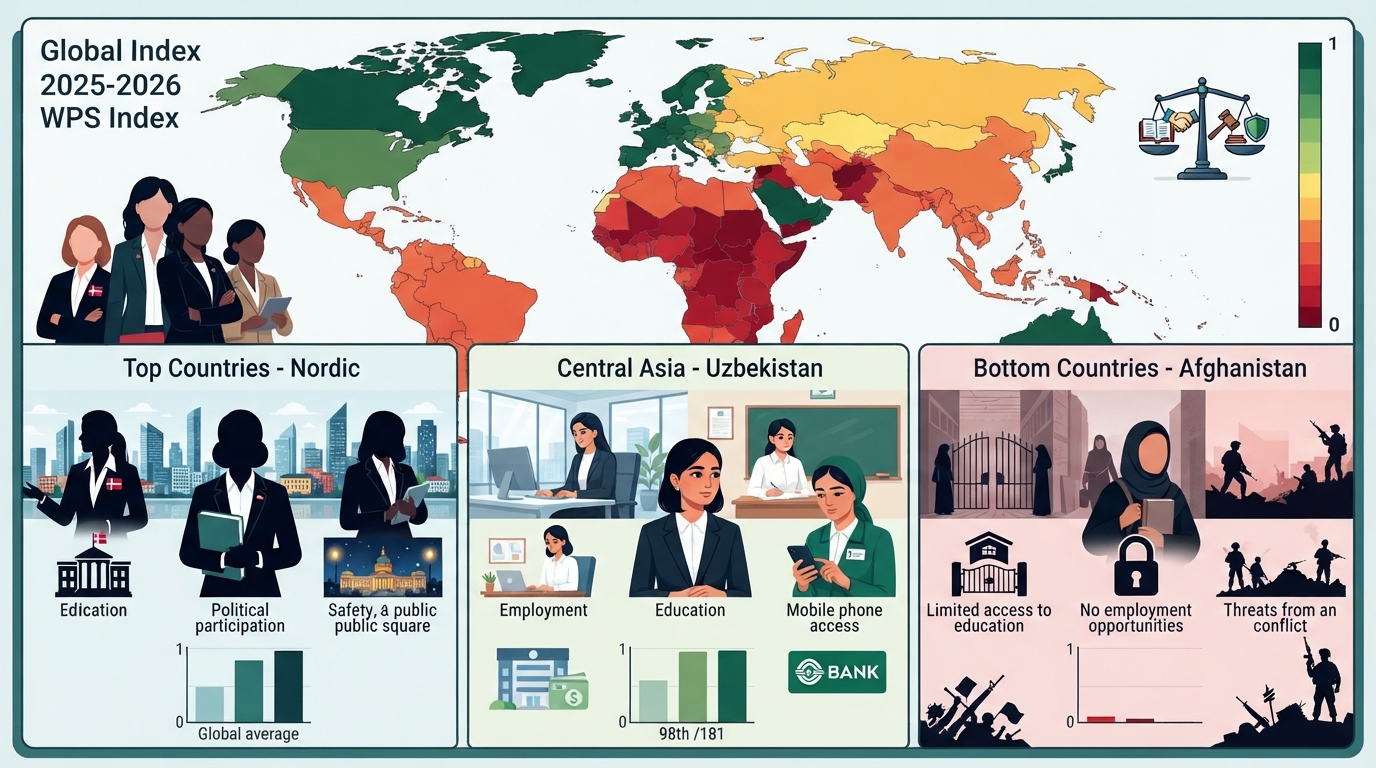
The 2025-2026 index, prepared by the Georgetown Institute for Women, Peace and Security and the Oslo Peace Research Institute, assessed 181 countries and economies in the world in terms of women's well-being. The index evaluates countries with a score from 0 to 1: the higher the score, the better the conditions for women.
The study takes into account 13 indicators. They are divided into three main areas:
* **inclusion** — women's participation in education, employment, financial services, communication and political life;
* **justice** — women's legal protection and access to the judicial system;
* **security** — domestic violence, sense of safety in the community, political violence against women and proximity to armed conflict.
**Most Friendly Countries: Northern Europe Leads**
Denmark has once again been named the most friendly country in the world for women in the 2025-2026 ranking. The country ranked first out of 181 countries with a score of 0.939. The top five are all Northern European countries:
* Denmark — 1st place, 0.939 points
* Iceland — 2nd place, 0.932 points
* Norway — 3rd place, 0.924 points
* Sweden — 3rd place, 0.924 points
* Finland — 5th place, 0.921 points
Next in line are Luxembourg, Belgium, the Netherlands, Austria and New Zealand. That is, all countries in the top ten of the ranking are in the group of developed countries.
The high ranking of these countries is influenced not only by women's safety, but also by many factors, such as educational and employment opportunities, financial independence, political representation, legal protection, and social security.
However, a high ranking does not mean that all the problems related to women in a country have been solved. For example, Finland, despite its high ranking in the WPS index, lags behind other developed countries in some safety indicators. So, the advantage of the index is that it evaluates a country not based on just one criterion, but on 13 indicators at once.
**Which countries have the worst conditions for women?**
The countries with the lowest scores on the 2025-2026 WPS Index are:
* 181st place — Afghanistan, 0.279
* 180th place — Yemen, 0.323
* 179th place — Central African Republic, 0.362
* 178th place — Syria, 0.364
* 177th place — Sudan, 0.397
* 176th place — Haiti, 0.399
* 175th place — Democratic Republic of the Congo, 0.405
* 174th place — Burundi, 0.407
* 173rd place — South Sudan, 0.411
* 172nd place — Myanmar, 0.442.
Afghanistan has consistently recorded one of the lowest scores in this ranking. In the 2025/26 index, the country's score was only 0.279. For comparison, Denmark, which ranks first, has a score of 0.939. That is, the difference between Denmark and Afghanistan is very large. The authors of the report note that Denmark's score is more than three times higher than Afghanistan's.
The situation in the countries in the bottom ten of the index is greatly influenced by factors such as armed conflict, political instability, limited opportunities for women in education and the labor market, weak legal protection, and the risk of violence.
**What is the situation in Central Asia?**
The countries of Central Asia are located in the middle of the ranking. Of the five countries, Kazakhstan has the highest score, and Uzbekistan has the lowest score.
* 72nd place: Kazakhstan 0.722
* 74th place: Turkmenistan 0.720
* 84th place: Kyrgyzstan 0.697
* 89th place: Tajikistan 0.685
* 98th place: Uzbekistan 0.674
**Uzbekistan — 98th place....**
Uzbekistan is ranked 98th out of 181 countries with a score of 0.674. The average education level for women over 25 in the country is 11.8 years, and the employment rate for women aged 25–64 is 44.7 percent.
Women’s access to financial services is 38.8 percent, and mobile phone use is 77 percent. The share of women in parliament is 34 percent.
In the legal indicators, Uzbekistan's score for legislation protecting women from discrimination was 82.5. Access to the justice system and legal protection was rated at 1.8.
In the safety index, Uzbekistan's rate of intimate partner violence was 11.2 percent, and women's perception of being safe walking alone at night in their neighborhood was 81 percent.
**Another interesting result in the ranking: UAE in 20th place**
One of the notable results in the index is the United Arab Emirates' 20th place. The UAE ranks above countries such as the United Kingdom, France, Spain and the United States with a score of 0.872.
The United States is in 31st place with a score of 0.840. Japan ranked 22nd, France and the UK ranked 23rd, Germany ranked 21st, and South Korea ranked 37th.
These results show that the ranking is not based on a simple formula: “rich country = best country for women.” In addition to economic opportunities, the study also takes into account factors such as law, justice, security, violence, political participation, and proximity to conflict.
**Is the situation improving worldwide?**
One of the most worrying conclusions of the study is that global progress in improving the status of women has slowed down and almost stopped.
The index has been compiled regularly since 2017. In the 2025-2026 report, the authors note that global progress in the status of women has largely stagnated. At the same time, the increase in armed conflicts in the world is seriously affecting women’s safety.
According to the report, in 2024, an estimated 676 million women were affected by armed conflict. This is a 74 percent increase compared to 2010 and the highest number in history.
Therefore, the concept of “the most comfortable country for women” cannot be measured solely by crime rates or street safety. A woman’s safety is closely linked to her ability to get an education, work, have an income and a bank account, participate in political decision-making, enjoy equality before the law, be protected from violence, and live in an environment free from war.