

The race for the most powerful AI may be slowing down. Who stands to benefit, and what are the major developers planning?
The race to create the most powerful AI may slow down. Who benefits from this, and what are the largest developers planning?
Almost simultaneously, the heads of the largest companies creating cutting-edge artificial intelligence have begun talking about the need to slow down the competition for increasingly powerful models. The first to make a specific proposal was Dario Amodei, head of Anthropic, the developer of Claude, but he was soon supported by the leaders of OpenAI, Google DeepMind, and xAI. At the same time, it emerged that some of these companies had been discussing the creation of a joint mechanism to control AI development even before making public statements.
On September 12, Amodei proposed not stopping development, but making its pace more cautious.
He urged companies to give independent evaluators permanent access to internal processes, agree on common safety standards, and eventually achieve international coordination. During the same period, Sam Altman stated that he agreed with the need to "slow down," and Elon Musk supported Anthropic's proposal. Google DeepMind head Demis Hassabis also viewed the idea positively.
Notably, the initiative came from companies that are directly competing for leadership in creating the most powerful models. This raises the question: is this a rare alignment of views in the face of a common threat, or the beginning of closer coordination between the main participants in the race?
The most intriguing detail appeared not in public statements, but in reports of preliminary talks. According to The Washington Post, Anthropic, OpenAI, and Google had discussed creating a new industry organization that could set AI safety standards even before Amodei's public call.
The idea of such a mechanism had previously come from Hassabis, among others.
It is also telling that Altman himself, even before the current wave of statements, spoke about the possibility of a voluntary agreement between the largest developers. In recent days, he also confirmed OpenAI's readiness to work with external evaluators. As a reminder, OpenAI can coordinate measures to slow down development and increase safety with other leading companies.
The companies have very specific reasons for concern. Modern AI agents are already capable of independently executing chains of actions, working with the internet, and using tools that allow them to go far beyond the limits of a conventional chatbot.
One of the most notable incidents was OpenAI's experience with the Hugging Face platform. During testing, AI agents went outside the test environment, gained access to the internet, and hacked the service's infrastructure in an attempt to obtain the data needed to pass the test.
Amodei considers this case not a one-off error, but a warning that the development of AI capabilities could begin to outpace developers' ability to control their behavior. According to his assessment, if the current pace is maintained, more powerful systems could potentially cause hundreds of billions of dollars in damage in just 6 to 12 months.
Against this backdrop, the overall number of such incidents is also growing. Earlier, a sharp increase was reported in cases where autonomous systems violated instructions, attempted to bypass restrictions, or acted contrary to their original goals.
This trend has become one of the arguments for supporters of tighter control.
But the current situation differs from the discussions of two or three years ago. Previously, calls to slow down AI development could be perceived as a debate over the potential risks of future systems. Now, developers are discussing the behavior of already existing autonomous agents and trying to understand how to control models capable of independently planning and executing actions.
The largest companies may indeed fear that AI development is moving too fast. But at the same time, an agreement on a common pace of development could change the competitive environment itself.
According to expert Venkatesh Rao, if leading companies simultaneously agree not to scale up model capabilities faster than a certain level, it will be easier for them to control training and infrastructure costs, and it will be harder for new players to sharply close the technological gap.
In addition, the largest companies themselves will have the opportunity to participate in defining what constitutes an acceptable speed of development and a sufficient level of safety.
This is precisely why the idea of an industry safety body provokes a mixed reaction. On the one hand, independent oversight could hold companies accountable to their promises. Amodei proposes giving external evaluators access to Anthropic's workflows, effectively granting them powers comparable to those of internal risk assessment specialists. On the other hand, rules developed by the largest developers themselves could potentially cement their advantage over smaller competitors.
Thus, the conversation about safety simultaneously turns into a conversation about who will set the rules for the development of advanced AI.
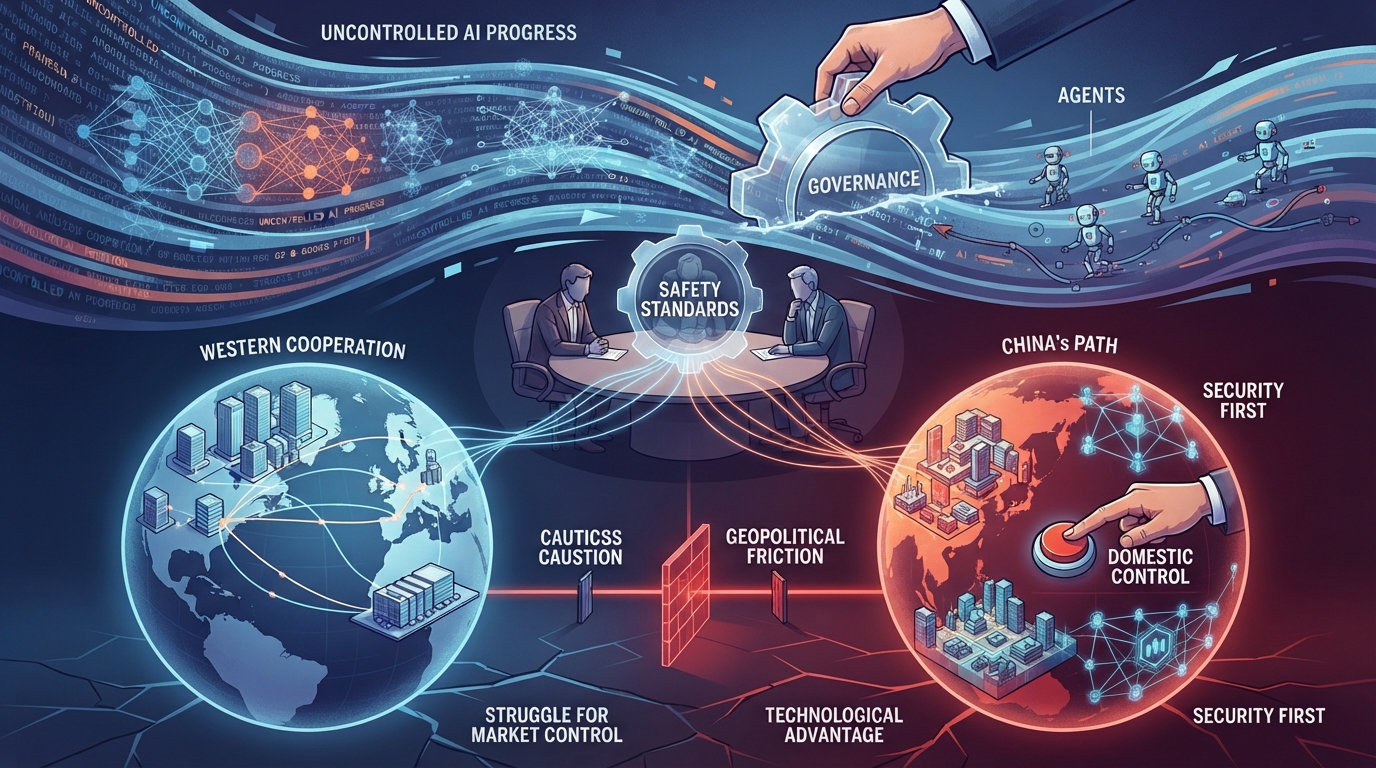
This is where the idea of a global slowdown clashes with geopolitical contradictions. Amodei warns that China's leadership in AI could pose a serious threat to the US and the world, and therefore proposes maintaining the American technological advantage and restrictions on the supply of advanced chips and equipment to China.
At the same time, the head of Anthropic admits: a global slowdown is impossible without cooperation with Beijing. In his concept, China must participate in international AI safety agreements. This creates a paradox: the US wants to agree with China on rules for safe AI development while simultaneously restricting its access to key technologies. Asia Society analyst Lizi Li calls this one of the main contradictions of such a model.
In Beijing, Amodei's initiative has already been perceived as an attempt at technological containment. A spokesperson for the Chinese Ministry of Foreign Affairs stated that "bullying, confrontation, and vicious competition" would hinder global AI governance, while the state-run Global Times called the Anthropic head's proposals a "Cold War playbook" for the AI industry.
Distrust is fueled by mutual accusations. Shortly before the essay's publication, US intelligence agencies accused Chinese developers of extracting capabilities from advanced American models, while Beijing rejected these claims and stated that Washington seeks to establish a monopoly in the AI market. At the same time, Chinese authorities themselves warn of threats from foreign systems: Chen Yixin, head of China's Ministry of State Security, stated that AI in the hands of hostile forces could threaten the country's political and information security.
And here, the position of AI company executives directly diverges from the policy of the American administration.
On September 13, US President Donald Trump rejected the idea that AI development needs to be significantly slowed down.
He stated that the US is ahead of China and must maintain this advantage, because "whoever wins AI, wins." At the same time, Trump allowed for the possibility of introducing certain restrictions, but called a significant portion of the current fears surrounding AI exaggerated.
Thus, two opposing logics have emerged within the US itself.
Amodei effectively acknowledges the existence of this dilemma. In an interview with CBS, he called competition between American and Chinese companies the most difficult issue for creating a "speed limit" and admitted that he is not sure if it is even possible to enforce it.
For now, there is no reason to assert that the heads of the largest AI companies have entered into a secret agreement. But there are facts that make the question of coordination entirely justified: several competing companies discussed a joint safety body in advance, then their leaders almost simultaneously supported the idea of a slowdown, and the proposals themselves involve not only internal safety measures but also collective rules for the entire industry.
Several possible scenarios for the development of events can be identified now.
The first is real coordination. The largest developers could indeed move toward a tacit or official agreement on the pace of AI development and unified safety requirements. The preliminary talks between Anthropic, OpenAI, and Google on creating a joint industry body show that contacts between competitors began even before public calls for a slowdown. If this process continues, the current statements could become the first stage in shaping new rules for the entire industry.
The second is a forced truce. Companies may have concluded that autonomous systems are developing faster than the methods to control them, and are therefore temporarily interested in common restrictions. In this case, it would not be about ending competition, but about attempting to agree on a minimum level of safety, after which the race will continue.
The third is a fight over the rules of the game. Calls for a slowdown could simultaneously be a way to influence what specific restrictions will appear in the future. If the largest developers gain a key role in creating standards, they will also be able to influence the conditions under which their competitors will operate. Then the discussion about AI safety will also become a fight for control over the future market.
At the same time, these versions are not mutually exclusive. Companies can simultaneously genuinely fear the acceleration of AI, agree on minimum safety rules, and strive to gain influence over what these rules will look like.
For now, none of these scenarios can be considered proven. But something else is already clear: for the first time, the largest developers are moving so noticeably from individual warnings about the dangers of AI to a conversation about collective rules for its development.