

The procedure for vehicle impoundment and the operation of impound lots will be changed in Tashkent
In Tashkent, the procedure for towing vehicles will be changed. If the driver appears before the loading begins and rectifies the violation, the car will not be taken away. Storage will be paid for in full days, and the countdown will start from the moment of loading onto the tow truck. Owners will be given the opportunity to monitor their vehicle in real time.
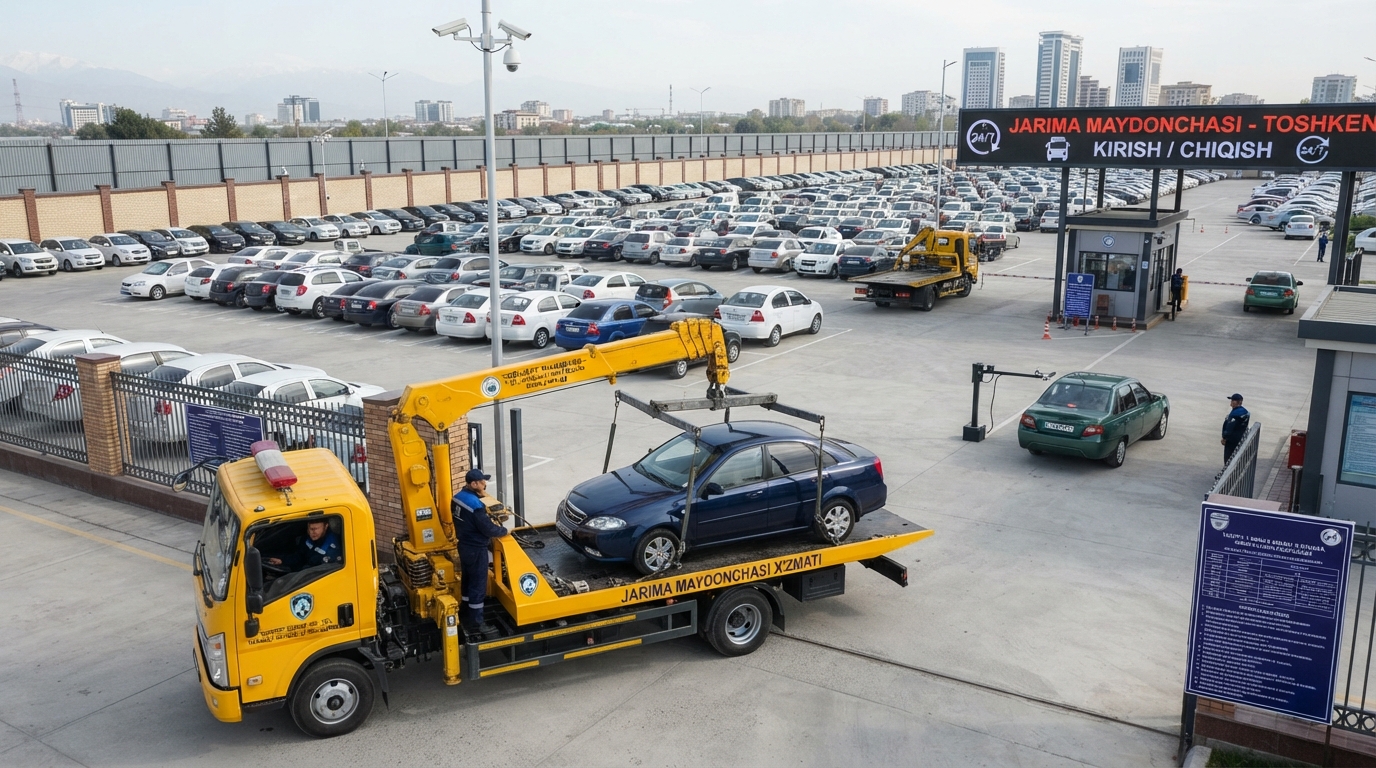
Tashkent to Change Vehicle Impoundment and Impound Lot Operations Procedures
A new procedure for the impoundment, placement, and storage of vehicles detained for violations of the law is being introduced in the capital.
According to the document, the experiment in Tashkent is scheduled for the period from October 1, 2026, to December 31, 2034. The Ministry of Internal Affairs already operates the "Jarima maydonchasi" module of the Unified Automated Information System of the Road Safety Service, through which the entire process of handling detained vehicles will be organized.
The system will maintain a unified electronic record of vehicles that have been detained, placed in an impound lot, or authorized for release. Through it, users will be able to pay fines for offenses, storage costs, and other mandatory payments. An electronic release permit with a QR code will also be generated through the Unified Portal of Interactive State Services.
The information systems of legal entities operating the impound lots must be integrated with "Jarima maydonchasi." Information on the turnover of these companies will be automatically transmitted to the tax authorities. Vehicles remaining in impound lots for more than six months will be included in a separate registry of unclaimed vehicles.
Following a decision by an authorized state body to place a vehicle in an impound lot, a notification will be sent via the electronic system to the relevant state bodies and to the towing and storage service provider closest to the detention site. The company must immediately dispatch a tow truck or a crane-manipulator to the vehicle.
Companies will have the right to tow detained vehicles based on the decision of a state body without the driver's presence.
Upon transfer of the vehicle, a transfer act will be drawn up, the integrity of seals and vehicle elements (doors, trunk, hood, fuel tank cap, and other parts) through which access to the interior is possible will be checked, and a visual inspection will be conducted. Until the transfer act is signed, the authorized state body is responsible for the safety of the vehicle; after placement in the lot, the operating company is responsible.
A separate rule is provided for vehicles detained for violating traffic regulations. If the driver appears before the loading of the vehicle onto the tow truck begins and rectifies the violation, the vehicle will not be towed. However, if by the time the driver appears, the vehicle is already partially or fully loaded onto the tow truck, its delivery to the impound lot will proceed.
Currently, there is no separate rule in the active regulations regarding the termination of towing before loading. Today, in certain cases, a vehicle of a person disqualified from driving can be driven to the lot by an authorized state employee, but this clause is absent from the new regulations.
The acceptance of vehicles at impound lots, as well as their subsequent release, must be carried out around the clock — regardless of weekends and holidays. After the vehicle is delivered, the owner or their representative will be able to retrieve any belongings remaining in the cabin in accordance with the established procedure.
In addition, the owner or a person with a power of attorney must be provided with the opportunity to track the vehicle located in the lot in real-time via "Jarima maydonchasi." The entry, storage, and exit of vehicles will be recorded by cameras integrated with the system.
After the cause of the detention is resolved, the release permit will be issued by an official of the body reviewing the administrative case. The document will be verified by a QR code and sent electronically to the driver and the impound lot operator through the system. An SMS will also be sent to the owner. One working day is allocated for issuing the permit.
Releasing a vehicle using a permit that has not been processed through "Jarima maydonchasi" is prohibited.
Before release, the owner must pay the cost of towing and storage. The module itself provides the option to electronically settle other payments, including the fine for the offense.
At the same time, the storage period for calculations will be counted from the moment the vehicle is placed on special equipment — a tow truck (currently, from the moment the vehicle is placed in the lot) — based on the time specified in the administrative offense protocol or the detention decision. The service provision regulations also state that the storage fee is calculated for each full day of actual storage (currently, the period is calculated in hours).
Tariffs for storage and towing, as well as the costs of dispatching a tow truck or manipulator to the call site without loading the vehicle, will be approved by the Tashkent Khokimiyat in agreement with the city's Main Department of Economy and Finance. Services can be paid for in cash, by bank card, and through other payment methods.
If the decision to detain the vehicle is subsequently overturned, the vehicle must be released based on the cancellation document. In such cases, the expenses incurred by the driver are reimbursed from the funds of the relevant authorized state body in accordance with the procedure established by law. The document also allows for the recovery of these expenses through recourse from the employee who unlawfully issued the decision or protocol.
If the vehicle is damaged during towing due to the fault of the operating company, the damage will be compensated at its expense.
Legal entities authorized to tow and store detained vehicles in Tashkent are expected to be selected through open tenders via the "Jarima maydonchasi" module. These will be conducted by an interdepartmental commission. The experimental tender system is also scheduled to run until the end of 2034.
Any legal entity registered in Uzbekistan that meets the established requirements can participate. The conditions include having an owned or leased property base, a sufficient number of spaces for vehicles, and tow trucks. For leased complexes, the lease term must be at least 10 years. Companies in insolvency or liquidation proceedings, those with seized property, and applicants who have submitted false information will not be admitted to the tender.
The tender announcement must be published at least 30 days in advance. Applications will be accepted through the electronic system within 15 working days. If only one participant applies and their proposal meets the requirements, they may be declared the winner.
When evaluating proposals, the area and capacity of the lot, fire safety, the number of tow trucks, the capability to store oversized vehicles, and the location of the site will be taken into account. In particular, the availability of crane-manipulators can bring a participant up to 30 points, with another 30 points provided for locating the site on the outskirts of the city.
A 10-year contract will be concluded with the winner of the tender. At the same time, they must provide services at the tariff declared in the tender proposal for at least the first two years.
If there is no active operator in a specific territory, detained vehicles are allowed to be temporarily stored at the relevant sites of the Road Safety Service units until the winner of the next tender is determined.
The document establishes detailed requirements for the sites themselves. They must have a hard surface, lighting, storm drainage, fire-fighting equipment, and video surveillance allowing for round-the-clock monitoring of the entire territory. Cameras at the entrance and exit must be integrated with "Jarima maydonchasi," including for license plate recognition.
The territory must be enclosed by a reinforced concrete, metal, or brick wall at least 2 meters high. For a parking lot with more than 50 vehicles, at least two entrances/exits are required, with a gate width of at least 4.5 meters. An area of 25 square meters is allocated for one parking space. At least two spaces must also be provided for specially equipped vehicles of people with disabilities.
Each site must have premises for staff and security, areas for the safe movement of tow trucks, fire lanes, and equipment. Tariffs and storage conditions must be posted in a prominent place near the cashier-controller's office.
Vehicles remaining in the impound lot for more than six months will be included in the registry of unclaimed vehicles.
The operator, together with the Road Safety Service, must notify the owner of the need to retrieve the vehicle and settle the debt. If a debt exists, measures for its collection are provided, including forwarding materials to the Bureau of Compulsory Enforcement.
If a vehicle is stored for more than 12 months and the owner does not claim it, the impound lot operator, together with the road safety authorities, will be able to apply to the court to have the vehicle declared ownerless. The foreclosure and subsequent sale of the vehicle will be carried out within the framework of enforcement proceedings.
Separately, the Ministry of Internal Affairs has been instructed to conduct an inventory of vehicles that have been in impound lots for more than five years and have not been claimed by their owners or representatives, and based on the results, to apply to the court to declare such vehicles ownerless in accordance with the established procedure.
The new procedure will apply specifically in Tashkent. An exception has been made to the 2011 government resolution regulating the towing and storage of detained vehicles in the republic: its relevant norms will no longer apply to the capital.
At the same time, there is a peculiarity with the dates in the document. In the main provisions, the start of the experiment is indicated as October 1, 2026, but the final clause of the resolution establishes that it comes into force three months after its official publication, which is December 24, 2026.
Currently, towing services are provided by various private companies. Tariffs have not previously been regulated at the city level. In early June, the Khokim of the capital, Shavkat Umurzakov, told journalists, including a representative of "Gazeta," about plans to purchase 120 tow trucks for the capital and introduce a new comprehensive system for towing and storing vehicles whose drivers violate traffic rules.
In August, by decision of the Khokim, maximum rates for vehicle towing and storage in impound lots were established in Tashkent. According to the document, the fee for towing and transporting a vehicle by a specialized vehicle will be 20% of the base calculating value per kilometer (88,000 soums), and for storing the vehicle — 20% of the BCV per day (88,000 soums).
At the same time, the total cost of towing a vehicle to an impound lot must not exceed an amount equal to 4 BCV (1.76 million soums).