

The paper industry of Uzbekistan in 2017–2025
CERR has prepared an infographic dedicated to the development dynamics of Uzbekistan's paper industry in 2017-2025.
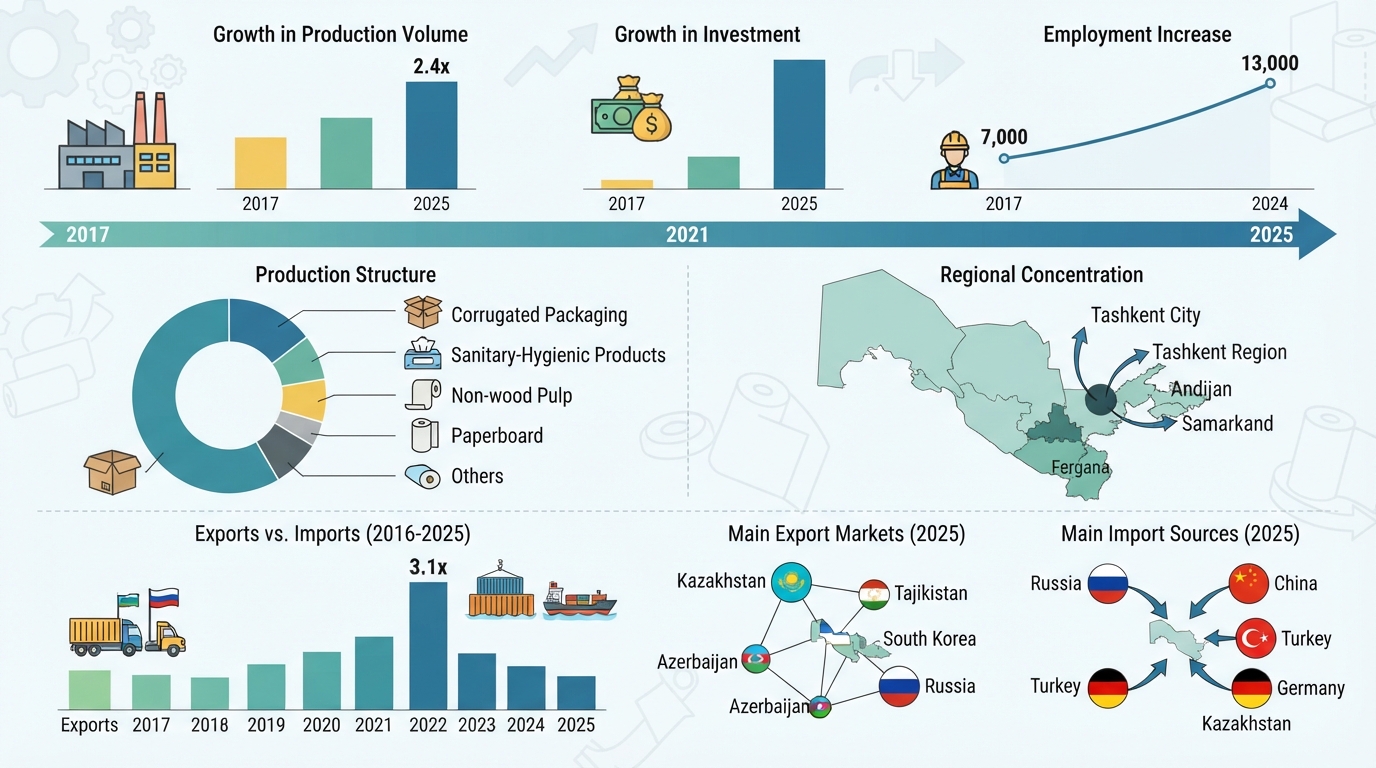
The Paper Industry of Uzbekistan in 2017–2025
The paper industry is one of the key segments of the manufacturing sector and supplies practically all branches of the economy with packaging, sanitary-hygienic, printing, and technical materials.
Steady demand for paper, cardboard, and products made from them is supported by the growth of e-commerce, the food and pharmaceutical industries, the expansion of consumer goods production, and the gradual replacement of some plastic packaging.
Against this background, the development of the paper industry is of particular significance for Uzbekistan. In 2017–2025, it went through a stage of rapid quantitative growth, but at the same time faced a number of challenges.
Main Trends in the Development of the Industry in 2017-2025
In 2017–2025, the production volume of Uzbekistan's paper industry grew 2.4 times and reached 10.2 trillion soums. The average annual growth rate was about 10.9%, which was higher than the average growth rate of the manufacturing industry — 6.9%. During this period, the industry's share in GDP increased from 0.12% to 0.17%.
In the structure of the industry's production, the main role is played by containers made of corrugated paper and cardboard, sanitary-hygienic products, pulp from non-wood fibrous materials, napkins and towels, sanitary and household paper, cellulose wadding, and webs of cellulose fibers.
The production of paper and paper products is characterized by high geographical concentration. In 2025, the city of Tashkent accounted for 44.7% of output, and the Tashkent region for 26%. Thus, the metropolitan agglomeration provided 70.7% of all industry products. This was followed in importance by the Andijan region with a share of 7.2%, Samarkand — 6.3%, and Fergana — 6.1%.
Investment activity in the industry has intensified noticeably. Capital investments increased from 134 billion soums in 2017 to 1.6 trillion soums in 2025. In 2025 alone, investments grew by 35%. The volume of foreign investment reached 89 million USD, including 61 million USD in foreign direct investment.
The number of operating enterprises grew from 1 thousand in 2016 to 1.4 thousand in 2025. Payroll employment increased from 7 thousand people in 2017 to 13 thousand in 2024, or by 84%. The average number of employees per enterprise rose from 6.1 to 9.7 people. This indicates a gradual consolidation of production, although the industry is still mainly represented by small enterprises.
Exports of paper industry products increased from 20 million USD in 2016 to a record 130 million USD in 2022. Subsequently, export deliveries declined for three consecutive years and in 2025 amounted to 83 million USD. This is 4 times higher than the level of 2016, but 36% lower than the peak of 2022. The decline is primarily associated with a decrease in exports of cotton pulp by 18% compared to 2022, women's sanitary-hygienic products — by 85%, and wallpaper — by 60%.
The largest sales markets in 2025 were Kazakhstan, Tajikistan, South Korea, Azerbaijan, and Russia. The five leading destinations accounted for 52% of deliveries, while Central Asian countries from the top ten accounted for 40%. Consequently, this region remains the natural core of paper product exports, while the geography of deliveries maintains a relatively diversified character.
Imports for 2016–2025 grew 3.1 times — from 179 million USD to 552 million USD. The largest items were sanitary-hygienic products, wallpaper, multi-ply kraft paper and cardboard, paper and cardboard in rolls, etc. The main suppliers are Russia, China, Turkey, Germany, and Kazakhstan, which account for 86% of imports.
Thus, Uzbekistan remains a net importer of paper products — in 2025, imports exceeded exports by 6.7 times, and the negative balance was 469 million USD. The most noticeable deficit was observed in sanitary-hygienic products, wallpaper, and multi-ply kraft paper and cardboard.
Priorities for Further Development
In terms of output volume, the paper industry already outperforms several individual segments of Uzbekistan's industry, in particular tobacco, leather and footwear, pharmaceuticals, and furniture. In addition, the industry holds leading positions on a regional scale. The volume of output in 2025 in dollar terms was estimated at 809 million USD, compared to 327 million USD in Kazakhstan, 26 million USD in Tajikistan, and 18 million USD in Kyrgyzstan. Consequently, the industry has already reached a scale that requires an independent long-term state policy and systemic coordination.
Despite fairly rapid growth over the last decade, the industry faces a number of constraints and challenges. The main and fundamental one is the lack of a large forest resource base. Uzbekistan cannot mechanically replicate the model of countries with developed wood pulp production. In this context, the competitive model must rely on the recycling of waste paper, the use of cotton linters, and economically viable agro-fibers. Also, in this direction, it is advisable to take further measures to streamline the activities of collection, sorting, and pressing points for waste paper, as well as the collection and processing of raw materials for the industry.
In-demand areas for expanding production and the product range of the industry are containerboard and testliner made from waste paper, fluting paper, corrugated packaging, sanitary-hygienic paper, paper bags, labels, and food and pharmaceutical packaging. Significant imports of these products indicate the presence of a market.
At the same time, it is desirable to restore export dynamics, primarily through finished products. The countries of Central Asia, the Caucasus, and Afghanistan, where demand for paper products is growing, remain promising markets.
Conclusion
To sum up, in 2017–2025, the paper industry of Uzbekistan reached a higher scale of production. Employment, the number of enterprises, and the role of the industry in manufacturing increased, and new production facilities emerged.
At the same time, the qualitative transformation is not yet complete. Further development of the industry should be aimed at forming a competitive complex for processing secondary and local fibrous raw materials, producing cardboard, modern packaging, and finished paper products, as well as increasing local added value with a focus on domestic and foreign markets.