

Industrial production in Uzbekistan grew by 7.9% in seven months
Uzstat reported that industrial production in Uzbekistan for January-July 2026 amounted to 795.4 trillion soums, with an increase of 7.9% year-on-year.
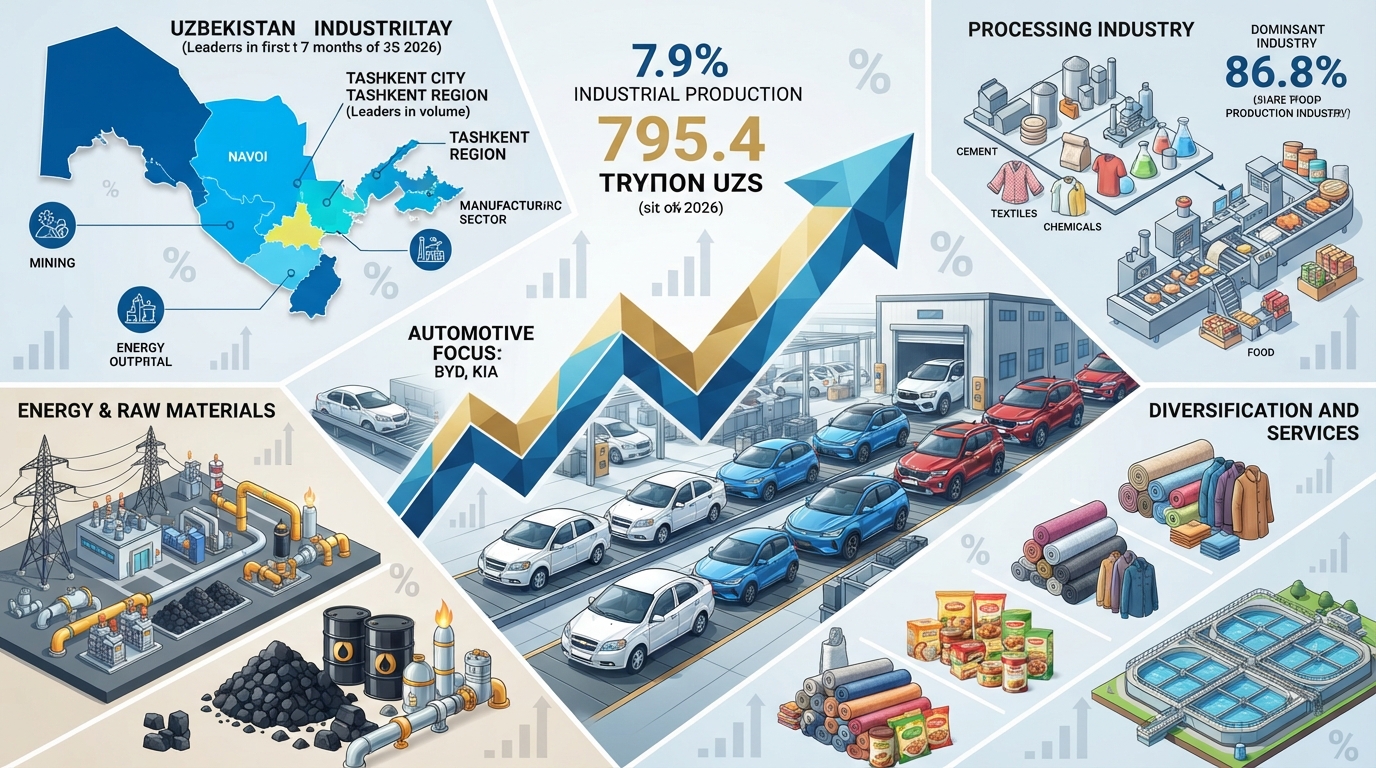
Industrial production in Uzbekistan grew by 7.9% in the first seven months of 2026. Total output by industrial enterprises in the country from January to July reached 795.4 trillion soums, exceeding the same period last year. These data were presented by the National Statistics Committee of the Republic of Uzbekistan.
As of August 1, 2026, 63,900 industrial enterprises were operating in Uzbekistan. Food production enterprises accounted for the largest share of these enterprises—12,800 (20.1%). Next in line are producers of other non-metallic mineral products (9,000, or 14.0%), clothing (6,500, or 10.2%), finished metal products (5,200, or 8.2%), furniture (4,400, or 6.8%), textiles (3,900, or 6.1%), and rubber and plastic products (3,000, or 4.6%).
Manufacturing dominates the industrial production structure, accounting for 690.7 trillion soums (86.8% of the total) with a physical volume index of 109.0%. Mining and quarrying accounted for 50.2 trillion soums (6.3%). The electricity, gas, steam, and air conditioning sector reached 50.4 trillion soums (6.4%, with an index of 108.1%). Water supply, sewerage, and waste collection and disposal generated 4.1 trillion soums (0.5%, index 108.4%).
The leading regions in terms of industrial production volume were Navoi Region (182.7 trillion soums), Tashkent City (135.4 trillion soums), and Tashkent Region (124.8 trillion soums). The highest index of physical volume was recorded in Jizzakh Region (112.7%), followed by Samarkand (109.7%) and Andijan Regions (109.0%). The index of physical volume of industrial production for the country as a whole was 107.9%.
Per capita industrial production in the country reached 20.7 million soums, demonstrating steady growth compared to 15.3 million soums in 2025, 11.8 million soums in 2024, 9.5 million soums in 2023, and 8.3 million soums in 2022. This indicator was higher than the national average in Navoi Region (163.8 million soums per capita), Tashkent City (42.4 million soums), and Tashkent Region (39.3 million soums). The fastest growth rates for this indicator were in Jizzakh Region (110.6%), Samarkand Region (107.7%), and Andijan Region (107.2%), compared to the national average of 106.0%.
Large industrial enterprises produced 21.6 billion cubic meters of gas in January-July 2026. Natural gas production increased to 368.7 thousand tons, oil production increased to 3.5 million tons, coal production increased to 731.9 thousand tons, motor gasoline production increased to 683.4 thousand tons, diesel fuel production increased to 12.1 million tons, yarn production increased to 478.2 thousand tons, and soft wheat and spelt flour production increased to 841.1 thousand tons. Gasoline production increased from 672.1 thousand tons a year earlier, diesel fuel production increased from 673.7 thousand tons, and Portland cement production increased from 12.0 million tons. However, natural gas production decreased from 25.4 billion cubic meters, oil production decreased from 378.8 thousand tons, and gas condensate production decreased from 667.9 to 567.5 thousand tons. Automobile engine production totaled 137.6 thousand units, compared to 131.8 thousand a year earlier.
In the manufacturing industry, the largest share (19.1%) is held by the production of food products, beverages, and tobacco products. This is followed by the production of textiles, clothing, leather, and leather products (12.4%), finished metal products, electrical equipment, machinery, motor vehicles, and other equipment (15.1%), and chemical products, rubber, and plastic products (6.4%).
In the automotive industry, 263,700 passenger cars were produced from January to July 2026 (versus 241,100 the previous year) and 3,200 trucks (versus 2,600). Among passenger car models, the Cobalt leads the way (91,100 units), followed by Damas (47,500), Tracker (25,800), and Onix (20,400). Significant growth was seen for BYD models (from 8,600 to 17,800 vehicles) and KIA models (from 14,400 to 17,100). Production of the Chevrolet Damas Move, launched in April 2026, reached 932 units.
The electric power industry generated 52.5 billion kWh of electricity in the first seven months of 2026, a 6.4% increase compared to the same period last year. However, generation by large enterprises decreased to 35.3 billion kWh, while small businesses increased their output to 17.3 billion kWh, compared to 12.8 billion kWh a year earlier. Thermal energy production by large enterprises decreased by 18.3% to 10,100 Gcal. Gas obtained from underground coal gasification was not produced during the reporting period.
In the water supply, sewerage, and waste management sectors, wastewater removal and treatment services totaled 444.6 billion soums, compared to 392.5 billion soums the year before. Cesspool and septic tank emptying and cleaning services totaled 241.9 million soums. Textile waste volume increased to 15,600 tons, compared to 14,500 tons the year before.