

The Pact of Mecca: Main Motives
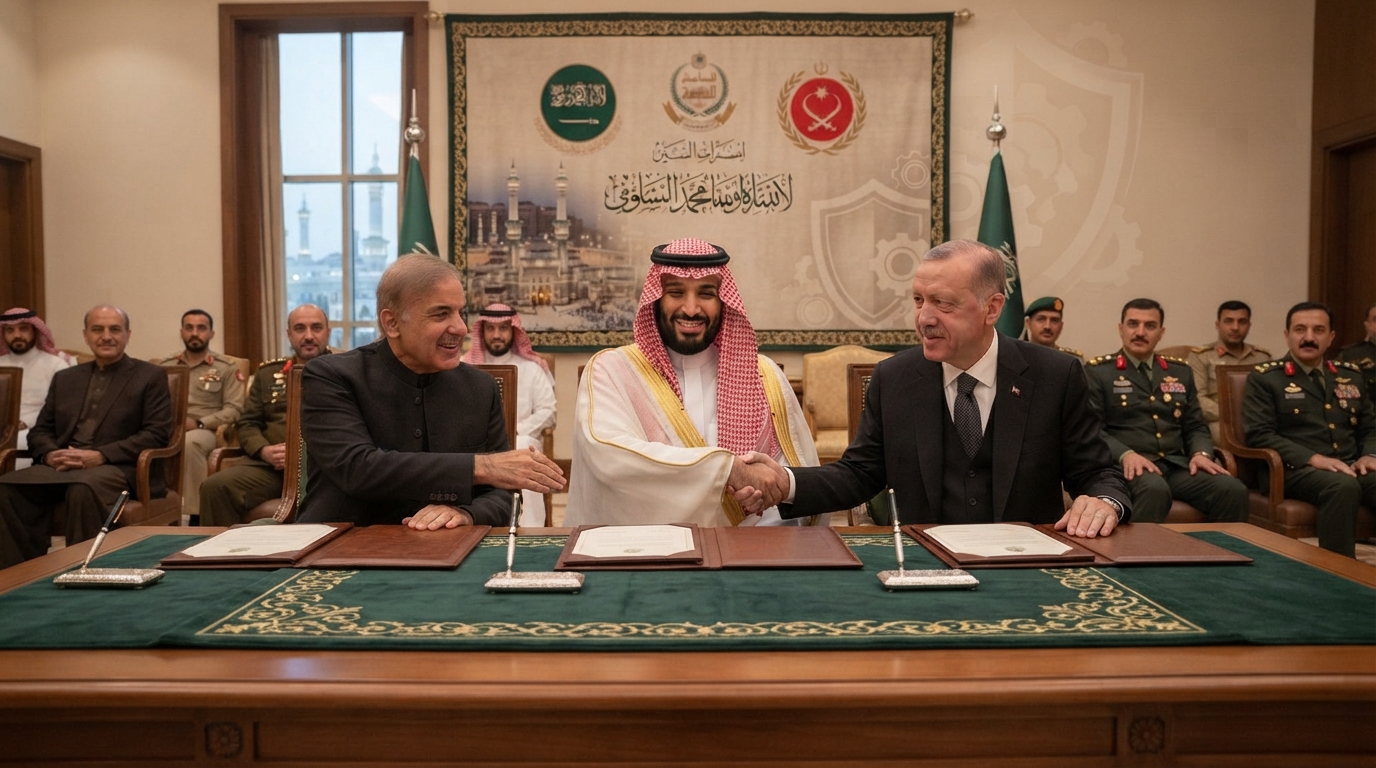
On August 7, a security and defense pact was signed by three major Muslim countries in the holy city of Mecca, near the Kaaba. In his column on Kun.uz, political scientist Kamoliddin Rabbimov spoke about the factors that prompted the Kingdom of Saudi Arabia, the Islamic Republic of Pakistan, and the Republic of Turkey to sign this agreement, and the significance of the agreement for Uzbek society.
Mecca Pact: Main Reasons
On August 7, a security and defense pact was signed by three major Muslim countries - Saudi Arabia, Pakistan and Turkey - in the holy city of Mecca, near the Kaaba. Political scientist Kamoliddin Rabbimov reflected on the factors that motivated this agreement and its significance for Uzbek society in his article for Kun.uz.
**Significance for Uzbekistan**
Uzbekistan is located in the center of the Central Asian region, bordering Kazakhstan, Kyrgyzstan, Tajikistan and Turkmenistan. Outside the region, there are four other important countries with which the people of Uzbekistan have strong historical and cultural ties: Turkey, Iran, Afghanistan and Pakistan. The Mecca Pact includes two of these "southern four" - Turkey, the largest Turkic country in terms of population, economic and military potential, and Pakistan, the only Muslim state with nuclear weapons.
Saudi Arabia, with its cities of Mecca and Medina, is the geographical center of Islamic civilization. Considering that more than 90 percent of Uzbekistan's population is Muslim, the security of these holy sites is of paramount importance. Therefore, it is natural that Saudi Arabia is perceived as a symbolic state for the entire Muslim world.
**Main goals and motives of the pact**
The main goals pursued by the three countries in signing the Mecca pact can be several:
**1. Individual motives:**
* **For Pakistan:** To expand the "Muslim community" in strategic competition with India and to send a signal to Delhi that "I have strong allies."
* **For Turkey:** Despite being a NATO member, not to tie its security solely to NATO, to diversify geostrategy and security. This pact gives Ankara additional weight in relations with NATO, and also plays a symbolic role in relations with Greece, Cyprus and some countries in the European Union.
* **For Saudi Arabia:** To send a regional signal against the Houthis in Yemen, the Shiites in Iraq and other "disturbing factors".
The three countries have complementary characteristics: Turkey has an advanced defense industry and NATO experience; Saudi Arabia is ready to be a source of investment to finance joint projects; and Pakistan has a highly prepared armed forces and nuclear capabilities.
**2. Signal to the US:**
While all three countries have strong ties with the US, the US and Israeli attacks on Iran have created a need for a new geopolitical and security architecture in the region. It has become clear that the US has failed to translate its military power into the political results it wants and has only supported Israel in the conflicts in the region, which has led to the strengthening of Iran. Therefore, by concluding this three-way defense pact, it is sending a signal to the US that "from now on, we will protect our own security without you."
**3. Being prepared for Israeli expansionism (main motive):**
Since October 2023, Israel has carried out unprecedented genocide and ethnic cleansing in Gaza, and has intensified its policy of occupying Syrian and Lebanese territories. Israeli officials have made no secret of their implementation of the "Greater Israel Project" and their ambitions to become the sole hegemon of the region with the help of the US. Statements that "Turkey is next after Iran" and even the fact that Qatar, an ally of the US, was attacked under the pretext of attacking Hamas have caused serious concerns in the countries of the region.
It is clear to everyone today that Israel and the United States intend to completely reformat the Middle East region. Therefore, for now, the three largest countries of the Muslim world have been forced to sign a mutual security and defense pact.
This pact is not yet a full-fledged organization and its stable operation is not guaranteed. However, this is the beginning of a great historical process. It has become clear that the Muslim world needs to ensure its own security and that none of the external powers can be a strategic friend.