

The one thing the chancellor didn't mention that will affect your pay
The point at which you start to pay tax, and the point where you tip into paying a higher rate of tax have been frozen for three more years.
The one thing the chancellor didn't mention that will affect your pay
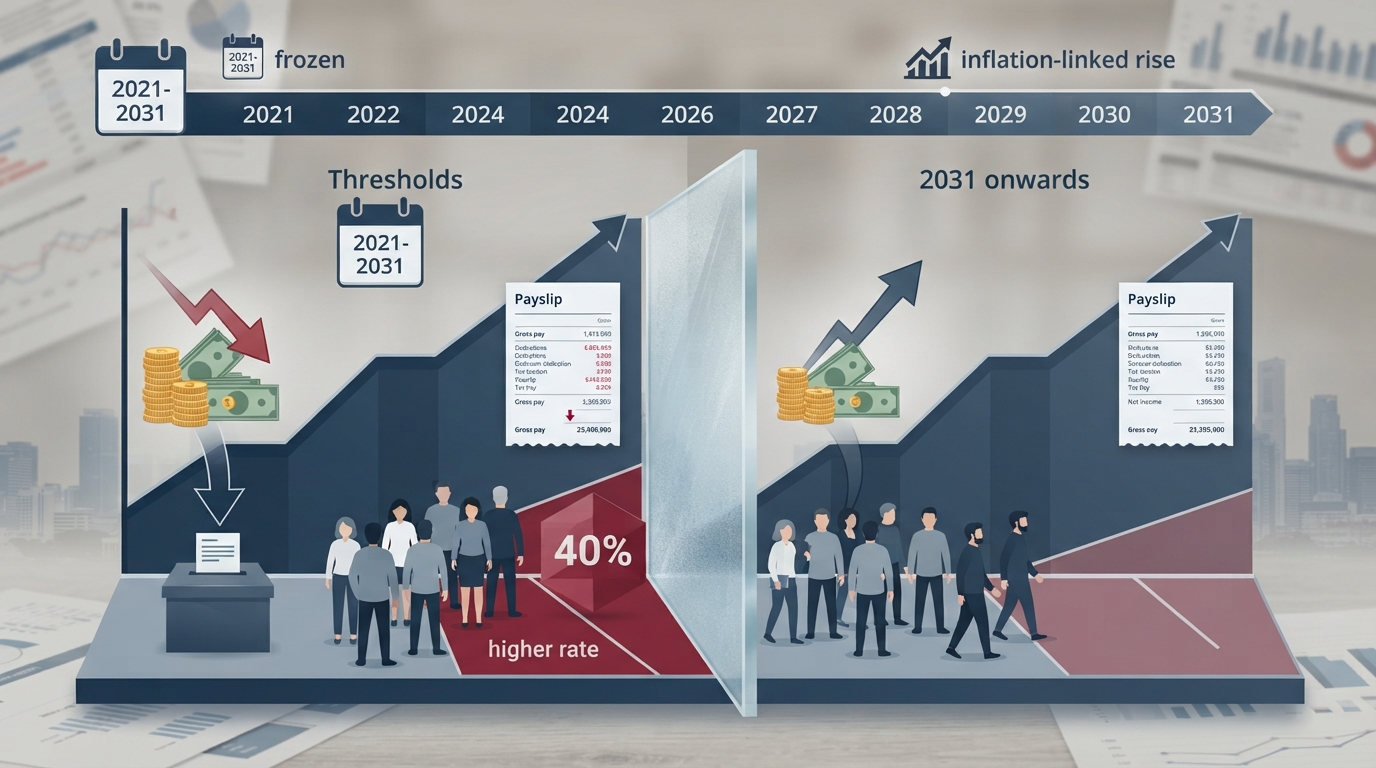
Income tax thresholds, which have been frozen by successive chancellors, are expected to begin rising again after 2031.
John Healey may not have referred to this in his Budget speech - after all, it is still a long way off - but the documents published by the Office for Budget Responsibility (OBR) show that this policy, which has been taking extra tax from people’s take-home pay for the past five years, is due to end.
The share of your income taken in tax will keep increasing over the next four years, in line with decisions taken in earlier Budgets.
After that, the personal allowance - the point at which you start paying tax - and other thresholds, where you move into a higher tax rate, will rise again with inflation, allowing you to keep more of what you earn.
Freezing thresholds is often called a stealth tax because, unlike increasing the headline rates, it is less visible on your payslip.
It has been a handy way for chancellors from Rishi Sunak onwards to raise more revenue to help fund defence, the NHS, schools and support for the sick, disabled and elderly.
The effect is strongest if your income is near one of the tax thresholds, but anyone who receives a pay rise is affected, provided they earn enough to pay tax. Only people earning below £12,570 - the personal allowance threshold - pay no income tax.
The state pension is currently just under the personal allowance threshold, and pensioners appeared likely to be brought into tax from next April, when the basic state pension rises to £13,036.
However, the chancellor is introducing a new separate Pension Tax Allowance, which will mean that anyone whose income comes only from the state pension will not pay tax on it.
The personal allowance threshold applies across the whole UK, so people in Scotland will also be affected, although other tax bands there differ.
National Insurance Contributions (Nics) are charged using the same thresholds.
Wages usually rise each year to keep pace with the cost of living. Normally, tax thresholds would also rise in line with prices. At present, that is not happening - the thresholds have been "frozen" at 2021 levels.
As your pay increases, a larger share of it falls above the point where tax starts.
As incomes rise, frozen thresholds also mean more and more people are pulled into the higher, 40%, tax band.
If you are earning just below the £50,271 threshold and your pay rises with inflation, some of your earnings will begin to be taxed at the higher rate.
If you were already earning more than the threshold and you get a pay rise, a larger share of your earnings will be taxed at the higher rate.
By 2031, almost one in four taxpayers will pay some tax at the higher rate, according to the government's official forecaster.
The same idea - that rising income can move you into a new tax band - also applies to the additional, 45%, rate charged on income above £125,140.
Wages have climbed sharply in recent years to keep up with inflation, making the effect of the first five years of this policy especially noticeable.
If the personal allowance had risen with inflation over the past five years, you would now be able to take home the first £16,070 of your pay without paying any income tax. Instead, you pay 20% on anything you earn above £12,570.
The Institute for Fiscal Studies (IFS) estimates that more than six million extra people will have been drawn into paying income tax by 2031 because of the frozen personal allowance threshold.
The IFS says that if Healey had unfrozen the personal allowance this week, rather than keeping it in place until 2031, basic rate taxpayers would save up to £198 a year in tax.
Higher rate taxpayers would save £395 a year.
However, for people in the middle of the earnings range, a cut to Nics introduced in 2024 has offset the higher income tax bill.
How much difference "unfreezing" thresholds will make in four years' time will depend on how quickly wages are rising then.
There is no basic principle at stake, no single point that is the "right" level for tax thresholds. Before the financial crisis the personal allowance was much lower than it is today, and it was allowed to rise until the pandemic struck. Even in 2031 you'll be able to take home a larger share of your earnings before income tax than you could in 2008.