

A high salary — a decent pension! Where does the connection between official income and future pension end?
The Ministry of Economy and Finance continues to search for an answer to one of the key questions of Uzbekistan's pension system: how tangible does a citizen's official earnings become when forming their future pension? Trust in the pension system begins with a simple question: if a person works officially today, receives a salary fully reflected in the documents, and mandatory payments are paid from it, will they see this contribution in […]
High salary — decent pension! Where is the line between official income and future pension?
For people with low incomes, the answer may seem obvious. But the higher the official salary, the more noticeable the gap becomes between real earnings and the portion of them that is taken into account when calculating pension payments.
This is precisely the issue raised by the Ministry of Economy and Finance when reflecting on the further development of the pension system.
### Salary grows, but pension rights do not grow indefinitely
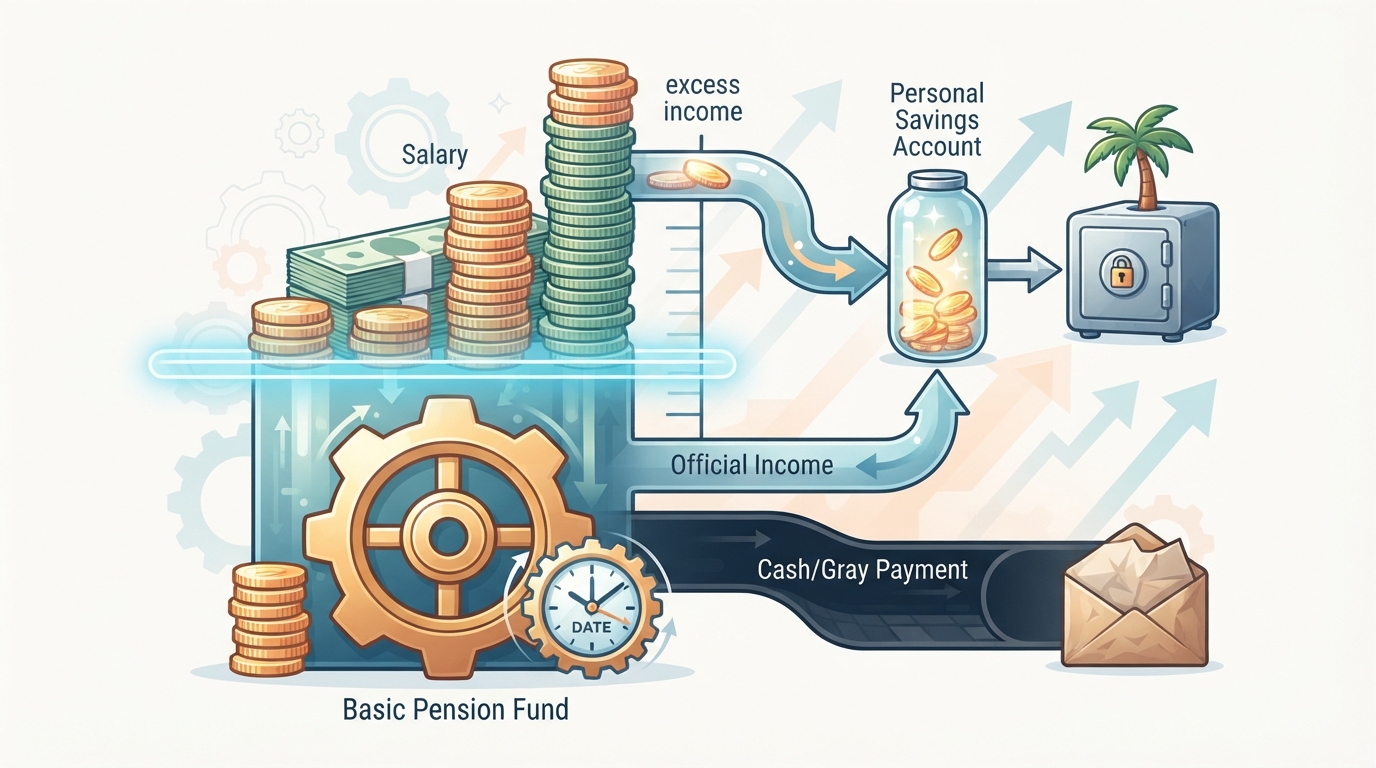
Today, when calculating a pension, earnings within the limit of 12 times the basic reference value (BRV) of the pension are taken into account. With the BRV amount of 504,000 soums specified in the materials, this limit is 6.048 million soums.
A paradox arises.
If a person officially receives 10 million soums, approximately 4 million soums of their earnings are already above the established limit of recognized income.
With a salary of 15 million soums, the excess is almost 9 million soums.
With an income of 20 million soums — already almost 14 million soums.
In other words, as the salary grows, the portion of income that does not participate in the pension calculation to the same extent also increases.
This is no longer just a question of the calculation formula. It is a question of incentives.
### Official salary must have a clear value for the employee themselves
For the state, a legal salary means taxes and contributions, transparent employment, and more predictable budget revenues.
But the employee has a different logic.
They must understand: the more they officially earn today, the more social guarantees they will receive tomorrow.
This is where the risk of a reverse effect arises: the higher the income, the weaker the incentive to declare it fully officially may become.
This potentially creates fertile ground for "under-the-table" payments, hiding part of the earnings, and evading official employment.
### How other countries cope with this
The problem is not unique to Uzbekistan.
In many countries, there is an upper limit on income that is taken into account when forming state pension rights or when calculating corresponding contributions. But at the same time, additional mechanisms operate, allowing citizens to build pension capital beyond the state system.
In Germany, for example, there is an upper limit on income from which contributions to the state pension insurance are calculated.
In the US, the Social Security system also provides for a maximum level of earnings taken into account when calculating corresponding taxes and pension rights. In 2026, this figure is $184,500 per year.
In Sweden, the pension model combines the state pension with occupational pension programs through employers and individual savings.
In Poland, there is a system of Employee Capital Plans — long-term savings with the participation of the employee, employer, and the state. The basic contribution of the employee is 2% of earnings, and the employer's is 1.5%.
In Kazakhstan, citizens' pension savings are kept in individual pension accounts. The system provides for mandatory pension contributions from the employee and additional mechanisms for employer participation.
### Can a funded pension become the missing link?
For Uzbekistan, this issue is particularly important against the backdrop of growing official salaries and the gradual expansion of formal employment.
One possible option is to link the portion of income exceeding the established limit more closely with individual pension savings.
For example, a certain share of earnings above the limit could be automatically directed to the employee's personal pension account. Then, a high official salary would cease to be just "income above the ceiling" for the pension system and would turn into additional pension capital for a specific person.
This should not be perceived as a privilege for wealthy citizens.
On the contrary, it is about a principle: a person who officially earns more and participates in financing the system with a larger amount should see a clear result of their own participation.
Otherwise, the pension system effectively tells them: after a certain level, your additional official income matters less and less for your future pension.
### The main question is not only to accumulate, but also to preserve
However, simply creating a funded mechanism is not enough.
A citizen must understand where their money is, who manages it, how investment income is formed, what fees are charged, and what guarantees are provided by the state.
Moreover, transparency here must not be formal, but personal.
Without such information, the funded system risks remaining just another incomprehensible deduction from the salary for the citizen.
### The pension system must compete with the "envelope"
Ultimately, the issue of pension reform goes far beyond the formula for calculating payments.
It is a question of the economics of official employment.
An employee must understand that a legal salary is beneficial to them not only today — it shapes their social rights for years to come.
Therefore, the pension system must compete not only with inflation and demographic challenges. It must also compete with the "envelope" (cash in hand).
And here, simply calling for official work is not enough.
An economic incentive is needed.
### What is the bottom line?
A high official salary should not turn into a pension dead end.
If the state limits the amount of earnings taken into account when calculating the basic pension, then the portion of income above this threshold must have a clear path into the system of long-term pension savings.
For the citizen, this means a simple thing: official income works for their future not only up to the established ceiling, but also beyond it.
For the state — more transparent employment, expansion of the tax base, and a potentially more sustainable pension system.
If there is no answer to this question, the ceiling of pension rights risks becoming at the same time the ceiling of motivation to work fully officially.