

The memorandum is non-binding
Central Asia is once again looking for a way to the sea. Astana and Tashkent are designing a railway line and counting on the participation of the UAE
**The Memorandum Commits to Nothing**
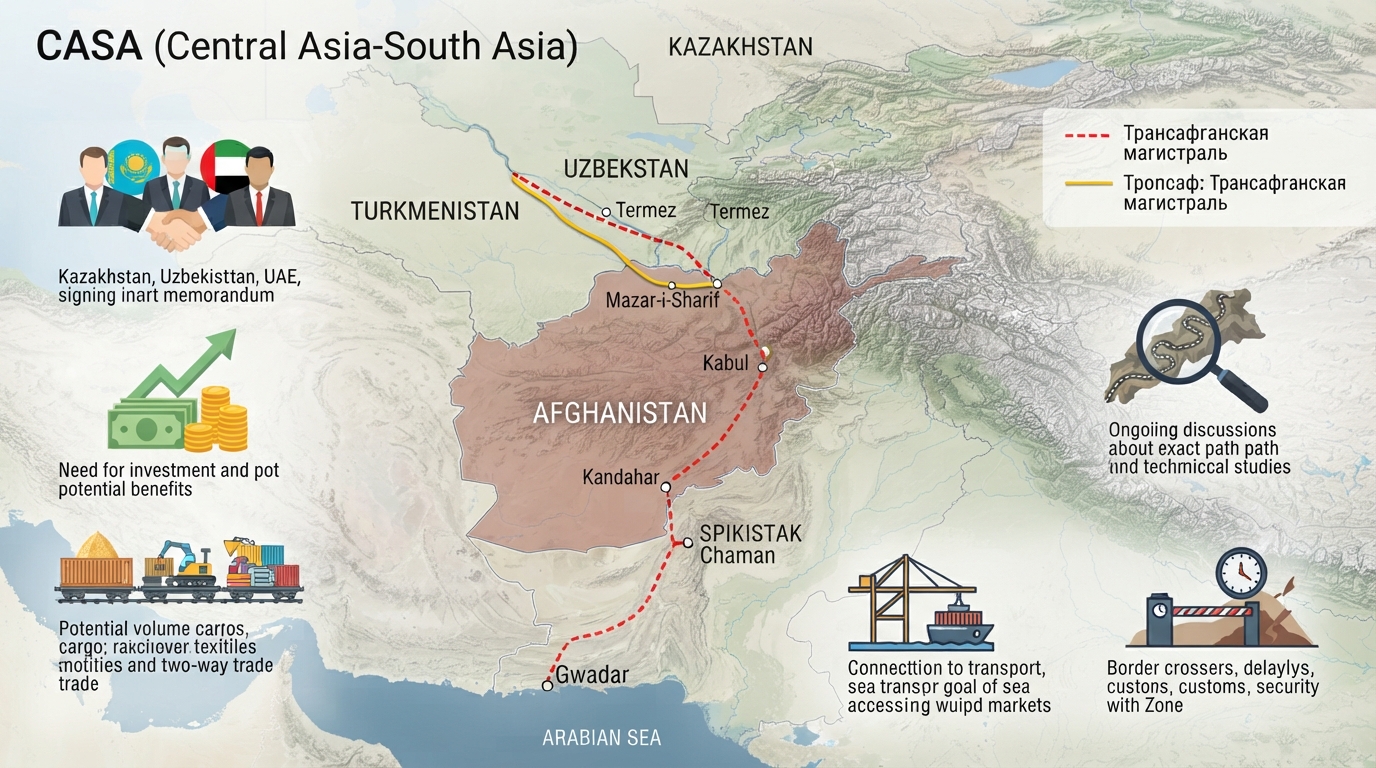
Kazakhstan and Uzbekistan, together with the United Arab Emirates, have agreed to study the possibility of constructing a railway route through Afghanistan to Pakistan. However, many questions remain between the signed memorandum and the first train to the Pakistani coast. The key ones are where the road will run, who will pay for its construction, and what cargo it will transport.
The agreement was announced by the government of Kazakhstan. The document was signed by the transport authorities of Kazakhstan and Uzbekistan, as well as the Ministry of Energy and Infrastructure of the UAE.
The project was named CASA — after the English designation for Central and South Asia. For now, the participants intend to assess how difficult it will be to build the road and whether it can pay off. To this end, the creation of a working group is being discussed.
The appearance of the UAE among the partners for the construction of this railway can be explained not only by the country's experience in logistics and major infrastructure projects, but also by the availability of financial resources. It can be assumed that Astana and Tashkent hope to interest Emirati investors. However, the published announcement did not name either the companies that could invest in the construction or the amounts.
The interest of Kazakhstan and Uzbekistan is understandable. To ship goods by sea, they first need to deliver them to someone else's coast. The more routes available, the wider the choice for businesses and the less dependence on the situation in a single direction. The southern route could provide an additional outlet to foreign markets. But for the shipper, the cost of delivery and the certainty that the cargo will arrive on time are more important than the line on the map itself. If the train is delayed for a long time at borders, the advantage in distance may lose its meaning. Pakistan's ports were not chosen by chance: goods can be transported further by sea, including to the Gulf countries.
The idea of connecting Central Asia with Pakistan through Afghanistan has been discussed for a long time. It already has an active northern section. The Hairatan–Mazar-i-Sharif railway connected the north of Afghanistan with the network of Uzbekistan. Uzbekistan gained the opportunity to deliver cargo deep into Afghanistan, but there is no through route to Pakistani ports yet.
The construction of the Trans-Afghan railway has been discussed for more than a year. In June 2025, in Kabul, Uzbekistan, Afghanistan, and Pakistan agreed to prepare a feasibility study for this railway: to determine the route, estimate costs, and understand whether future trade will justify the construction expenses. The Pakistani Foreign Ministry formulates the mutual interest simply: Uzbekistan gets access to seaports, and Pakistan gets access to Central Asian markets.
Now Kazakhstan and the UAE have joined the discussion of the southern railway outlet. However, how the new memorandum relates to the work already started by the other three countries has not yet been explained. Afghanistan and Pakistan, through whose territory a significant part of the route must pass, are not listed among the signatories of the current document. This does not mean they have been excluded from the project. But without agreements with them, the road will remain only an intention: both the construction and the rules of future transportation must be agreed upon.
The question of the route also remains open. Previously, Kazakhstan discussed with Turkmenistan, Afghanistan, and Pakistan the construction of the Torghundi–Herat–Kandahar–Spin Boldak railway. The plan was to start with the Torghundi–Herat section and a logistics center in Herat. However, in the current announcement, Uzbekistan has taken the place of Turkmenistan.
Meanwhile, as political analyst Derya Karaev explained, the easiest way to get to Herat is precisely through Turkmenistan. Uzbekistan has only one border crossing with Afghanistan, and from there, the route to Herat would have to be laid through the north of the country. And this, according to the expert, means difficult terrain, mountain passes, and additional difficulties associated with the current situation in Afghanistan.
A different route means different costs, different border crossings, and a different distribution of transportation revenues. Perhaps in the future, several lines will become parts of a common network. The most difficult conversation will likely begin after the route is studied. The participants will have to answer who is ready to transport goods along it for years and in what volume. Cargo in both directions is important: the return of empty wagons increases costs. Agreements on tariffs, customs operations, cargo safety, and track maintenance will be required. For business, all of this is no less important than the actual appearance of the rails.
Karaev draws attention to the risks in Afghanistan and beyond. The main question, however, is how safe the road through Afghanistan will turn out to be. The Taliban hold power and, according to the UN, control the country's territory, but this is not enough for long-term investments. Relations with Pakistan, without which access to the sea is impossible, are particularly worrying. At the end of September, hostilities on the border escalated again: Pakistani aircraft launched strikes on Afghan territory. Islamabad accuses Kabul of harboring militants who carry out attacks in Pakistan; the Afghan authorities deny this.
"Baloch armed groups operate in Pakistan, and instability also affects neighboring regions of Iran. Attacks on Chinese specialists show how vulnerable foreign participants in major infrastructure projects can be. Therefore, the security of the future railway, according to the political analyst, remains one of the main issues," Karaev noted.
Against this background, the promise to build a railway does not yet mean that uninterrupted traffic can be established on it. Investors need confidence in the safety of the builders and the tracks, and carriers need an open border. Until Kabul and Islamabad agree on a sustainable cessation of hostilities, investing money in this railway will be much more difficult than signing documents of intent.