

The International Monetary Fund has published its new forecast on the global economy
Inflation, trade wars, and AI: What lies ahead for the global economy?
The International Monetary Fund presented a new forecast on the global economy
The International Monetary Fund (IMF) has published its forecast for the global economy.
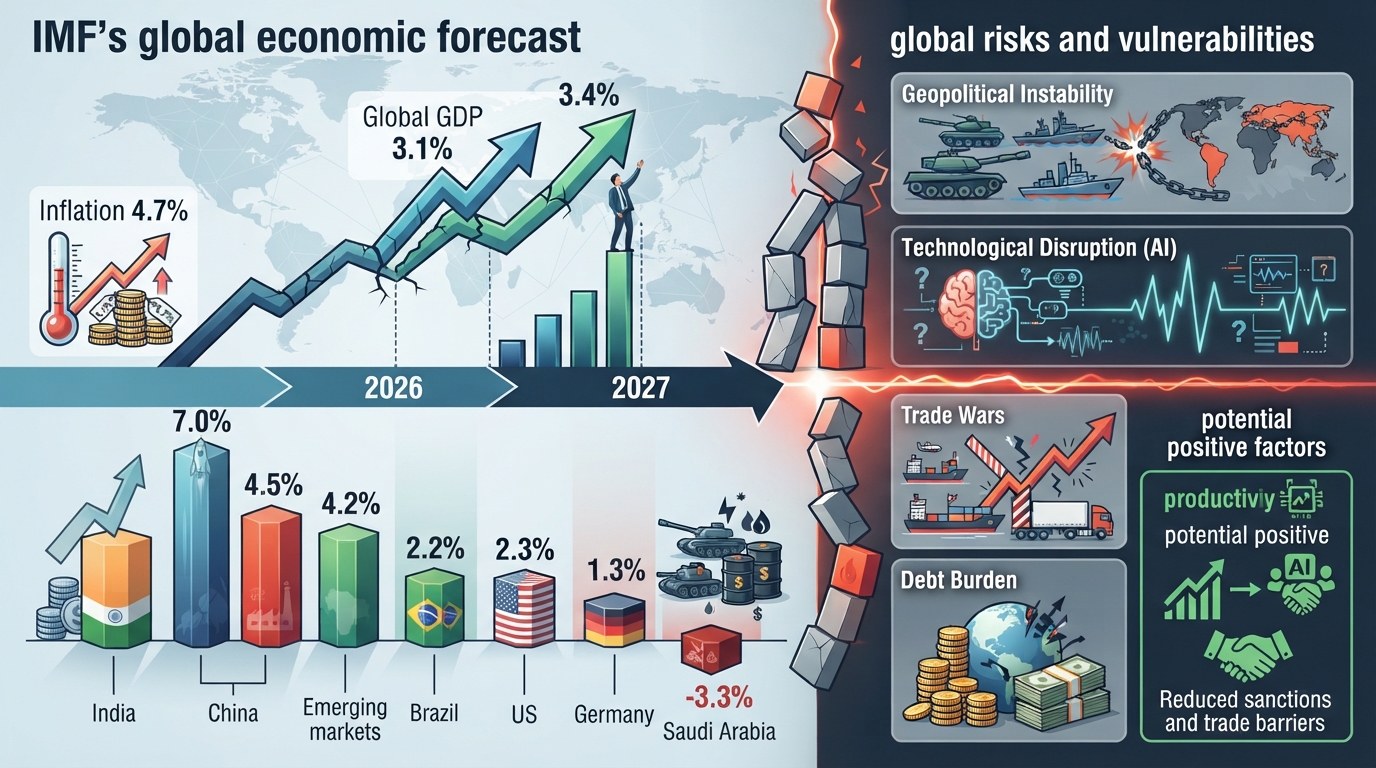
According to the IMF's assessment, global economic growth will be 3.1 percent in 2026 and 3.4 percent in 2027. Despite this, the world economic system is becoming increasingly fragile, and the balance of development between countries is being disrupted. Inflation is expected to reach 4.7 percent against the backdrop of rising prices for energy resources and food products. The greatest damage will be suffered by remote countries that are cut off from main technological chains and purchase energy resources from outside.
Looking at individual countries, in 2026 the US economy is projected to grow by 2.3 percent, Germany by 1.3 percent, France by 0.4 percent, Italy by 0.8 percent, Spain by 2.5 percent, the UK by 1.3 percent, Japan by 0.7 percent, and Canada by 1.1 percent.
Among developing countries, India maintains its leadership in economic growth with a figure of 7.0 percent. During this period, China's economy will grow by 4.5 percent, Nigeria by 4.2 percent, Brazil by 2.2 percent, Mexico by 1.5 percent, the Republic of South Africa (RSA) by 1.0 percent, and Russia by 0.9 percent. The largest decline is expected in Saudi Arabia — due to military conflicts, the country's GDP dynamics are estimated to fall to minus 3.3 percent.
The most important aspect is that the global system's reserve of resilience is running out, and risks have reached a worrying level. Any next factor — a new wave of wars, fluctuations around artificial intelligence (AI), trade wars, or countries sinking into a debt trap — could instantly derail the global economy. There are also positive aspects: if artificial intelligence starts delivering the expected high productivity, or if politicians agree to reduce the pressure of sanctions and tariffs, economic growth rates could increase. However, high risk remains, and the zone of instability is constantly expanding.