

The Indian workers filming their work to train AI
Indian workers are being paid to film themselves at work and the footage is used to train AI.
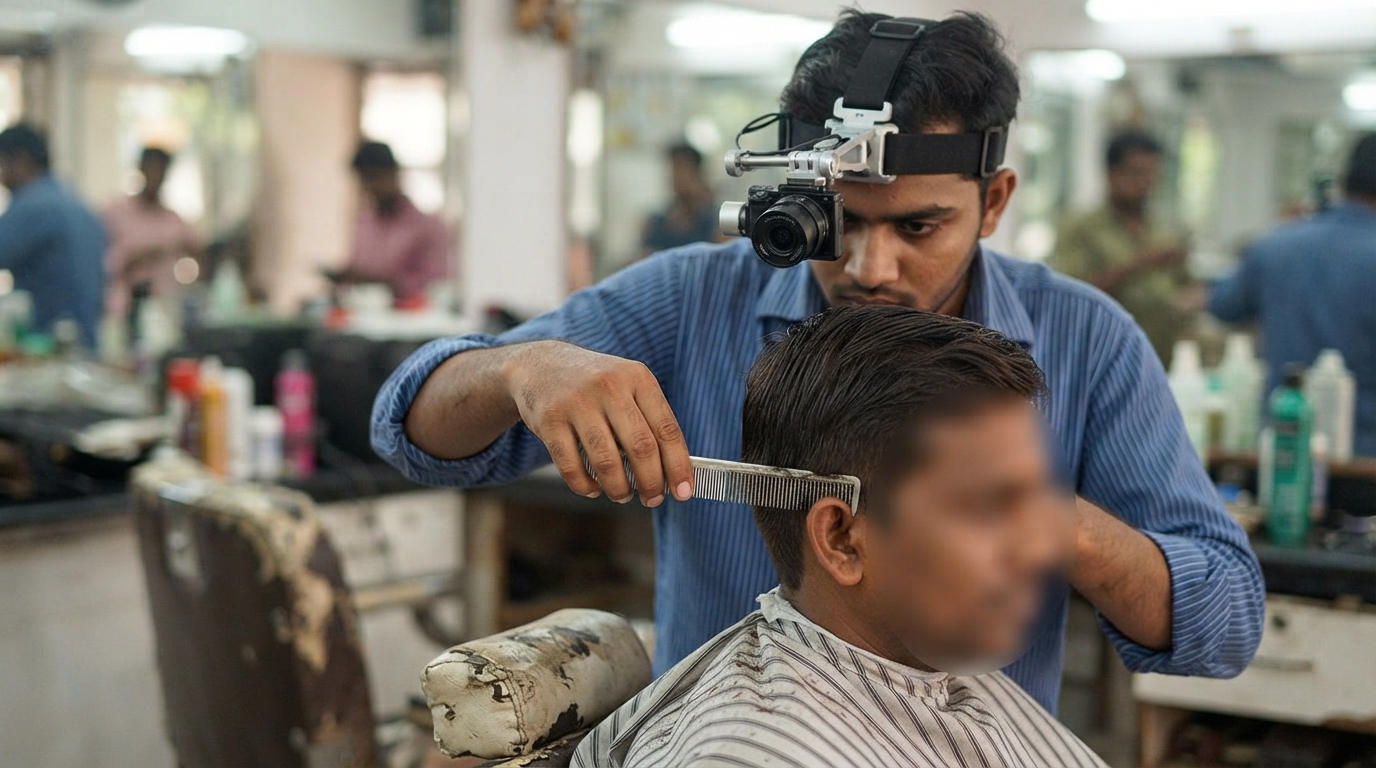
**Indian workers film their jobs to help train AI**
Mohammed Ashim is paid to record his hands while he works
Mohammed Ashim has spent four years cutting hair and trimming beards in Bengaluru.
But lately, the 22-year-old has been fastening a camera to his head to capture his work.
The camera films only his hands and fingers, while his client’s faces are blurred.
“The routine is simple, but you have to be disciplined about how you move. The operations team taught me that my hands always have to stay cleanly inside the frame, the lighting has to be sharp, and I can't tilt my head too abruptly while working.”
He wears the camera for five or six hours each day.
“It’s good money, but honestly, the feeling of doing something this futuristic is what keeps me excited. I never imagined my razor techniques would be useful to a global tech company,” Ashim says.
He is among hundreds of thousands of workers around the world who are paid to document what they do.
Ashim’s footage is gathered by a local company, which may have hundreds of people filming their work.
That video is then sold to technology companies and research organisations, which use it to train artificial intelligence — especially so-called physical AI, a form of AI that can control robots in the real world.
Rashdan Technologies collects and processes this kind of human-generated data.
“Every robotics company, every frontier AI lab, has a specific kind of data they want: industrial tasks, agriculture, household chores, small business work like pottery, garment-making, embroidery, candle-making. We go wherever the task is,” says co-founder and CEO Shahil Baig.
His company pays $5 to $10 (£3.74; £7.47) for eight to 10 hours of recorded work.
“For a lot of these people, that's meaningful,” Baig says.
He says it is important to ensure workers consent and feel comfortable with the process.
“We record hands, not faces, and where multi-camera rigs do capture more of the body or environment, we blur faces out. No names, no contact details, nothing that identifies them personally goes into what we hand off.”
But customers are becoming more demanding.
“Now clients are asking for four to six cameras rigged around a person's head to cover the entire scene, not just the hands.
“Getting someone to agree to one small camera is one conversation. Getting them to agree to wearing what's effectively a five-camera headset is a completely different, and harder, one. We pay more for that tier of data collection because of what we're asking of people.”
The sector is also getting more crowded, and Agarwal expects dozens more competitors to appear in India this year.
Shahil Baig expects dozens more firms to start collecting video of workers
### Why is this data so important?
If robots are to move through the real world, they cannot be trained only in computer simulations, argues Manish Agarwal, founder of Humyn Labs, which collects and processes human-generated data.
Most of this data comes from video, though sometimes collectors wear equipment on their hands and fingers to capture physical contact.
“Physical tasks require high-quality signals involving limb movements, fingers, wrists, elbows, shoulders and dynamic force application. For example: applying the correct grip force so a plastic bottle doesn't crumble versus a steel glass,” he says.
Until recently, that data was unavailable.
“There is no existing internet archive of embodied human activity - no dataset of a kitchen being cleaned, or a car being assembled by hands that know exactly how much force to apply. That data has to be captured from scratch, in the real world, across diverse environments,” says Agarwal, whose company has bases in Bangalore and San Francisco.
At present, his firm has 96,000 data collectors across countries in Latin America and Southeast Asia.
Humyn Labs sorts through the thousands of hours of video provided by those collectors, choosing the most useful material. It is then labelled so the AI understands what it is seeing and packaged in a format clients can use.
“You need to source across a variety of factories, a variety of tasks, in different geographies because if you want to build deployment for US factories or US houses, you'd want environments that are a proxy for that. Residential houses in India may not be the right context for building a robotics use case for the US.”
But are workers gathering data for machines that may one day replace their jobs?
At this stage, it is too soon to know, says Bino Paul, senior professor at the School of Management and Labour Studies at the Tata Institute of Social Sciences (TISS) in Mumbai.
For some workers, AI may become a useful tool, but robots could automate other jobs, he says.
The issue is that if machines do begin to take over, workers may have little they can do about it.
“By the time workers realise what they have participated in, things may have gone too far,” he says.
Like many others, he wants governments to regulate AI.
“AI cannot be viewed merely as a technical system. We need to develop a socio-technical system in which ethics is upheld through human agency, ensuring that AI delivers beneficence rather than maleficence.”
Even with concerns about where AI is headed, huge sums continue to be invested in its development.
Some of that money reaches workers in India, where there is no shortage of people willing to wear a camera for a few dollars a day.
Mohammed Arman has worked in the textiles industry in Bangalore for 10 years.
“Garments stitching and cutting. I know this work so well I could probably do it with my eyes closed. Cloth, thread, needle, machine after 10 years, your hands just know what to do before your mind even tells them,” he says.
He has recently begun wearing a head-mounted camera that records his work.
“For me, it's simple. This is survival. I have a family back home in Bihar, and every rupee I send back matters. If someone offers me extra money to wear a camera while I do the exact same work I've been doing for 10 years, I'm not going to say no.
“It doesn't cost me anything. I'm already doing the stitching, already doing the cutting. Now I just get paid a little more for it,” he says.
As long as there is demand for this footage, it will be collected somewhere.
“India's current role in this industry is largely as a supplier of raw material - people strap on cameras, record themselves doing ordinary tasks, and that footage gets shipped off to labs abroad,” Agarwal says.
But he says the value of that work will soon be reduced as more companies compete for collection contracts.
“India can't afford to stay a footage supplier. It needs to move up the value chain: from recording raw video to owning the pipeline that turns that video into something usable - cleaning it, structuring it, validating it, and ultimately setting the standards for what counts as high-quality training data,” he says.
For some people, collecting data is appealing part-time work.
Science teacher Jolly Arifur was searching for work she could do from home around her young son.
“For the past seven months, I strapped a rig-mounted camera on my head while doing my routine domestic work scrubbing, cooking, sweeping tile floors, and folding laundry.”
Arifur, who lives in Guntakal, Anantapur, fits the recording work around her teaching.
“I get paid two to three dollars per hour. If I record three to five hours a day, that's a good amount in hand it's become an extra source of income for me, on top of teaching. I'm managing both honestly, fantastically.”