

The Indian chef who brought curry to America - then vanished
Indian chef Ranji Smile opened America’s first Indian restaurant in 1901 - then became a fake prince.
The Indian chef who brought curry to America - then vanished
Ranji Smile was among the most vivid and mysterious personalities to influence the American food world.
One hundred and twenty-five years ago, in 1901, an Indian chef launched what was almost certainly the first Indian restaurant in the US.
Ranji Smile was one of the most colourful and enigmatic figures to shape the American food scene.
In the summer of 1899, Smile travelled from London to New York. Very little is known about his background or early years, including his true name.
“Ranji” was likely a reference to the Indian cricket star KS Ranjitsinhji, then a major draw at Test matches in Britain. “Smile” may have been an anglicised form of “Ismail”.
Whatever his beginnings, Smile had a rare gift for self-reinvention. After passing through Ellis Island, he added another name to his identity, one that better matched America’s egalitarian ideal: Joe.
Joe Ranji Smile arrived in New York to work at Sherry's Restaurant, a dazzling new venue on Fifth Avenue.
In London, he had worked as a curry cook at the Cecil and Savoy hotels. In New York, according to an 1899 profile in Harper's, he was spotted by Sherry's owner, Louis Sherry, who asked him to bring his cooking talents across the Atlantic. Late Victorian London already had an Indian dining culture: as early as 1810, Sake Dean Mohamed, a native of Patna, had opened his Hindostanee Coffee House near Portman Square, serving customers curry and hookah alike.
Manhattan diners had little experience with masala. Still, interest in India and its culture was growing. Swami Vivekananda, the captivating speaker and advocate of Hindu philosophy, drew crowds during his visits to the city in the 1890s. At the same time, more Indian sailors, students and professionals were arriving in New York. This was likely why Louis Sherry chose to add a curry cook to his kitchen staff.
At Sherry's Restaurant, Smile became part of one of the great culinary institutions of the American Gilded Age. Marketed as a competitor to Delmonico's, New York’s shorthand for fine dining, Sherry's served city plutocrats such as the Astors and was known for extravagant dining spectacles. At one such event, guests led their horses into a ballroom, mounted up and ate while seated on horseback.
Smile, a gifted performer, excelled in this setting.
Soon, customers were coming to sample his Bombay duck, a sticky lizardfish delicacy from the western Indian coast, and inventive dishes such as “Lettuce Ceylon”.
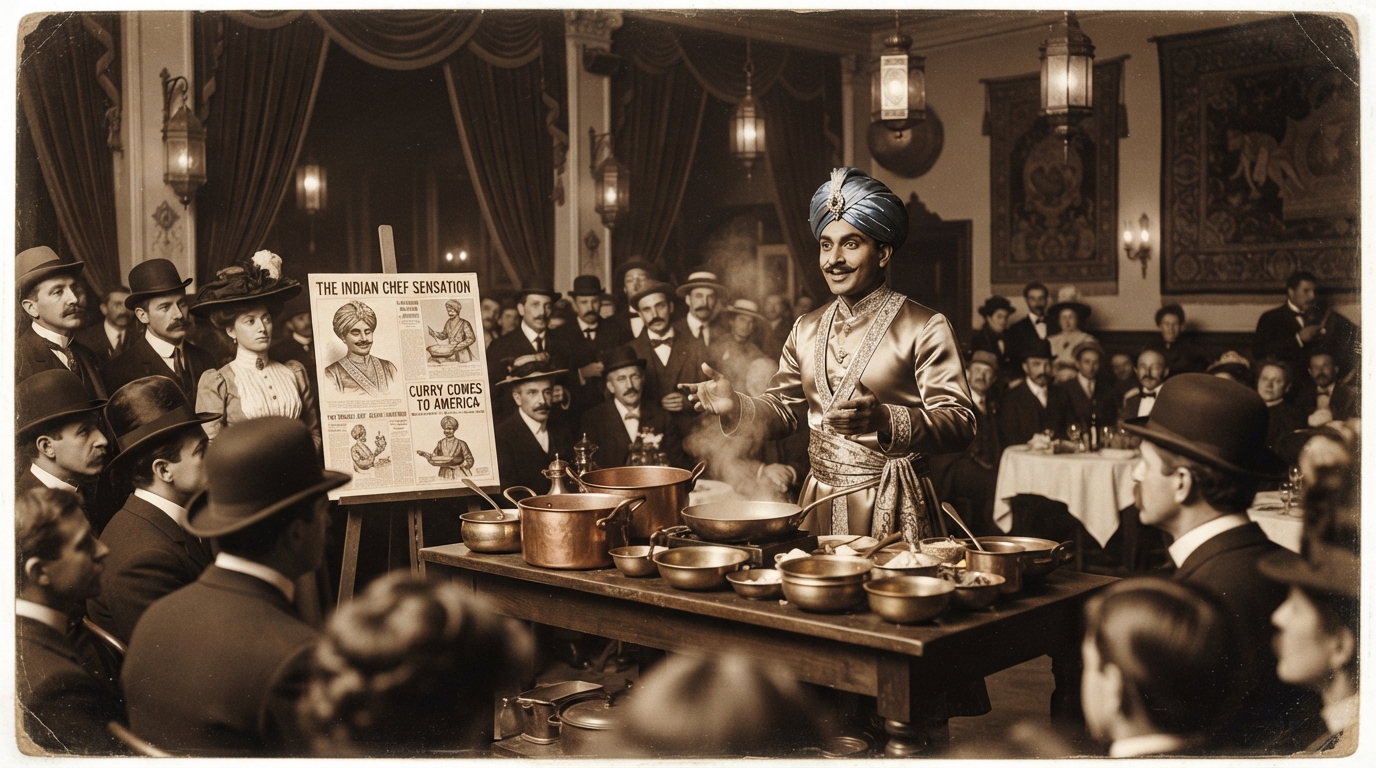
Cooking and serving turned into theatre. Wearing a satin coat and blue silk turban, Smile salaamed before customers and asked, “Will you have the curry hot or mild, sahib?” Images of Sherry's curry chef quickly appeared in newspapers and magazines. One headline captured the sensation: “New York women go wild over him.”
As his reputation expanded, Smile chose in 1901 to leave Sherry's and open his own restaurant, one devoted entirely to Indian food. For funding, he relied on Roland R Conklin, a prominent financier
, external and the inventor of an early version of the motorhome.
Omar Khayyam, Smile's Indian restaurant, opened in late 1901 at 325 Fifth Avenue. It occupied prime property, just a block from the original Waldorf-Astoria Hotel, where 29 years later the Empire State Building would rise. Smile decorated the restaurant with Indian draperies and hanging lanterns.
According to the New York Herald, the staff included a group of Indian waiters in “voluminous turbans” as well as Indian musicians. Now fully cast as an American immigrant success story, Smile eagerly awaited the crowds of customers and admirers.
But they never came. Within a year, Omar Khayyam had closed. The New York Sun said people had “tired” of Indian food, treating it as a short-lived craze.
Smile’s fame, which had burned so brightly in New York, also began to fade. Sadly, his flair for showmanship and theatrics slipped into deception and criminal conduct.
Smile started claiming that he was not an ordinary Joe after all, but a prince, the son of the emir of Baluchistan, a made-up title. And before opening Omar Khayyam, he made a brief trip to Bombay, where he said he was a guest at the forthcoming coronation of King Edward VII in London and recruited a staff: valets, a dancing girl, and “mahouts to drive his herds of elephants”.
Newspapers in New York, including the Times, reported all of this because, as a later federal case against him alleged, Smile illegally trafficked this staff into the US to work at his restaurant. Rather than becoming a pioneering centre of Indian cuisine, Omar Khayyam nearly led to Smile’s deportation.
“Prince” Joe Ranji Smile avoided deportation (many in his entourage were not so fortunate) and continued reshaping his invented identity, while courting and marrying a succession of impressionable young American women. He began insisting that Indian food was a secret beauty tonic for women. “The eye will grow lustrous, the complexion will be yet so lovely,” Smile promised, presenting his wives as proof.
At the same time, he refined his performance skills through Indian cooking demonstrations around the country.
In Washington DC, Smile cooked dishes including a suspicious-sounding dessert called “bungalow”, while a juggler and dancing girl entertained the audience. On his way to Chicago, as one newspaper in remote Idaho reported, he said he was no longer the son of the emir but the brother of an even more fanciful figure, the “great Beglerberg of Baluchistan”. If Smile was guilty of being a conman, his American listeners were equally guilty of believing him too readily.
Although Smile’s theatrics and good cooking entertained people for a time, the lies and outright inventions eventually caught up with him.
Smile withdrew from public view after further run-ins with the law, including the forcible confinement of one of his dancing girls and refusing to pay a bill at an Italian restaurant in Manhattan. By the 1920s, he seems to have given up cooking altogether and listed his occupation as a merchant.
The last trace of Smile comes from 1937, when his fourth or fifth American wife went to the New York Supreme Court and sought an annulment of her marriage to her now-vanished husband. Ranji Smile’s final act of reinvention was simply to disappear.
Even with this undignified ending, Smile and his Indian restaurant helped open the door to the popularisation of Indian cuisine in America. Other immigrants soon followed.
In 1909, Saint Nihal Singh, a travelling journalist from Punjab, introduced readers of the Chicago Daily Tribune to recipes for bhajias, puris, halwa, and “Fried Chicken a la Hindoo”.
Recognising that many Chicagoans were unfamiliar with Indian ingredients, Singh advised readers to find them in the city’s Chinese grocery stores. On another occasion, which may make modern chefs wince, he suggested that hamburger meat was an acceptable substitute for making gosht pilau (a meat pilaf).
Not long after Ranji Smile was taken to court for trafficking immigrants, a young man from Ceylon named KY Kira arrived at Ellis Island.
KY Kira opened a successful Indian restaurant in New York in 1913
Like Smile, he had a talent for reinvention. Kira joined a troupe of Sinhalese dancers that performed for American circuses such as Barnum and Bailey and Ringling Brothers. In 1913, he opened an Indian restaurant in Harlem, later known as the Ceylon India Inn. Unlike Omar Khayyam, the Ceylon India Inn was a success.
New York now had a far larger Indian immigrant community, and the restaurant drew expatriate nationalists and revolutionaries. It also benefited from a growing American fascination with Indian culture and cuisine. By the 1920s, Kira's restaurant, then located off Times Square, served Broadway and Hollywood stars. The Ceylon India Inn stayed open until the late 1980s, promoting itself as the first Indian restaurant in America.
Of course, that was not true. Ranji Smile may be largely forgotten, but 125 years after the short-lived Omar Khayyam restaurant, his legacy endures in the thousands of Indian restaurants thriving across the US.