

The further it goes, the worse it gets
Ecology of Central Asia: Real Threats vs. Alarmist Forecasts
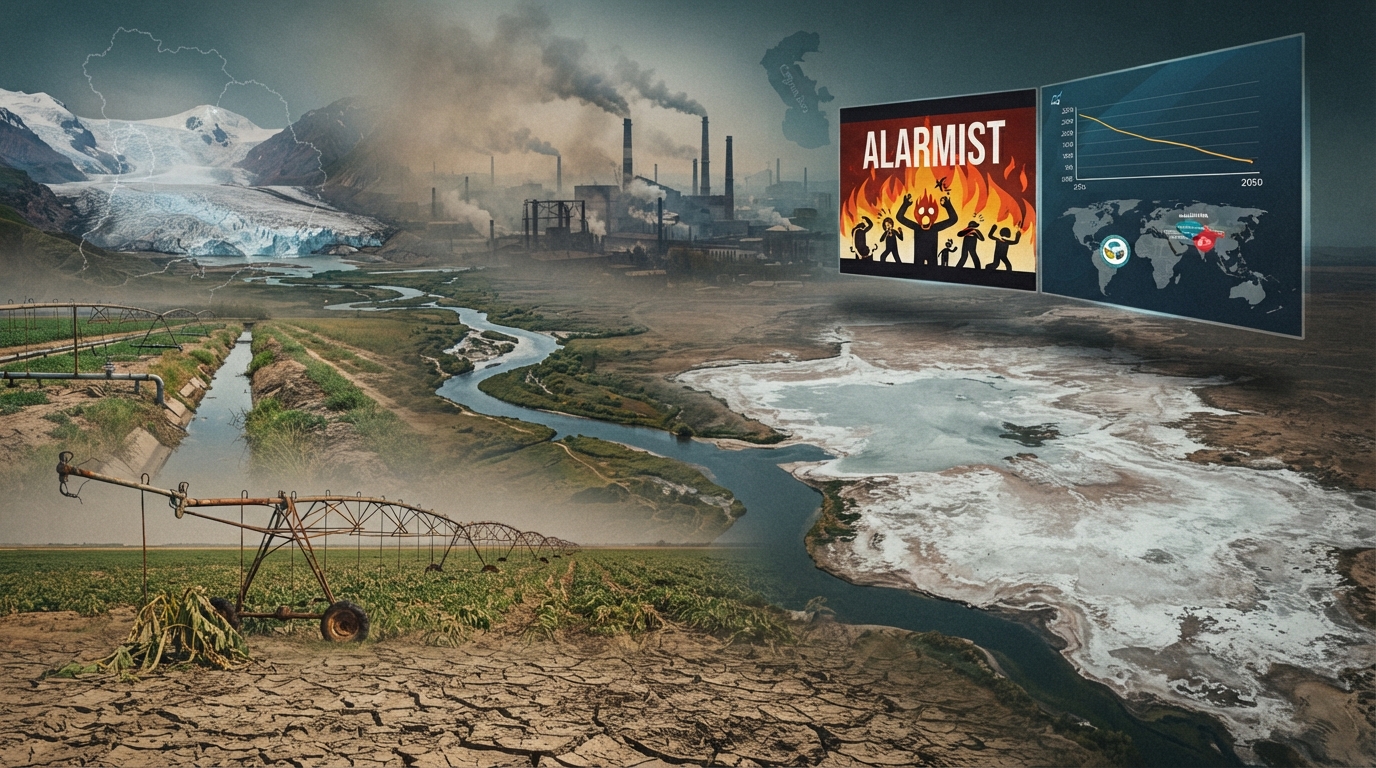
The Further, the Worse
Environmental protection issues in Central Asia are sounding louder and louder. "VES 24" reached out to Taisia Marmontova, head of the Institute for Regional Integration Research (Kazakhstan), to learn which challenges are genuine and which are merely artificially blown out of proportion.
Ecological difficulties in Central Asia are not a myth; they exist in reality. However, it is fundamentally important to separate objective dangers from their political interpretations, which often acquire an excessively panic-stricken tone.
Among the truly serious problems, one should name the shortage of water resources, land degradation, melting glaciers, air pollution, the consequences of the Aral Sea catastrophe, as well as the issues of the Caspian, which today is subjected to intense stress and cannot cope with anthropogenic pressure. The scale of all these issues is confirmed by statistical data.
For instance, back in 2020, the Eurasian Development Bank recorded that 79% of the water consumed in Central Asia goes to irrigation. According to World Bank data, fine particulate air pollution led to the deaths of over 60 thousand people as early as 2021.
The problem of glacier melting requires special attention, as changes in glacial runoff can affect seasonal water availability, which is critical for agriculture and hydropower. As for water, Central Asia is indeed among the eight regions experiencing water scarcity, but there is an important nuance here. Ecological difficulties in Central Asia cannot be reduced solely to climate change. Some of the problems are linked to inefficient water management, outdated infrastructure, obsolete production technologies, and weak coordination of economic policy.
If we talk about exaggerating threats, I would primarily name the thesis regarding the inevitability of so-called "water wars" in Central Asia. Water scarcity does indeed create ground for friction between states, but by itself, it does not predetermine armed conflicts. Moreover, the interdependence of countries in the water sphere — between those located upstream and downstream — serves not only as a source of potential disagreements, but also as an incentive for developing cooperation.
Another example of a simplified view is portraying the environmental problems of Central Asia exclusively as a consequence of global climate change. Such an approach distracts from discussing issues of economic management, the effectiveness of state institutions, and responsibility for the use of natural resources. The main danger here lies not so much in exaggerating environmental problems, but in replacing them with emotional forecasts.
This is probably a question for journalists, as I share the opinion that a fake is born where reading evokes an emotional response. And this, in turn, becomes a tool for manipulation.
An environmental threat is an objective process. Environmental risk is the probability of negative consequences occurring. Political conflict is one of the possible response scenarios to this risk. Therefore, purely methodologically, equating these three categories is completely wrong. Thus, Central Asia needs not a competition of catastrophic forecasts, of which there are quite a lot right now — I see them constantly myself and somewhere right now we are talking about this with you, — but rather a pragmatic regional environmental policy based on data.
The Potsdam Institute for Climate Impact Research published this on October 22, 2026: according to scenario estimates, by 2050 the volume of river runoff in July – September under certain conditions could decrease by up to 50%. That is, this is a serious argument in favor of adaptation, but not a reason, let's say, to claim that all of Central Asia will inevitably lose half of its water resources.