

The extreme engineering of aircraft windows
Few companies have the technology to make aircraft windows which are getting harder to make.
**The extreme engineering of aircraft windows**
An industrial emergency was unfolding south of Los Angeles.
In late May, a chemical storage tank holding more than 7,000 gallons of toxic material started to heat up rapidly. The tank was owned by GKN Aerospace, a supplier of aviation parts, including aircraft windows.
As the temperature inside the gleaming metal vessel climbed, workers understood there was a serious issue. The tank could have exploded, possibly spraying nearby neighborhoods with methyl methacrylate (MMA), a compound used in plastics production that can irritate the skin and lungs.
The tank’s temperature hit 100F (38C) — and may have gone even higher, since 100F was only the highest reading shown on the temperature gauge inside.
More than 50,000 Garden Grove residents were evacuated, and fire crews began dousing the tank in an effort to bring the temperature down. At one stage, the vessel “actually bulged,” according to the local fire chief.
Fortunately, there was no explosion. Months later, in August, GKN and local officials announced a $100m (£74m) programme to compensate residents evacuated during the incident. But production of aircraft windows at the site, which had been suspended, has still not fully recovered.
The disruption has caused a small ripple through the aircraft manufacturing sector, because GKN is one of the surprisingly small number of companies anywhere in the world that produce aircraft windows — highly engineered, safety-critical components for planes.
According to public statements by its UK parent company Melrose Industries, production at GKN’s Garden Grove plant is still constrained at about 50% of normal. The goal is to restore full production by 28 September. GKN declined to give the BBC an interview.
“They’re one of only a handful of suppliers – less than a handful, really – of critical windows,” says aviation industry analyst Marisa Garcia. “One of the breaking points of supply chain in aviation is you have very few companies qualified to do something and, when something goes wrong, it really upsets the entire system.”
Boeing tells the BBC it is “taking steps to mitigate any potential impacts”, calling the production shortfall an “industry-wide” issue.
“We are supporting our supplier,” a spokesman adds. An Airbus spokeswoman says, “We are closely monitoring and are seeing positive progress toward a return to normal.”
This is happening at a time when airlines “can’t get new aircraft fast enough,” says Mike Stengel of consultancy AeroDynamic Advisory. “They’re holding on to aircraft for longer.”
Even though only a few companies make aircraft windows, it is difficult for new rivals to enter the market because the industry is so heavily regulated, Stengel adds. “It can take time to pivot to a new supplier.”
That creates a “balancing act” between aircraft makers and the companies they depend on for different parts, Stengel says.
To learn what goes into making an aircraft window, I spoke with Jean-Eric Vermont, general manager of French company Saint-Gobain Aerospace.
“We focus mostly on commercial aircraft, regional aircraft and helicopters,” he says. Vermont, however, declines to say what share of the aircraft window market his company holds — or transparencies, as they are called in the industry.
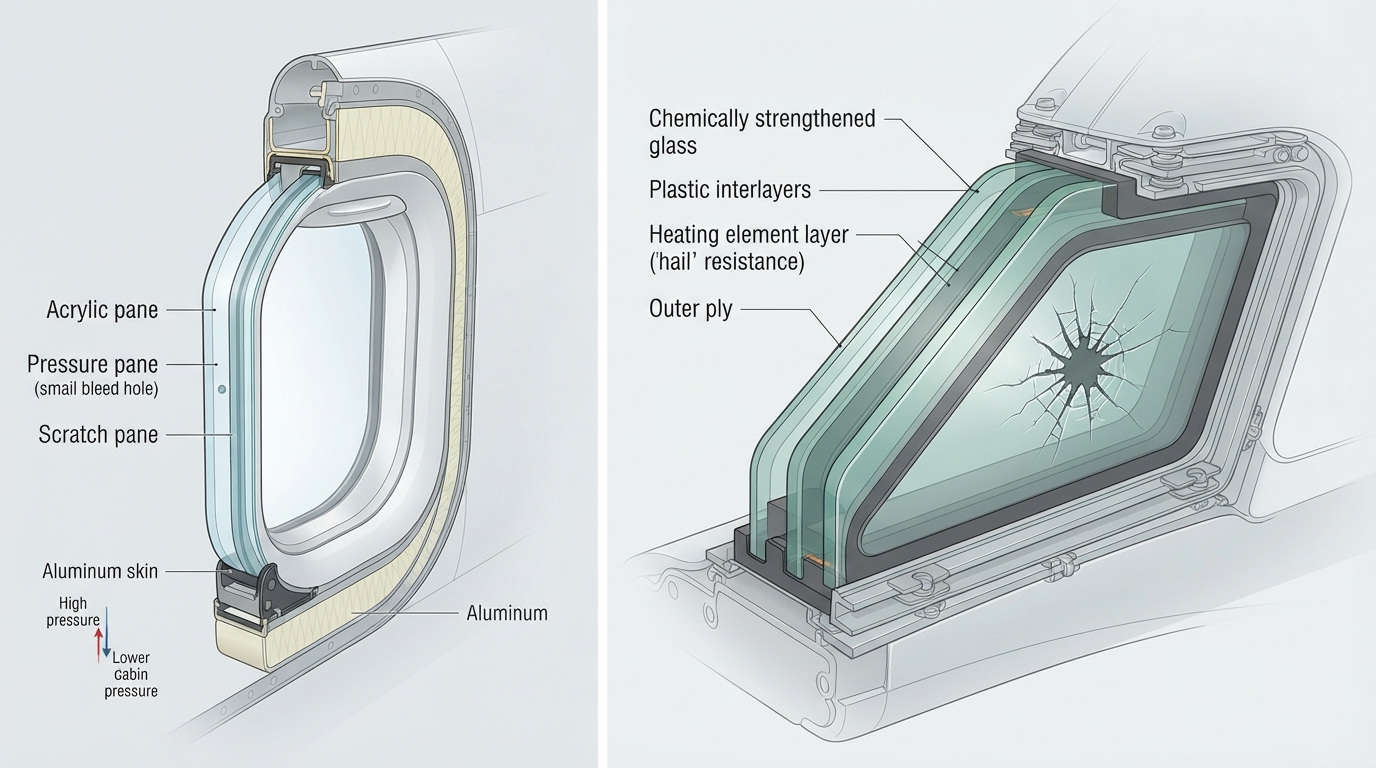
The oval cabin windows beside passengers’ seats are usually made from plastic-based materials, Vermont says. “You start from a sheet of acrylic,” he explains. “Then you cut to size, [to] give the shape.”
A Saint-Gobain spokesman confirmed to the BBC that the company does not store or process MMA like GKN, but instead buys sheets of polymerised MMA, or acrylic.
Aircraft manufacturers are increasingly ordering larger cabin windows, Vermont says, so passengers can enjoy a broader view outside. It is a selling point, but it also requires extra testing to determine whether the larger windows are as durable as the smaller ones.
Saint-Gobain tests its windows by subjecting them to pressures many times greater than those normally experienced by an aircraft flying at altitude.
These acrylic cabin windows are generally made from two layers, or plies, and Saint-Gobain also carries out tests to verify that the window will still survive if one of those plies is damaged.
Cockpit windows, Vermont says, are “totally different”.
They are usually made of glass that is chemically strengthened by adding potassium. This means replacing smaller sodium ions with larger potassium ions, which helps fill out the glass’s molecular structure and causes it, as it cools during production, to compress into an extra-strong, tightly formed material.
Some of the newest aircraft have cockpit windows that are also curved, helping the plane become more streamlined and improving fuel efficiency. But curved cockpit windows are difficult to manufacture — even the slightest distortion or flaw is plainly visible to the pilot.
Quality control checks are used to make sure no such defects remain in the finished product.
All aircraft windows must withstand impacts, but cockpit windows at the front of the plane are especially exposed to bird strikes, Vermont says: “The issue is not the speed of the bird, the issue is the speed of the aircraft.”
Saint-Gobain uses numerical simulations and “physical tests representative of a sizeable bird impact” to evaluate its windows against this hazard.
“Typically, if you go through a hailstorm or if you hit a large enough bird, the external ply will crack,” says Vermont. “The cockpit window is designed for that.”
Although a mid-air emergency was declared, the aircraft landed safely. “There can be [such] cases,” says Vermont, though he adds that Saint-Gobain’s windows have not been involved in any recently.
“You’re obviously dealing with a surface that is interfacing with two very different environments,” says Stengel. “That’s why these are more highly-engineered products.”