

The era of militant amateurs
Experts call the present time the era of militant amateurs who have seized the levers of control. It seems they are right
**The Era of Militant Amateurs**
There are topics that the authorities are capable of ignoring for years. One can overlook the rising cost of living, people's irritation over yet another tariff hike, conversations in queues, taxis, social networks, and kitchens, convincing oneself that as long as the discontent has not shaped into an official political grievance, it virtually does not exist. But a moment comes when seemingly scattered, unrelated decisions piece together into one quite clear picture. Experts call the current era the time of militant amateurs who have gained access to the levers of power. It seems they are right.
It is difficult to find a more accurate emotional reaction to yet another government initiative, which is formally termed an economic reform, an improvement of the accounting system, or a transition to market principles, but is essentially perceived by the population as another attempt to shift the consequences of inefficient management onto them.
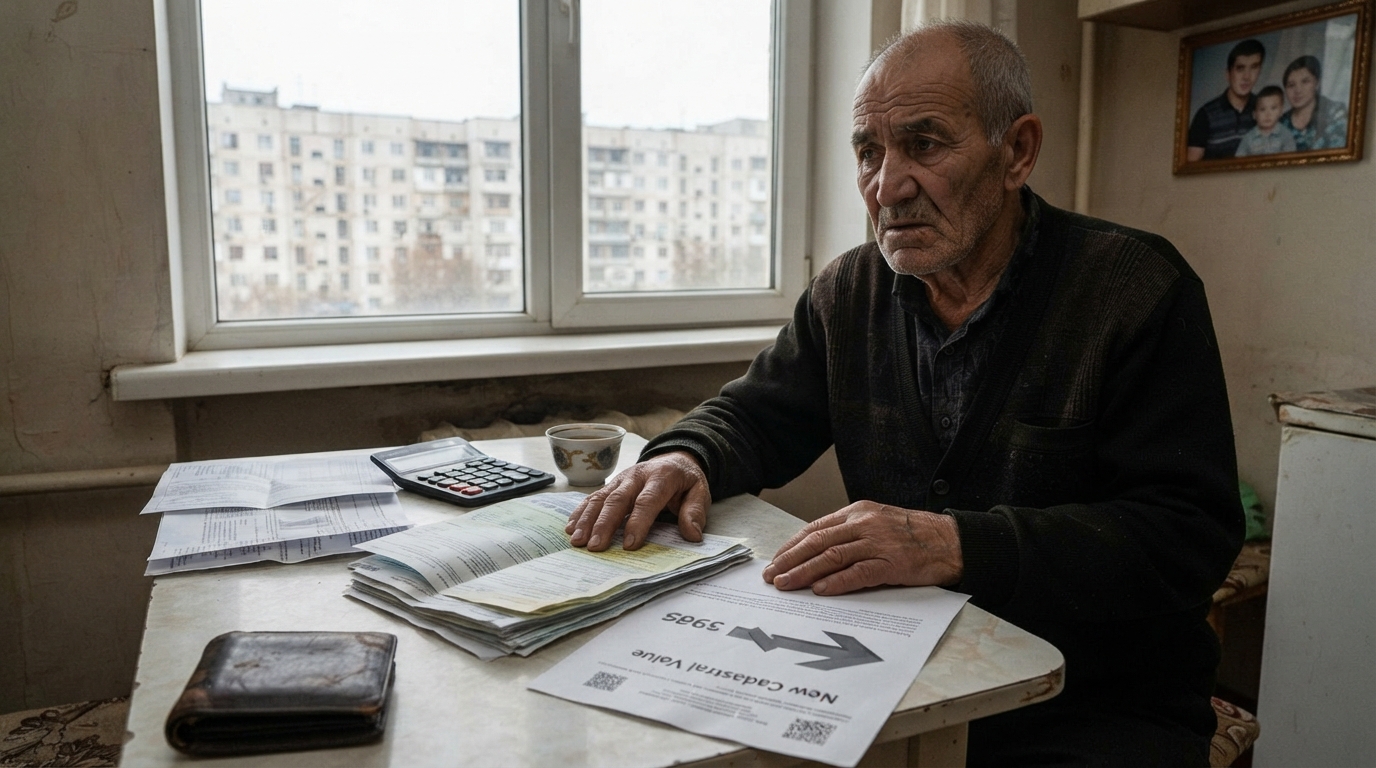
Now it is about real estate. The state has decided to reassess citizens' houses and apartments, and the results of this campaign turned out to be so striking that even the Uzbek man in the street, accustomed to sharp figures, was forced to ponder.
In Tashkent, more than 600,000 apartments received a combined estimated value of about 426.7 trillion soums (≈ $36.12 billion) against approximately 57.7 trillion (≈ $4.88 billion) of the current cadastral value, which is almost 7.4 times more. With private households, the gap turned out to be even more noticeable: their new estimated value is about 587 trillion soums (≈ $49.79 billion) against approximately 39 trillion (≈ $3.31 billion) under the former cadastral system, representing an increase of about 15 times.
The overall arithmetic looks particularly telling. If you add up apartments and private houses, it comes to about 1.014 quadrillion soums (≈ $85.84 billion) of the new estimated value against approximately 96.7 trillion (≈ $8.20 billion) of the former cadastral value. In other words, the value of the two largest categories of residential real estate in the capital, as assessed by the state, has increased by about 10.5 times.
No one knows exactly what criteria officials used to reassess the housing. And after this, the authorities suggest that citizens calmly believe that this is merely a technical adjustment of property values and has nothing to do with an increase in the tax burden.
This is precisely where the main question arises: why did the state need to so drastically change the valuation of the property of millions of citizens if the new figure is not supposed to have significant financial significance? Representatives of the Institute for Fiscal Studies argue that the increase in real estate value does not mean an automatic rise in the tax burden and that instructions have been given not to increase it. For now, according to them, a new database of values is being formed, after which tax rates will be discussed.
But the words "for now" sound much louder here than all other explanations. After all, a tax is not an abstraction, but a concrete system that has a tax base and a rate. If the base increases several times over, the state gains completely different opportunities for generating tax revenues. And if it is simultaneously officially declared that the new valuation system will eventually be extended to the entire country and used to improve taxation, citizens naturally ask: why should they believe assurances about today when it comes to a system designed for years to come? According to Presidential Decree No. UP-43 of March 5, 2025, the mass valuation is to cover more than 9 million residential and non-residential premises and about 8 million land plots, and in the future, it is expected to be conducted regularly — once every three, five, or seven years.
Therefore, attempts to convince the population through state-controlled propaganda outlets that the new valuation is allegedly not linked to taxes look more like a smokescreen than a full-fledged answer to the question posed. Even if the tax rate does not change today, the new value has already formed a completely different base, which means it has created a fundamentally different mechanism for future decisions.
One cannot simultaneously claim that the new valuation is needed to form an objective economic value of property, for fair taxation, and for the further improvement of the tax system, and then with the same zeal convince people that there is no tax prospect here at all. Citizens have the right not only to hear that nothing is being taken from them today, but also to know what will happen to the new valuation tomorrow. Especially since the current anxiety of the population did not arise out of nowhere.
Over the past nine years, citizens of Uzbekistan have already grown accustomed to the fact that practically every subsequent "improvement" of the system ultimately turns into additional expenses for the family budget. Utility tariffs are regularly increased under quite rational explanations: the need to transition to market relations, reduction of budget subsidies, modernization of infrastructure, and ensuring the financial sustainability of the energy sector. But for a person who receives an electricity or gas bill, all these explanations are of secondary importance: they have to pay more.
As a reminder, in 2024-2026, tariff policy continued this trend. For electricity, a system of social norms was introduced, under which consumption exceeding the established volume is paid at higher tariffs, and from June 1, 2026, another indexation increased the cost of electricity and gas by about 10%. For residential electricity consumers, the tariff within 200 kWh is set at 650 soums per kilowatt-hour, from 201 to 500 kWh — 900 soums, and from 501 to 1000 kWh — 1100 soums. Gas for the population within the social norm costs 1100 soums per cubic meter.
And this is not a one-off measure. The tariff regulation system itself contains a mechanism for further indexation, which means the population is actually being asked to get used to a constant increase in spending on basic utility resources. Formally, each individual increase may be relatively small, but for a family, it is not the individual percentage that matters, but the total sum of all mandatory expenses.
The same is happening with services. According to the National Statistics Committee, the cost of services in the country continued to rise in 2025, and in 2026, price increases are also recorded for a number of socially significant services. Banking operations, money transfers, educational services, private kindergartens, and many other items are becoming more expensive. As a result, a citizen faces not a single reform, but a constant rise in the cost of everyday life itself.
This is precisely why people do not perceive the new apartment value imposed by the authorities in isolation. They look at it through the prism of already accumulated experience. A person receives a new utility bill and remembers the previous one. They learn about a new tariff and remember the old one. They log into their MyGov personal account, see that the apartment they own is suddenly valued several times higher, and quite naturally begin to think about what this will turn into tomorrow.
This is the main problem of the current situation. The state can explain as much as it wants that the new value is not the sale price and not the tax amount, but for the citizen, something else is of fundamental importance: why did their property, bought with their own earned money and not bringing them a single penny of additional income, suddenly end up in the state database 7, 10, or 15 times more expensive?
Has the person become 7 times richer? Has their salary grown 7 times? Has their pension increased 15 times? Has their apartment started to bring in a corresponding income? Of course not. Only the figure that the state entered into its registry has changed. But if this figure subsequently becomes the basis for tax calculations, the paper increase in value will inevitably turn into real expenses.
This looks particularly unfair to elderly people and low-income families. For a pensioner, an apartment worth several billion soums does not mean having several billion in spare cash. This is their only housing. Selling it to pay a tax is impossible without actually losing their place of residence. Thus, the state risks creating a situation where a citizen will be considered rich simply because the state highly valued the house they own, even though this person has no more real money.
Based on this, the conversation about the new real estate value inevitably turns into a conversation about the quality of public administration. If the former cadastral system indeed diverged so greatly from market value, a natural question arises: who created it, who used its data for years, and why should the citizen now bear the financial consequences of the imperfection of the state accounting system? The state itself formed the cadastral rules, determined the coefficients, and built the tax system. If the former model proved ineffective, why should the correction of this mistake occur at the expense of the owner?
This is exactly how the population increasingly perceives the policy of state "robbery" under any pretext. The assessment is, of course, harsh, and officials will certainly deem it unfair. But the problem is not the emotionality of the definition, but the accumulated feeling among citizens that the state too easily finds grounds to increase their expenses and too rarely shows the same determination when it comes to cutting its own costs.
Citizens are told of the need to save electricity, water, and gas, to pay taxes, to pay for public services on time, and to accept tariff increases. But where are the equally strict requirements for savings within the state apparatus? Where is the annual public report on how much the state has saved on inefficient expenditures? Where is the independent evaluation of the effectiveness of major state projects? Where is the personal responsibility of officials for failed decisions that result in multi-billion losses?
These are the very questions that must be asked simultaneously with the question about the new value of apartments.
One cannot demand that a citizen live within their means if the state itself does not demonstrate the same financial discipline. One cannot explain another increase in the tax base by the need to replenish the budget without showing society how effectively the already collected funds are being used. One cannot constantly raise tariffs if the quality of services by no means always corresponds to their cost. Finally, one cannot endlessly view citizens' property as a source of additional income without simultaneously auditing one's own expenses.
Because the citizen pays for everything at once. This is precisely why public irritation arises not from one specific decision, but from their accumulation.
The growth of citizens' appeals on issues of the fuel and energy complex is telling enough. In the first half of 2026 alone, 39,220 such appeals were addressed to the president. Even if this is 26.1% less than a year earlier, the figure itself shows how sensitive the topic of the cost and quality of energy services remains for the population.
Even more telling is a Central Bank survey, according to which in May 2026, 59% of respondents named the rise in utility tariffs as the main threat to future price stability. This was the highest figure in 14 months. Against this background, the new real estate valuation looks like a particularly unfortunate decision, as it touches upon the last thing most families consider their economic protection — their own housing. But for now, the population is simply being asked to take the officials' word for it.
The last nine years have formed a feeling among a significant part of the population that the state too often tries to solve its own financial and managerial problems at the expense of citizens. If a citizen is in debt, they are reminded of their responsibility. If the state system allows for inefficient spending, the public is offered another reform.
People are ready to pay taxes and accept reasonable restrictions if they see that the state works effectively and fairly. But when a person begins to feel that an increasingly large part of their income is regularly being taken away, and in return they are offered new explanations, patience inevitably comes to an end. As does the era of militant amateurs.
However, the latter is hardly possible: no others are visible on the horizon.