

The critical tech staying safe by going underground
The war in Ukraine has spurred people to consider putting vital infrastructure underground.
**Critical Technology Seeks Safety Underground**
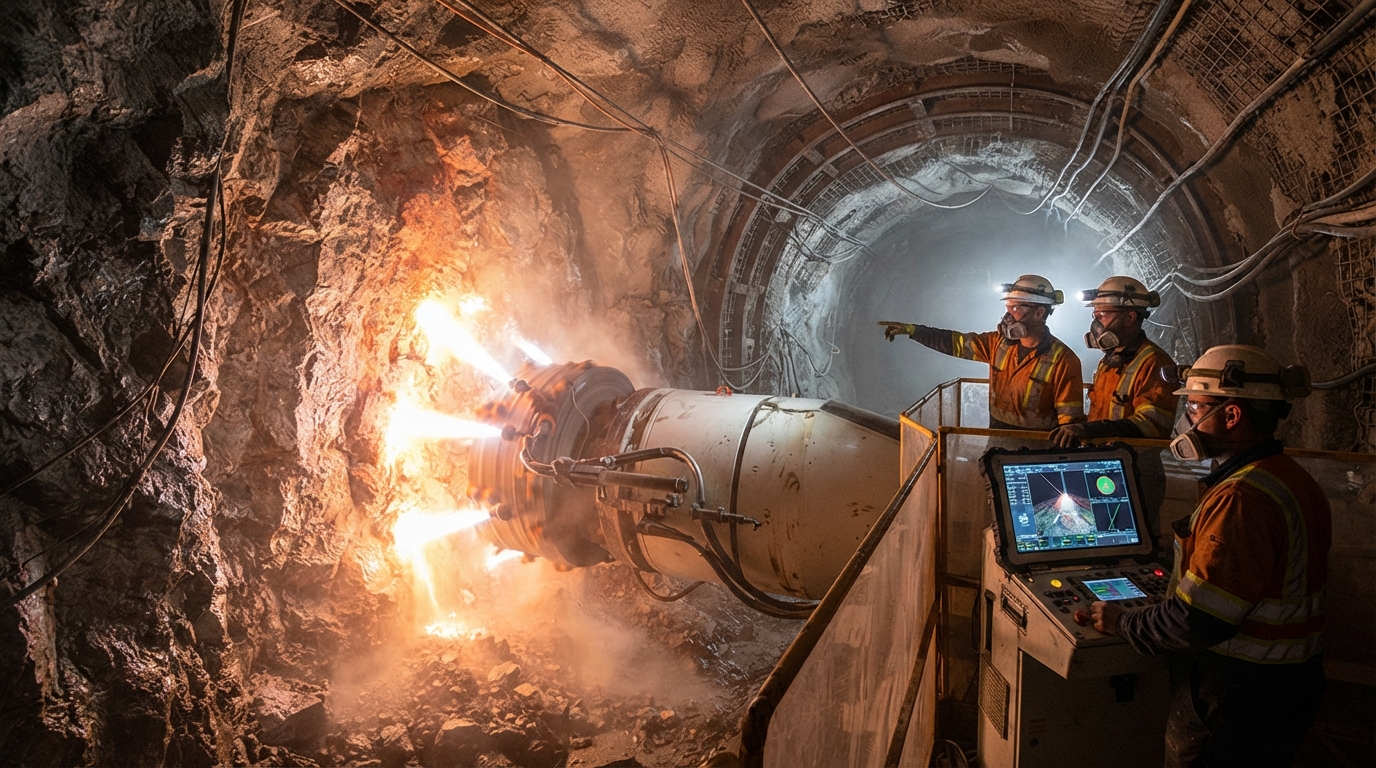
The Earthgrid machine, operating at extreme temperatures "like lighting a rocket," is revolutionizing tunnel boring.
In a California quarry, a small team of engineers faced a towering wall of white granite, an ancient and incredibly hard material considered impermeable to most forces. Then, the rock-melting tunnel-boring machine (TBR) roared to life.
Troy Helming, founder and chief executive of EarthGrid, likened the initial ignition of the machine's three plasma torches to "igniting a rocket" due to the loud process. These torches, housed within a spinning head, quickly quieted as they generated a super-heated plasma stream reaching 27,000C – a temperature significantly hotter than the Sun's surface.
During a January test in California, EarthGrid's cigar-shaped boring machine successfully drilled through three meters of granite. Helming explained, "We create, basically, a tornado – a violent vortex inside the tunnel," which helps the machine remove debris, sometimes in the form of lava. The entrepreneur admitted to getting "a little bit emotional watching it," having anticipated this moment for a decade.
Emerging technologies like this could streamline tunnel boring, making it faster and easier. Placing critical infrastructure such as electricity or telecommunications cables, substations, and data centers underground offers enhanced security but has historically been a costly and challenging endeavor.
Engineering firms have reported to BBC News a growing demand for undergrounding, partly influenced by Russia's war with Ukraine, which has highlighted the vulnerability of above-ground facilities to drone attacks. Helming noted interest from companies seeking to utilize his tunnel boring machine for power and fiber optic cables, as well as pipelines for transporting water, natural gas, or ammonia. One potential project involves boring tunnels for an underground freight-distribution system near airports and warehouses, aiming "to take more trucks off the road," Helming stated.
The January TBR test was successful, though the machine "over-bored" slightly to the top and left of the tunnel, according to Helming. His team plans to adjust the machine to create a vortex that alternates spin directions every five minutes to correct this, with hopes for commercial deployment as early as next year.
**Humans have long buried items for protection.** Safely and cost-effectively burying modern infrastructure remains difficult, but it's an increasingly viable option, even in remote areas.
Alexander RE Taylor, a senior lecturer in communications at the University of Exeter, observed that "brutal materiality is still important." He identified a "data bunker boom," where data centers are increasingly being moved underground.
Earlier this year, a data center was completed in the Dolomite Mountains of Italy. Freshly excavated caverns 100 meters underground are situated alongside storage areas previously used for sparkling wine, apples, and cheese. Trentino DataMine's naturally cool environment reduces the cost and energy consumption required to cool servers. Chief executive Dennis Bonn emphasized, "Ninety million cubic meters of dolomite rock provide natural protection against physical intrusion, electromagnetic interference, seismic events and hydrogeological risks - levels of protection that simply cannot be replicated above ground." Trentino DataMine asserts its facility offers "security designed by nature."
Elsewhere, some technology is being embedded in the seabed. Subsea internet cables, which can span thousands of kilometers beneath oceans, are occasionally damaged by ship anchors. Lane Burdette, a senior analyst at TeleGeography, a telecoms market research firm, explained that evidence suggests as burying part or all of these cables has become more common, faults per kilometer of deployed cable have become rarer. "Submarine cables are increasingly being buried up to three meters deep," she said. "In some fault-prone areas, they are buried along their entire lengths."
Taylor highlighted various examples demonstrating the effectiveness of keeping things underground or deep within caves as a defensive strategy. He noted that "The tunnels that Al-Qaeda were using were a major strategic problem for the US [during the war in Afghanistan]." More recently, Iran's notoriously difficult-to-bust underground nuclear facilities have garnered significant attention.
Robbie McGoran, head of work winning and business development at Joseph Gallagher, a civil engineering and tunneling firm, confirmed that the war in Ukraine and other geopolitical events have "definitely had an impact" on demand for undergrounding in certain regions. Countries bordering Russia are increasingly inquiring about undergrounding. "They're very cautious about who they'll even let do their work – and also burying [infrastructure] and making sure it's well protected. We are noticing that," he added.
McGoran also mentioned that advancements in technologies like laser-guidance systems and gyroscopes have improved tunneling accuracy in recent years. However, significant challenges persist, including the release of potentially dangerous gases from the ground and occasional flooding. Dramatic innovations in tunnel boring equipment, which significantly increase the rate at which tunnels can be excavated, are infrequent. "We usually measure [progress] in millimeters per minute," McGoran stated.
In the UK, a noticeable shift towards placing critical infrastructure underground has not yet occurred, according to Mark Neller, energy leader for Europe, India, Middle East and Africa at engineering consultants Arup. However, in some instances, tunnels are clearly essential. Neller and his colleagues worked on the £1bn London Power Tunnels project, which involved constructing 18 miles (29km) of tunnels beneath London to house large electricity cables. This was an ideal solution for such a densely populated urban area, but because tunneling can be several times more expensive than above-ground cable infrastructure, Neller suggested that elsewhere, simply installing additional circuits can provide sufficient resilience. "That's actually a much more cost-effective way," he said, adding, "The electricity system [in Great Britain] is designed with quite a lot of redundancy built into it."
Richard Little, an infrastructure policy consultant and editor of the Journal of Critical Infrastructure Policy, recalled the latter days of the Cold War, when the threat of all-out nuclear war made bunker-building a frequent topic of discussion in the West. To this day, Switzerland mandates that every citizen must have access to a nuclear bunker, with many apartment buildings in the country featuring such facilities in their basements. "A lot of it was real Dr Strangelove stuff," Little said, referring to discussions around bunker-building during President Ronald Reagan's administration. "The world's going to end but I guess we'll maybe harbour a few hundred critical people down here and they'll survive."
Little, who authored policy documents regarding underground critical infrastructure during the 1990s, added, "It became obvious rather quickly that you can't put everything underground." Today, it might be more practical to identify specific facilities that would be difficult to restart or replace if attacked as candidates for undergrounding. "The first thing that occurred to me was [computer] chip manufacturing," Little offered as an example. "Underground facilities, I'm sure in certain instances, would make a great deal of sense – but it's all about what's critical."