

The country where diploma holders earn more than three times as much has been revealed
Higher-educated employees earn more than those with secondary education in many countries. However, this difference is not the same everywhere. While the average income of higher-educated individuals in the Republic of South Africa is 205.8 percent higher, the advantage in Norway stands at 17 percent.
The country where degree holders earn more than three times as much has been revealed
Higher education is often associated with better jobs and higher salaries. International data also generally confirms this connection. However, the income advantage of degree-holding employees varies significantly depending on the country.
The comparison includes employees aged 25–64 in 38 countries who worked full-time throughout the year. The category of people with higher education includes individuals holding bachelor's, master's, and doctoral degrees. In the OECD classification, short-cycle tertiary education programs are also included in this category.
Across the 35 OECD countries with available data, employees with higher education earn an average of 54 percent more than those with full secondary education.
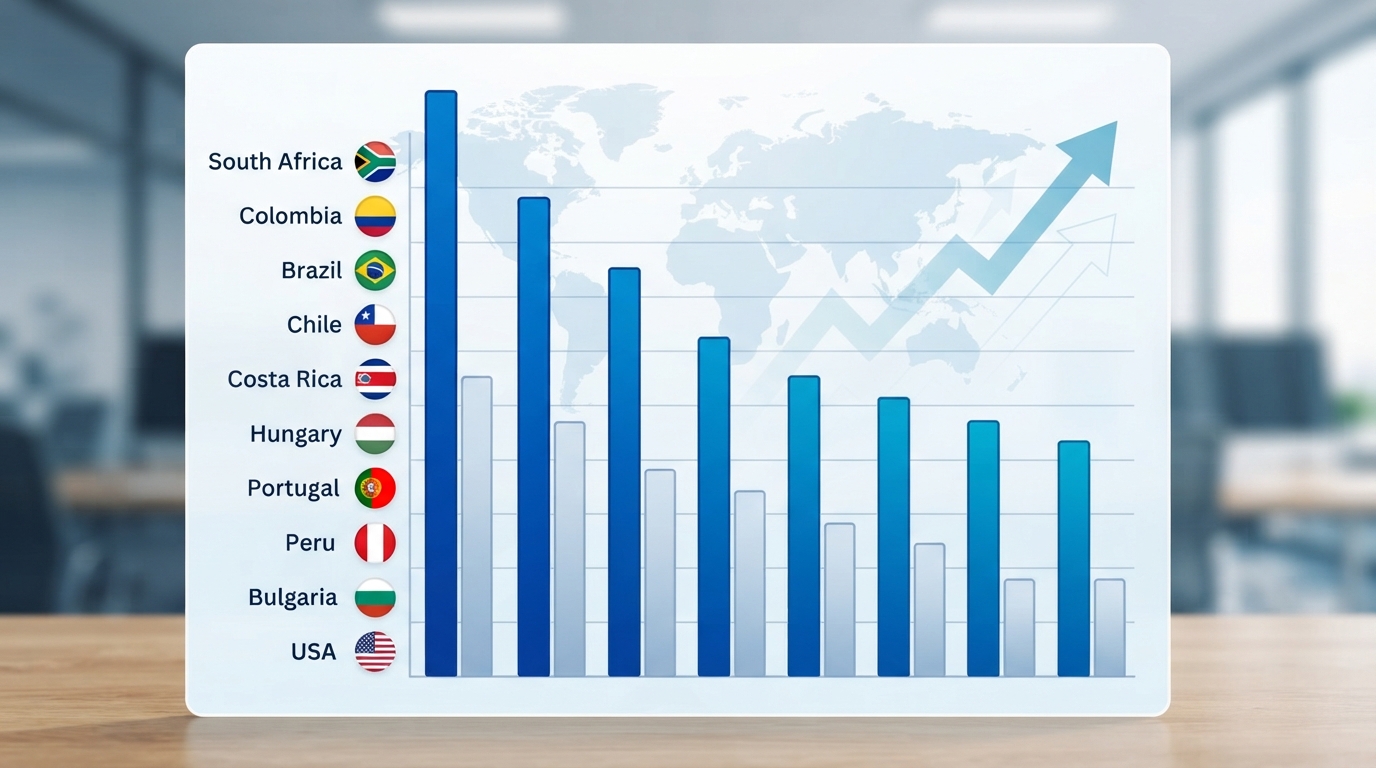
Among the countries in the infographic, the largest gap was recorded in the Republic of South Africa. Here, the average salary of employees with higher education is 205.8 percent higher than that of the comparison group.
This figure of 205.8 percent means that the salary is not double, but almost 3.06 times as much. That is, a result more than three times higher compared to the income of those with secondary education is observed.
In Colombia, Brazil, and Chile as well, the average income of those with higher education is more than double that of those with secondary education. The difference in a number of countries presented in the infographic is as follows:
Colombia - 149.8 percent;
Brazil - 137.6 percent;
Chile - 106.4 percent;
Costa Rica - 93.2 percent;
Hungary - 76.4 percent;
Portugal - 75.4 percent;
Peru - 75 percent;
Bulgaria - 74.01 percent;
USA - 69.8 percent.
Thus, in the USA, employees with higher education earn almost 70 percent more than those with secondary education. In Costa Rica, this difference approaches double.