

The Cotton Plan, hard work, and changed destinies: how did independence change the lives of Uzbek women?
It is not easy to forget the painful traces of history.
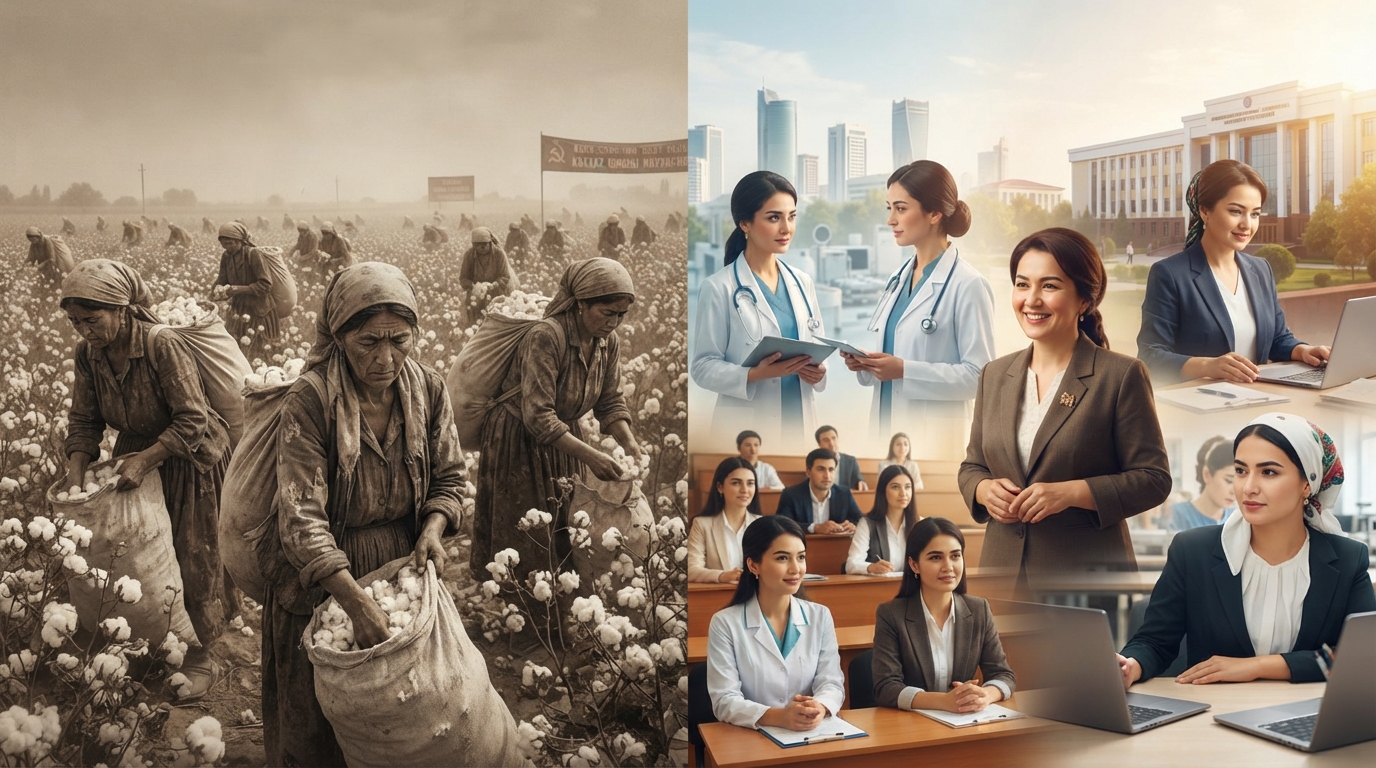
The Cotton Plan, Hard Work, and Changed Fates: How Did Independence Change the Life of an Uzbek Woman?
The value of independence is best understood by those who experienced the difficult days of the former regime. It is not easy to forget the painful traces of history imprinted in human memory. But as the pages of a new era opened, hope awoke in hearts. The new opportunities created began to encourage people to strive for a prosperous life and high goals.
**All roads led to the cotton field...**
During the former Soviet Union, the position of a rural woman was determined by the status of a “collective farm worker.” In those years, all roads led to a single point for them - the cotton field. Since the “plan” was in the first place in state policy, the potential of women was assessed not by their internal capabilities, but by the number of quintals harvested, the fulfillment of daily plans and norms.
Thus, the dreams of thousands of women were extinguished in the whirlwind of the "white siege" in the cotton fields. This sad scene was not limited to the fields. Even at home, women were considered the only task of earning a living and raising children, and views such as "a girl's place is at home" and "someone's enemy" were paramount. Such deeply rooted stereotypes blocked the path of personal development for many women, and their abilities and dreams were overshadowed by everyday worries. After all, any potential, if not opened up in time, can remain dormant, undeveloped, and unproductive like "barren land."
Of course, this reality may not be fully imagined by the generation that is growing up today in prosperous conditions, receiving modern education, and growing up in prosperity. However, representatives of the generation that toiled in the cotton fields and grew up in the fields know this truth well.
At that time, there were many obstacles to a woman's work, study, and self-development. Just one example is that due to the lack of preschool educational institutions, the main burden of raising children fell on mothers. Since 2017, a consistent solution has begun to be found to this problem. The preschool education system has been radically reformed, and funding for the sector has been sharply increased. Over the past eight years, funds allocated to preschool and school education have increased 7 times, and 1.5 million new places have been created. Today, more than 7,000 state and more than 31,000 private kindergartens operate in the country. Behind these numbers are not only children, but also new opportunities for thousands of mothers. Giving a woman the opportunity to get an education means holding in her hands not only a diploma, but also the key to changing her destiny. The introduction of distance learning and other flexible forms of education has turned the choice of “either family or education” into an opportunity for women with many children: “both family and education.”
**If girls study, the future will change**
In subsequent years, opportunities such as interest-free educational loans for women, grants for needy girls, and state reimbursement of the costs of studying at the master’s level were created. As a result, today, 53 percent of students studying in higher education are women. In master’s degrees, their share has reached 60 percent. After all, an educated woman is not just a specialist. She is a huge force that influences family upbringing, child development, and the spirituality of society.
Today, women make up 75 percent in the medical field, 71 percent in education, 47 percent in economics and industry, and 43 percent in agriculture. A woman who yesterday measured her fate in a cotton field with the "norm" is today contributing to the development of society as a doctor, teacher, entrepreneur, scientist, and leader. This change is not accidental. This is the result of the path opened to women's potential.
**The "Uzbek model" that opened women's potential**
Within the framework of the "Uzbekistan-2030" strategy, large-scale work is being carried out aimed at increasing the political, social, and economic activity of women, ensuring their rights and interests, and protecting motherhood and childhood. In recent years, about 100 regulatory and legal documents have been adopted to support women. Measures such as preferential loans, subsidies, grants, vocational training, and support for entrepreneurship are strengthening women's economic independence.
Of course, the true value of each reform is reflected in real life examples, in the fate of people, and, moreover, in the mirror of history. Undoubtedly, this is a long-awaited social renewal, an expression of the upsurge and awakening taking place in society as a whole. Indeed, the woman who yesterday was a symbol of patience, remaining in the "white siege" or "sitting at home" has today become a gem that is showing its potential in the process of reforms, and is increasingly becoming more and more polished.
Today's woman is not a optimist - she is a giver of hope. She is the active force of independent Uzbekistan, the support of the development of the family and society, the owner of great potential that will educate the future of an entire nation.