

The closest people to Uzbeks: what similarities do we have with the Uyghurs?
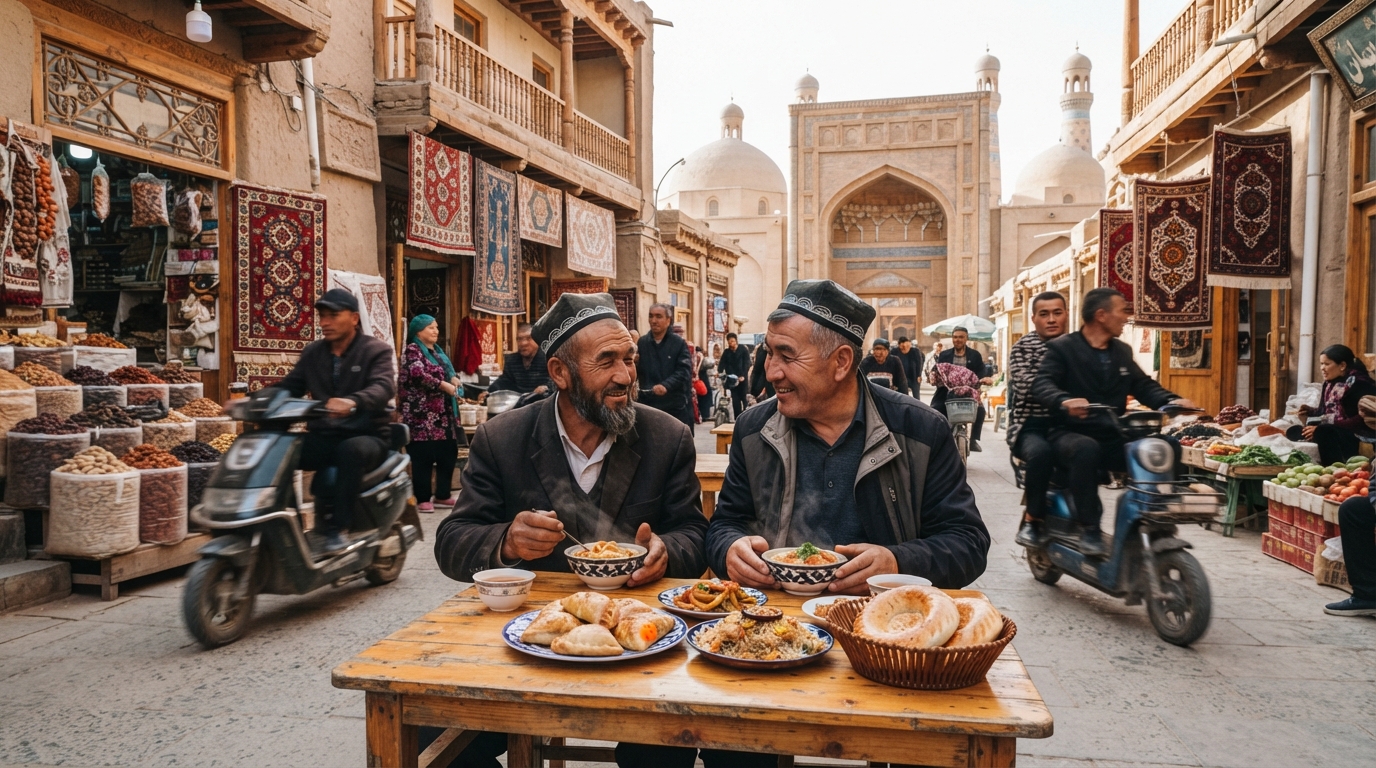
**Uzbeks and Uyghurs: Common Roots and Today's Lifestyle**
There is a people in the world who are very similar to Uzbeks in terms of appearance, language, food and customs, and they are the Uyghurs. The "Daryo" correspondent visited the Xinjiang Uyghur Autonomous Region of China and got to know the current life of the Uyghurs closely.
**Trip Details and Geographical Features of Xinjiang**
The trip was organized by the Chinese Embassy in Uzbekistan. A group of Uzbek journalists, diplomats and community activists visited the cities of Urumqi and Kashgar. Xinjiang's territory is 1.66 million square kilometers, almost four times larger than Uzbekistan. Its population is more than 26 million 360 thousand, 61% of whom live in cities.
**Similarities and Differences in Language and Writing**
The first thing that catches the eye in Xinjiang is the Uyghur language. Like the Uzbeks, the Uyghurs are a Turkic people, and their historical roots are the same. Therefore, you can easily communicate with them in Uzbek. With the exception of some words, the two peoples can understand each other. However, their writing is different - the Uyghurs use the Arabic alphabet. The Uzbeks also used the Arabic alphabet for many years in history, but over the past 100 years they have experienced the transition to Latin, Cyrillic, and then back to Latin.
The participants of the trip talked to the Uyghur driver Abdukayum. According to him, the income of drivers working eight hours a day in Urumqi is 5-6 thousand yuan (up to 10.6 million soums), which is easily enough to cover their monthly expenses.
**Commonality in Religion and Culture**
A second important similarity is that the Uyghurs, like most Uzbeks, are Muslims. It was noted that there are many mosques in Xinjiang. For example, in Kashgar province alone, there are about a thousand large and small mosques. The delegation visited the Eidgah Mosque, the largest Muslim prayer house in China, built in 1442 and preserved for almost 600 years. The mosque is still in operation.
**Kashgar: Historical City and Economic Life**
The next destination was the city of Kashgar, which has a two-thousand-year history. The narrow streets, mud walls and ancient markets here create a unique atmosphere. Today, 5.75 million people live in Kashgar province, of whom 82.4 percent are Uyghurs. 60 percent of the population is engaged in agriculture, the rest work in industry and services. The city of Kashgar itself is home to 1.5 million people. The distance from Urumqi to Kashgar is 1.5 thousand kilometers. From Kashgar to Andijan is 550 kilometers, and from Tashkent to Tashkent is 800 kilometers.
Master Abdullajon, who has been engaged in blacksmithing for 20 years, talked about his profession. He mainly makes cauldrons, kapkirs, ladles and other household items. Blacksmithing is his main profession, and he works six hours a day.
**Uyghur Cuisine: Similarities with Uzbek Cuisine**
During the trip, eating in Uyghur cafes and restaurants showed that Uyghur cuisine is very similar to Uzbek cuisine. Among their national dishes, dishes such as lagman, pilaf, manti, samsa, gijda bread and chapon occupy a special place.
Askar Mamajonov, a representative of the Ministry of Foreign Affairs, said about the similarities and differences between Uzbek and Uyghur cuisine: "Their bread is similar to the bread baked in Jizzakh. Lagman is also a bit spicy, just like ours. Their kebabs are very similar, and their somsa is like our Olot somsa. Only the dough is a little thicker. While we make Olot somsa on the stove, they bake it in a tandoor. Their watermelons and melons are like ours. Uyghur soup is closer to Khorezm soup. In general, Uyghurs are a people in cooking."
**Markets and Online Shopping**
The delegation visited several markets in Xinjiang. Here, like in the markets of Uzbekistan, you can bargain and buy at lower prices. The "Daryo" correspondent talked to some traders. They noted that due to increased competition and the rapid development of online shopping, sales in the markets have slowed down and income has decreased.
In Xinjiang, the fact that food can be ordered online in 20 minutes, and medicine or clothes in half an hour, is a sign of very fast service. This development has a significant impact on the traditional market, as many people prefer to order from home rather than spend time going to the market. In Uzbekistan, goods ordered online are not delivered so quickly.
**Family Traditions and the Neighborhood System**
Another interesting fact is that the Uyghurs are a large-child nation. Among the Uyghurs interviewed, the majority had up to five children. Uyghur weddings also have many similarities to Uzbek ones. For example, weddings are attended by 300 to 500 guests, and cottages are built, as in many parts of Uzbekistan.
Uyghurs also have a large number of horses, as in some regions of Uzbekistan. The delegation visited the equestrian complex, where they watched horse racing, archery and other equestrian events. They also visited several national and historical museums of the Uyghurs. The carpets hanging on the walls of the museum are similar to those woven by the Uzbeks.
Interestingly, the Uyghurs also have a mahalla system. The delegation visited the "Yashnan" mahalla point near the international market in Urumqi. 4,214 people, representatives of 14 nationalities, live here. Due to the presence of a market in the area, the proportion of the population engaged in trade is higher. Various crafts and sports clubs have been established in the mahalla center for young and old.
Shahboz Rakhimov, an employee of the Association of Neighborhoods of Uzbekistan, said that he was surprised by the similarities between the Uyghurs and the Uzbeks: "Their holidays and events are very similar to ours. For example, during the Navruz holiday, everyone brings things from their homes and gathers in one place, and there is a parade. Their national traditions and values also have many aspects that attract us. They have various cultural circles. We also have them. But we mainly cover young people. Here, more pensioners are involved in the circles. Problems in the neighborhood are written on the boards here. Looking at the board, you can get answers to questions such as who will solve the problem, when, and what the current process is. We can also take these aspects."
**Transport and Greenery**
Unlike in Uzbekistan, there are a lot of scooters in Xinjiang, and they are mainly driven by women. At every step, you can meet motorcycles, scooters or bicycles. On the streets, special roads have been made for them. These are not ordinary small roads, but tens of kilometers wide roads that can accommodate an entire car.
Good attention is also paid to greenery on the streets. As in other cities in China, in Urumqi, plants or short junipers are planted not only on the edges of the roads, but also in the middle. Such greenery stretches for hundreds of kilometers across China.
The delegation visited several streets of Xinjiang, shops, markets, cafes and restaurants. They spoke with many Uyghurs. Most of the Uyghurs said that they knew about Uzbekistan or Uzbeks. Some said that they had been to Tashkent, Samarkand, Bukhara or Khorezm. Some also said that they dreamed of visiting Uzbekistan.