

China's Western Gateway: What Does Xinjiang Uyghur Autonomous Region Look Like Today?
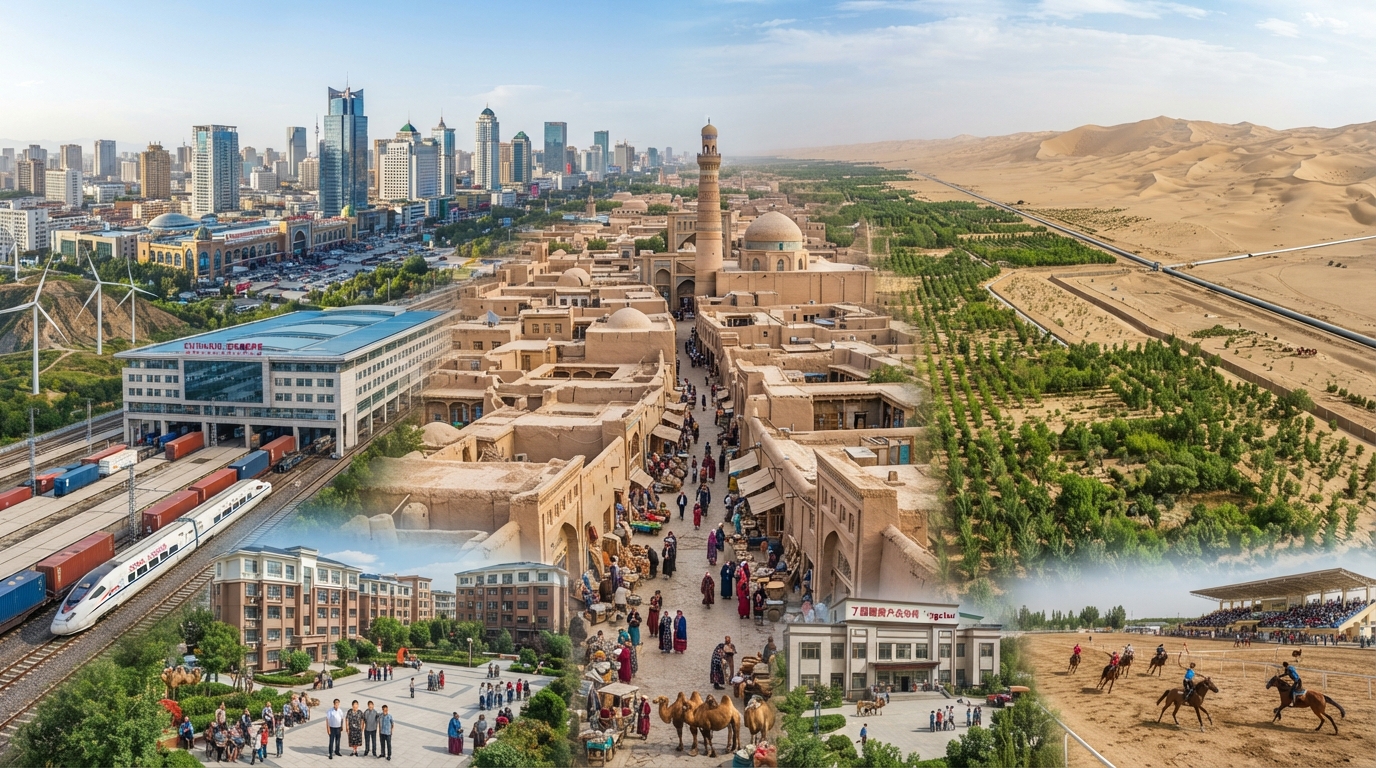
**China's Western Gate: A Look at Xinjiang Uyghur Autonomous Region Today**
Xinjiang Uyghur Autonomous Region is the largest administrative region in China, covering an area of 1.66 million square kilometers and accounting for one-sixth of the country. In this region, the modern technology center Urumqi and the ancient city of Kashgar, which has preserved the spirit of the Great Silk Road, are located side by side.
On August 3-7 of this year, representatives of the Ministry of Foreign Affairs of Uzbekistan, the Association of Neighborhoods and a group of journalists, including a correspondent for "Daryo", got acquainted with the current situation in Xinjiang as part of a trip organized by the Chinese Embassy in Uzbekistan.
**Urumqi and Kashgar: The Crossroads of Modernity and History**
The delegation visited more than 15 sites in the cities of Urumqi and Kashgar. Among them were an international logistics center, a mahalla-type residential complex, museums, various enterprises and the Taklamakan Desert.
**Xinjiang Population and Economy**
A Chinese government representative told Daryo that at the beginning of 2026, Xinjiang's population exceeded 26.3 million people, of which 16.2 million people (61.6 percent) live in cities. In 2025, the region's gross regional product (GRP) amounted to 2.14 trillion yuan ($318 billion), an increase of 5.5 percent compared to the previous year. GRP per capita is 81.6 thousand yuan ($12 thousand). For comparison, last year, Uzbekistan's GDP reached $147 billion, with a per capita income of $3.8 thousand.
**Geographical Location and Logistics Center**
Xinjiang borders Mongolia, Russia, Kazakhstan, Kyrgyzstan, Tajikistan, Afghanistan, Pakistan and India, and has now become China's main land gateway to West and Central Asia.
**Urumqi International Land Port: To Tashkent in 72 Hours**
The first stop on the tour was Urumqi International Land Port. Covering an area of 67 square kilometers, the complex has received more than 30 billion yuan ($4.45 billion) in investment. It includes a railway port, a customs zone, a multimodal transportation center, an industrial park and an international textile and clothing center.
Since the launch of the China-Europe train service in 2011, 166,000 containers have been transported through the complex. Today, 61 percent of trains from China to Europe pass through Xinjiang, delivering cargo to 19 countries.
According to port officials, regular trains have been launched from Urumqi to Uzbekistan under the "Tianshan" brand. The train from Urumqi reaches Alashankou, Kazakhstan, via Almaty in 36 hours. The train, which departs every Friday and Saturday, covers the distance to Tashkent in 72 hours (3 days).
The "China-Kyrgyzstan-Uzbekistan" railway, which will be completed in the coming years, will further accelerate this logistics chain and reduce product delivery times by several times. A separate express center has been set up in the port area for large online stores such as Alibaba and Ozon, where small shipments are quickly packed using laser sorting and loaded directly from trucks onto trains.
**The “Smart Neighborhood” Experience in Xinjiang**
The delegation also visited the “Yanshan” residential complex in Urumqi, built in 2001. This complex is home to 4,214 residents from 14 ethnic groups, including Han, Uyghur, Kazakh and Hui.
The “One-Stop Shop” system has been introduced in the neighborhood, and services are provided quickly, as all processes are digitized. Pensions and social assistance are processed on site. There is a special board in the center of the neighborhood to write down problems. For example, when the owners of apartment 71 left a letter asking for an elevator to be upgraded, the neighborhood administration studied the problem and, based on a tender, replaced eight elevators with new ones.
A professional psychologist works in the neighborhood and helps resolve family conflicts. The complex has chess and card rooms for the elderly and children, a choir of Nuroniyil, and dance groups. Free summer camps are organized for children, and they are sent on trips to major cities such as Beijing and Shanghai. At the end of each month, a mass birthday party is held for all children born in that month.
As part of the “May Month — National Unity Month,” the “Baijia Yan” festival is held. During this time, representatives of different nationalities cook national dishes in their homes, take them out to the neighborhood square, and share them with everyone.
**50 Years of Pharmaceutical Giant and Equestrian Sports**
During the trip to Urumqi, the delegation also visited the Ingolan Pharmaceutical Factory, which has a history of over 50 years. This complex is not only a factory, but also a center for scientific research. The factory produces unique herbal medicines based on traditional Chinese medicine.
In addition, the delegation members visited the local equestrian complex and watched the skills of the riders. There, they demonstrated cross-country skiing, archery, and various horse shows, which are very similar to Uzbek national games. The complex's special museum dedicated to horses aroused great interest among the participants.
**Old and New Kashgar**
The second part of the trip continued in the ancient city of Kashgar, the historical heart of Xinjiang. The delegation members first visited the Etigar Mosque, one of the largest Islamic monuments in China. The prayer hall can accommodate up to 20,000 worshipers at a time.
The mosque was built in 1442 and has been expanded several times. Its area is 1.68 hectares (140 meters from north to south, 120 meters from east to west). The monument has the status of a national cultural monument and was renovated by the state in 1983, 1994 and 2011.
Chinese officials have previously stated that the population density in the old part of Kashgar is very high and there are a number of problems. For example, in the past, houses were built of mud and wood, which made them very vulnerable to earthquakes. It was noted that roofs can collapse during rain, fire engines cannot enter the narrow streets, and residents are forced to burn coal due to the lack of a heating system.
Taking these circumstances into account, the government is completely renovating the old city, while preserving its historical architecture. Engineering and utility networks (hot water, heating, sewage) are being laid.
In 2015, the old part of Kashgar was awarded the status of a national 5A-level tourist attraction. Currently, more than 20 million tourists visit the area annually. The city receives more than 20 billion yuan ($2.96 billion) in tourism revenue per year. The main flow of tourists comes from various regions of China.
**112-kilometer Water Pipeline and Taklamakan “Green Belt”**
The participants were impressed by an infrastructure project in Jiashi District, near Kashgar. A 112-kilometer water pipeline was laid from the Kezi River to provide quality drinking water to the district’s 460,000 residents.
The project cost 1.75 billion yuan ($259 million). Officials said that thanks to this major project, the drinking water problem that the people of Southern Xinjiang had been suffering for many years has been completely resolved.
The delegation also visited the border areas of the Taklamakan Desert, one of the largest deserts in the world. The desert covers an area of 337,000 square kilometers, which is slightly smaller than the area of Germany. This desert has long been described as “a place where birds fly and people walk, and where their feet burn.” In addition to being very hot in summer and very cold in winter, Taklamakan is also subject to sandstorms throughout the year. To prevent sand drift and protect nature, millions of trees have been planted in this desert, and a drip irrigation system has been installed.
During the trip, fruit growing, pottery, and mushroom processing complexes in Qarqar were also visited. Several museums were also visited. In particular, the visit to the equestrian complex left a great impression on the participants.
**Xinjiang: A Colorful World**
During the trip, Xinjiang witnessed dramatically different landscapes. While Urumqi is home to huge logistics centers and international train traffic, Kashgar is home to ancient streets, mosques, crafts, and local markets. On one side is the Taklamakan Desert, and on the other, desert greening projects.
While new residential complexes and digitalized social services are on display in one place, monuments with a history of hundreds of years are preserved in another. The scale of the projects being implemented in Xinjiang is huge. But this region cannot be judged only by new roads, factories or logistics centers. Because Xinjiang is a very complex territory economically, geographically, historically and culturally at the same time.
A trip to Xinjiang allowed us to see its current appearance - from ancient Kashgar to modern Urumqi - at close range, albeit in a few days.