

'The city is alive': A brief peace in Kherson, but residents fear what comes next
A temporary ceasefire has brought rare quiet to Kherson, offering its residents a glimpse of normal life before fighting resumes.
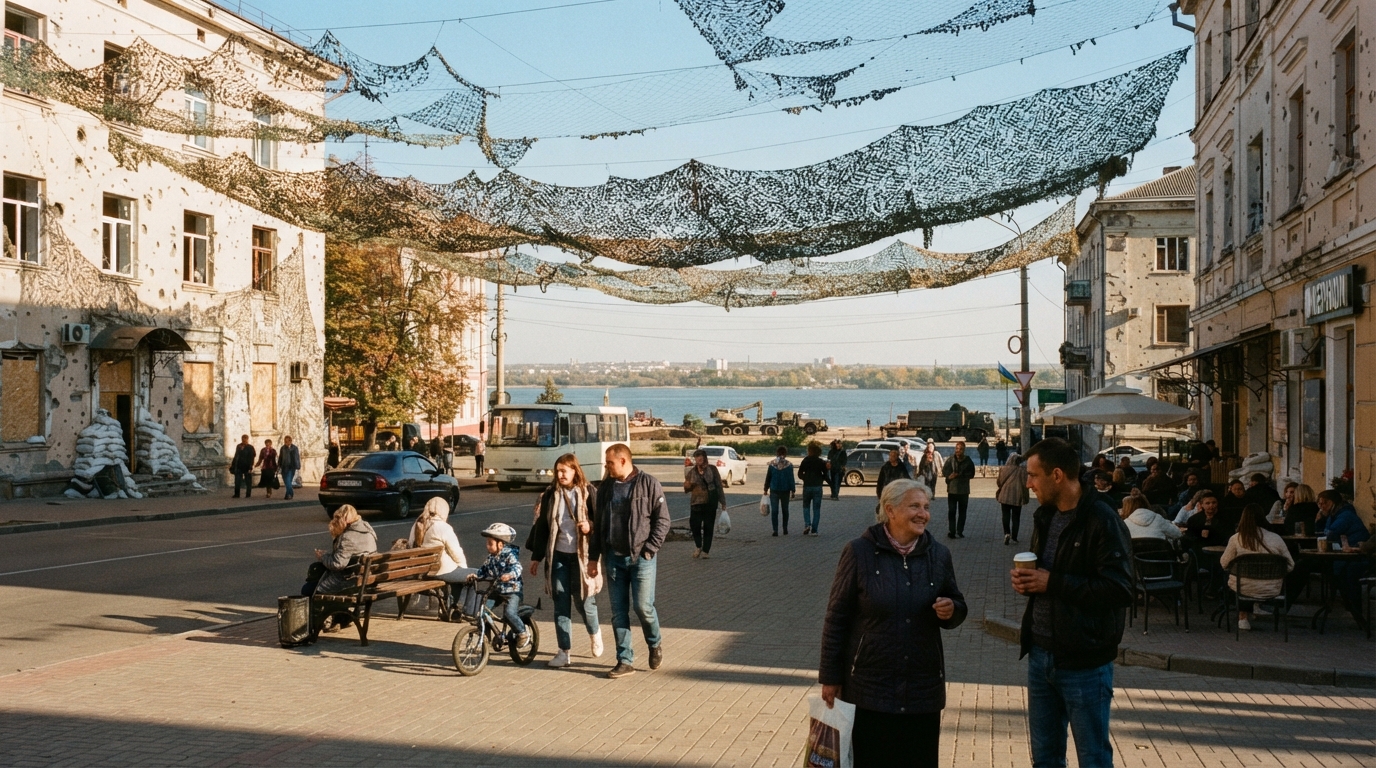
‘The city is alive’: A short calm in Kherson, but residents worry about what comes next
The temporary ceasefire in Kherson has given residents their first taste of peace in almost five years.
The Ukrainian city has experienced its first two quiet days in years after a US-brokered temporary ceasefire brought rare relief from the relentless Russian aerial attacks that have battered this front-line region.
Videos shared on social media showed people walking along streets covered with anti-drone nets and meeting in the city’s squares — everyday scenes that normally mean keeping a constant watch on the sky and listening for incoming drones.
“Ever since the ceasefire was announced, there’s been total silence,” said Olga, 42, speaking by phone from Kherson. “We are all, of course, overjoyed.”
“I don’t even know what to call it,” she added, with her smile audible in her voice. “It’s as if everything has finally come to an end.”
Since Tuesday, Kherson has “literally come back to life,” Ukraine’s human rights ombudsman Dmytro Lubinets said.
“People are calmly going out, walking, enjoying the autumn sun. What for some is ordinary everyday life, for residents of the Kherson region today is the greatest desire.”
The temporary halt in fighting — set to expire on Sunday — stems from efforts by US First Lady Melania Trump to arrange safe passage out of the Russian-occupied Ukrainian city of Oleshky, which sits across the Dnipro river from Kherson.
For several days, Russian forces have been clearing mines from the road ahead of a planned evacuation of Oleshky’s civilians on Friday.
But there are concerns that, while carrying out the widely publicised “humanitarian operation” — which some American journalists will be invited to observe — the Russians are using the truce to strengthen their forces in the area before a renewed assault on Kherson next week.
“They are... using this lull to strengthen their positions, bring in more military supplies, weapons, ammunition, and drones, and carry out some redeployment of their forces,” an anonymous source working in local government told the BBC.
Petro Andriushchenko, director of Ukraine’s Center for Studying the Occupation, said Kherson residents had told him they saw a military build-up near Radensk, about 20km (12 miles) from Oleshky.
Its residents will be saved, but “we are simultaneously giving the enemy an opportunity to exploit the ceasefire for its own military purposes,” he said. Once the ceasefire ends, the situation may be “worse than we saw before, because Russia’s units will be stronger. They have enough time to prepare to prolong this action.”
Although Kherson residents know what may come next, the city briefly had room to breathe this week.
No violations have been reported by either side since Tuesday. There have been other ceasefires before, but they were usually ignored, Kherson resident Dima said.
“This is the first time the shelling has stopped, people don’t quite believe it,” he told the BBC. “They are going to the shops, drinking coffee, walking around... The city is alive.”
On social media, a woman named Yulia described her unusually ordinary trip to the supermarket with clear disbelief. For once, she said, she came home from the shops “whole and calm, not as usual - scared, sweating from the horror and with a lump in my throat.”
“We’ve managed to adapt to this way of life,” Olga said. “We’ve been living under these conditions for nearly five years now.”
This week, dozens of people were also able to reach their belongings and homes in Kherson’s so-called “red zone” — an area so exposed to drone and artillery attacks that it has become unlivable.
“Some are venturing into places where nobody has dared to go for years, filming areas where simply being present has meant - and will once again mean - almost certain death,” said Denisa Bohackova, a Czech volunteer who lives in Kherson.
Dima described scenes of “girls, boys, parents, grandmothers” walking through the red zone with suitcases and bags, returning to their flats to see what they could recover.
Some who went back found buildings reduced to charred, empty shells; in other cases, homes had been looted. The extent of the destruction in some of these places, Bohackova said, is “breathtaking”.
Others were returning for reasons beyond possessions.
Angela Dobrovolska’s husband Serhiy was killed two years ago by a grenade dropped by a piloted Russian drone — one of the “human safari” attacks that have made Kherson sadly notorious.
On Thursday, Angela travelled back from Kyiv to Kherson to visit his grave for the first time in months. “They say that all the people have rushed to Kherson,” she said. “And I’ll be going to the cemetery to my husband.”
Kherson’s population has fallen from more than 250,000 to about 65,000 since Russia’s full-scale invasion of Ukraine began, which will enter its sixth year in February.
Although civilian life in the city never fully stopped, Bohackova said it continued under the conditions of an active battlefield, with schools, theatres, kindergartens and hospitals moved underground.
“An ordinary civilian from Kherson has experienced more of this war than many soldiers,” Bohackova said.
Olga, who is raising two children, described frequent blackouts, mines dropped by drones and hidden under fallen leaves, drone fragments flying around, and a city that usually shuts down by afternoon.
But since silence fell over the city, Olga has been able to live normally. She drove to another town and took a bus to a different district to visit her grandmother with her son. The shops were busy, as were the cafes. After years of empty streets, “there was even a small traffic jam,” she smiled.
But time is running out.
The evacuation of nearby Oleshky is expected to be finished by Sunday, after which the ceasefire will end. “The concern is that, starting Monday, things could turn truly chaotic,” Olga said.
“We know the strikes will resume, and that they will increase,” said Dima, as he and his wife prepared to visit their flat in the red zone for the first time in several months.
“These few days showed us how it could be if it all finally ended.”