

The Central Bank of Uzbekistan held a series of meetings at the Silk Road Forum.
The Central Bank of Uzbekistan held a series of bilateral meetings with regulators and partners from Cambodia, Malaysia, Azerbaijan, Kyrgyzstan, and Ant Group as part of the Silk Road Finance and Technology Forum.
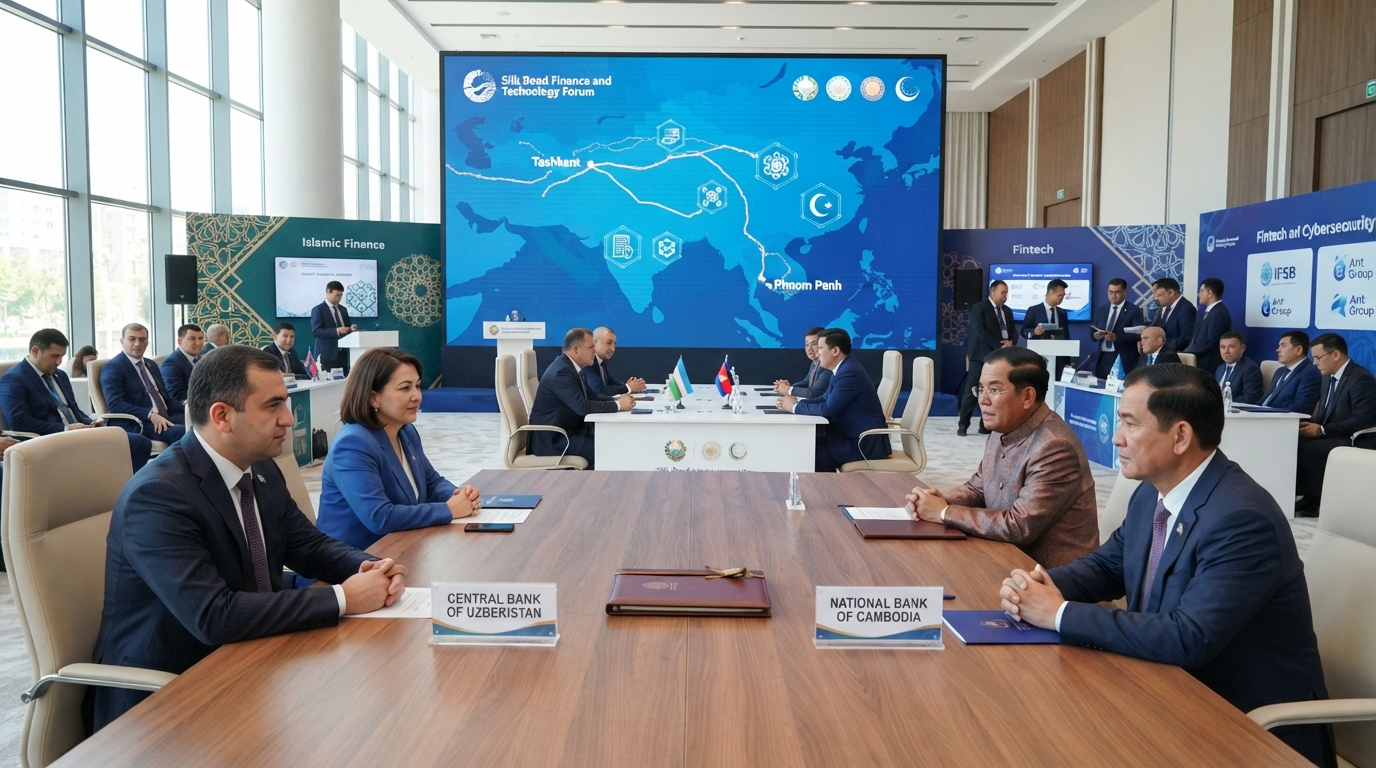
The Central Bank of Uzbekistan held a series of meetings at the Silk Road Finance and Technology Forum, discussing issues related to the development of payment systems, financial technologies, Islamic finance, and digital currencies, according to the press service of the Central Bank of the Republic of Uzbekistan.
Cooperation with the National Bank of Cambodia
The leadership of the Central Bank of Uzbekistan and the National Bank of Cambodia held a meeting to discuss the exchange of experience in priority areas of central banking. These included improving financial inclusion and literacy, developing payment systems, financial technologies, and central bank digital currencies (CBDCs).
Participants also exchanged views on the development of modern payment infrastructure, expanding access to digital financial services, improving payments using QR codes, and enhancing the compatibility of payment systems.
Particular attention was paid to strengthening the institutional and research capacity of central banks, as well as studying international best practices. Following the meeting, the parties expressed interest in further expanding their cooperation.
Following negotiations, the Central Bank of Uzbekistan and the National Bank of Cambodia signed a memorandum of cooperation, which lays the institutional foundation for collaboration between the two central banks.
The document provides for cooperation in monetary policy, payment systems, financial inclusion, monetary heritage, and the activities of central bank museums. The memorandum also provides for meetings on current issues, training, internships, and seminars, joint research and publications, and mutual visits to exchange experiences.
Development of Islamic Finance in Partnership with the IFSB
The management of the Central Bank of Uzbekistan met with Dr. Giyath Shabsigh, Secretary General of the Islamic Financial Services Board (IFSB).
The meeting focused on the development of the Islamic finance system in Uzbekistan, including improving regulatory and supervisory mechanisms, establishing a Sharia Council, and implementing international standards into national practice.
The parties discussed improving the regulatory framework, developing Sharia-compliant liquidity management tools, strengthening prudential supervision, and leveraging international expertise and IFSB standards, including expert assessment of developing regulatory documents.
The training of qualified specialists was also discussed, including organizing educational programs, seminars, and training sessions using simulation methods. Following the meeting, the parties agreed to expand practical cooperation and joint initiatives in Islamic finance.
Fintech Dialogue with the Central Bank of Azerbaijan
The forum also included a meeting between representatives of the Central Bank of Uzbekistan and the Central Bank of Azerbaijan, dedicated to strengthening cooperation between regulators and integrating the region's financial and fintech ecosystems.
The parties exchanged experiences in developing and implementing national strategies in financial technology, creating infrastructure to support financial innovation, developing venture financing mechanisms, and approaches to supporting fintech companies. The participants expressed their willingness to continue collaborating to create a more integrated financial ecosystem in the region.
Malaysia's Experience in Developing Islamic Finance
The management of the Central Bank of Uzbekistan held talks with a delegation from Bank Negara Malaysia, led by Dr. Ashraf Hashim, Chairman of the Shariah Supervision Council.
The Uzbek side presented practical measures for implementing Islamic financial services, including licensing Islamic banks and "Islamic windows," introducing a special tax regime, and establishing a two-tier Shariah governance system with Islamic finance boards at the Central Bank and commercial banks.
The parties also discussed the developing legal and regulatory framework for Islamic banks, prudential supervision, and compliance with Shariah principles.
The Malaysian side shared its experience in developing an Islamic finance ecosystem, including a centralized Shariah governance system and the phased introduction of Islamic banking products. It was noted that Islamic finance has been developing in Malaysia since 1983. Following the meeting, the parties agreed to facilitate further exchange of experience.
**Fintech and Cybersecurity with Kyrgyzstan**
The leadership of the Central Bank of Uzbekistan met with the Kyrgyz delegation, which highly praised the forum's organization. The parties exchanged views on the development of digital financial services, payment systems, cybersecurity, and cash circulation, and discussed regulatory sandbox mechanisms for testing innovative financial products.
Special attention was paid to SupTech solutions and the use of data in supervisory processes; the Kyrgyz side reported on its work in this area with international partners.
The parties also discussed cooperation in cybersecurity and fraud prevention, including the implementation of anti-fraud systems in banks, the detection of suspicious transactions, and the creation of assistance mechanisms for clients affected by fraud. Following the meeting, the parties expressed their readiness to further exchange experiences.
**Digital Payments with Ant Group**
Representatives of the Central Bank of Uzbekistan and Ant Group discussed expanding cooperation in digital financial services, cross-border payments, and financial technology.
The parties discussed ways to improve the convenience of payment transactions for international travelers, including the development of new payment solutions and expanding access to payment services for Uzbek citizens abroad.
The development of the country's fintech ecosystem and enhancing the professional potential of industry specialists were also discussed, including through the 10x1000 Tech for Inclusion international educational program. Following the meeting, the parties expressed their willingness to continue the dialogue on the development of digital finance and payment technologies.
Cooperation with the Bangko Sentral ng Pilipinas
The management of the Central Bank of Uzbekistan and representatives of the Bangko Sentral ng Pilipinas (BSP) discussed the development of cooperation in the financial sector, including issues of Islamic finance, regulation and supervision of the financial sector, money transfers, digital financial services, and joint research.
Particular attention was paid to the Philippines' experience in creating a favorable regulatory environment for the development of Islamic finance. The parties discussed the creation of financial instruments compliant with Sharia principles, as well as the formation of an integrated ecosystem uniting the banking sector, capital markets, and insurance.
The participants also exchanged views on the more effective use of digital technologies in the money transfer market, including increasing the accessibility and efficiency of cross-border payments and the further development of digital financial services.
A separate focus of the talks was strengthening research and expert capacity; the parties explored opportunities for joint research and knowledge sharing between the two regulators.
Following the meeting, the Central Bank of Uzbekistan and the BSP expressed their willingness to continue the expert-level dialogue and expand practical cooperation in the areas discussed.