

The Central Bank of Uzbekistan forecasts economic growth of 7–7.5% in 2027
The Central Bank expects inflation to fall to its target of 5% in the second half of 2027 and intends to maintain tight monetary conditions.
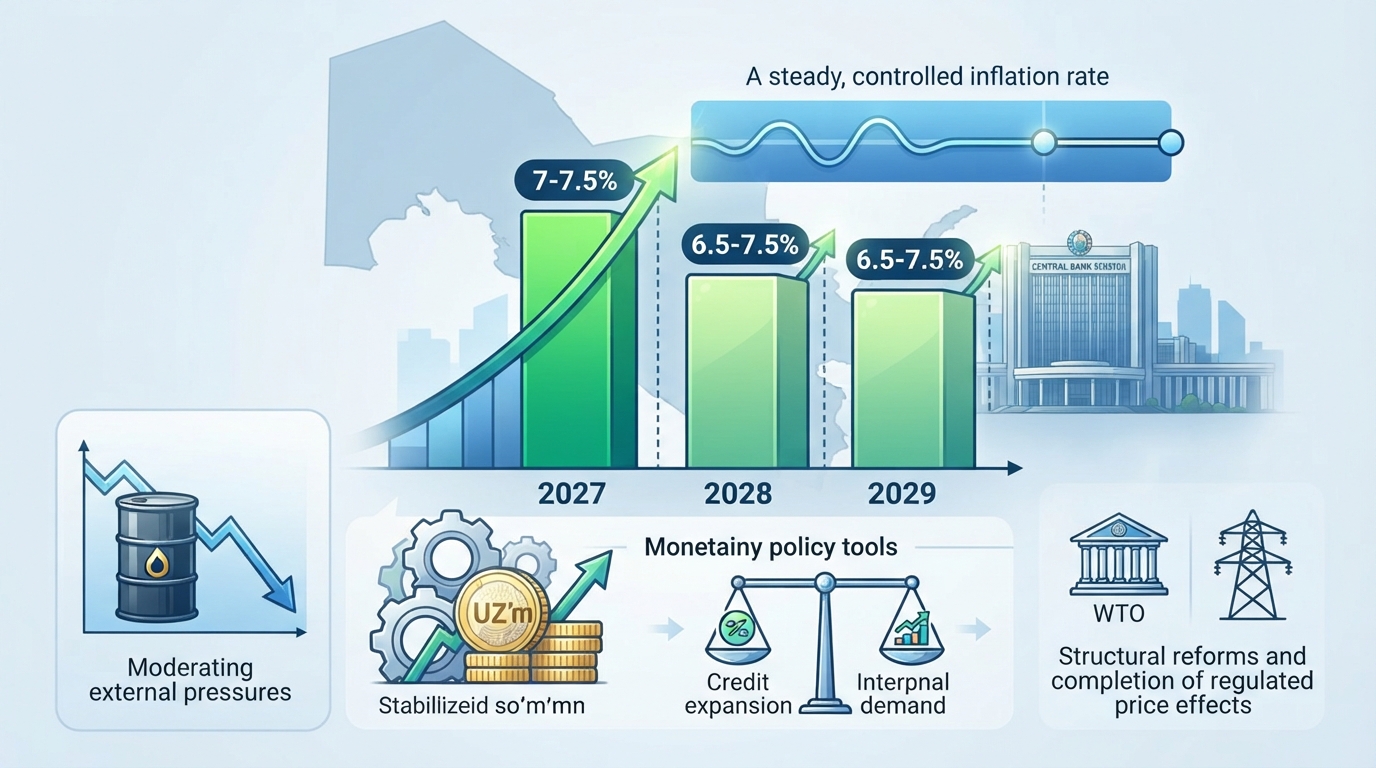
Central Bank of Uzbekistan Expects Economic Growth of 7–7.5% in 2027
The Central Bank of Uzbekistan forecasts economic growth of 7–7.5% in 2027 and 6.5–7.5% in 2028–2029. Under the regulator's baseline scenario, inflation should fall to the target level of 5% in the second half of 2027 and then remain approximately around this value over the following two years.
On November 4, 2026, the Board of the Central Bank approved the draft concept of the Main Directions of Monetary Policy for 2027 and the Period 2028–2029. The document presents macroeconomic development forecasts, an assessment of potential risks, and measures to maintain price stability.
The baseline scenario assumes a gradual stabilization of external and domestic economic conditions. In particular, the regulator proceeds from a possible reduction in geopolitical tensions and oil prices, as well as the maintenance of moderate growth rates among Uzbekistan's key trading partners.
Domestic assumptions include keeping the overall fiscal deficit at approximately 3% of GDP, balanced expansion of lending and domestic demand, completion of regulated price reforms, and Uzbekistan's accession to the World Trade Organization within the forecast horizon.
According to the Central Bank's assessment, core inflation in 2027 could decline to 4–5%. Among the factors that will restrain price growth are the end of the direct effect of previous increases in energy and utility tariffs, easing external price pressure, and growth in domestic supply.
The regulator plans to maintain tight monetary conditions in 2026–2027. According to the forecast, the real UZONIA rate in the money market in 2027 will be around 6–7%. This policy is expected to help limit domestic demand, reduce inflation expectations, and maintain the attractiveness of savings in the national currency.
The issue of a gradual easing of monetary conditions will be considered once preconditions emerge for the sustainable stabilization of inflation near the target level. If price pressures intensify or secondary effects of price increases prove to be more pronounced, the tight policy may be maintained longer.
The Central Bank also analyzed alternative scenarios associated with a potential deterioration of external and internal conditions. Key risks include a significant depreciation of the currencies of major trading partners, a sharp rise in global oil and food prices, and an acceleration of lending amid intensifying competition in the banking sector. The realization of these factors could lead to inflation above the baseline forecast.
A separate section of the document is devoted to improving the effectiveness of monetary policy. In 2027–2029, the Central Bank intends to develop a Monetary Policy Strategy and a roadmap for its implementation, improve liquidity management in the banking system, revise the interest rate corridor, and strengthen the role of UZONIA as a money market benchmark.
The development of liquidity provision and absorption instruments for Islamic banks, taking into account Sharia principles, is also envisioned. The regulator plans to modernize its macroeconomic analysis and forecasting systems and expand the use of probabilistic models and alternative scenarios.
Other priorities include the development of the money and financial markets, the market for derivatives and interest rate and currency risk hedging instruments, as well as increasing liquidity in the domestic foreign exchange market.
In addition, the preparation of an overall monetary policy communication strategy is planned. It aims to increase the transparency of decision-making regarding the key policy rate, inflation forecasts, and risk assessments, as well as to enhance the Central Bank's accountability in achieving the inflation target.
The draft concept of the main policy directions will be published on the official website of the Central Bank of Uzbekistan and finalized taking into account received proposals.