

The Central Bank has announced the Q3 anti-rating of banks based on customer appeals
The Central Bank updated the customer complaint index for the end of July–September 2026. AVO Bank improved its position, moving up from first place to ninth place, and continues to work on improving customer service.
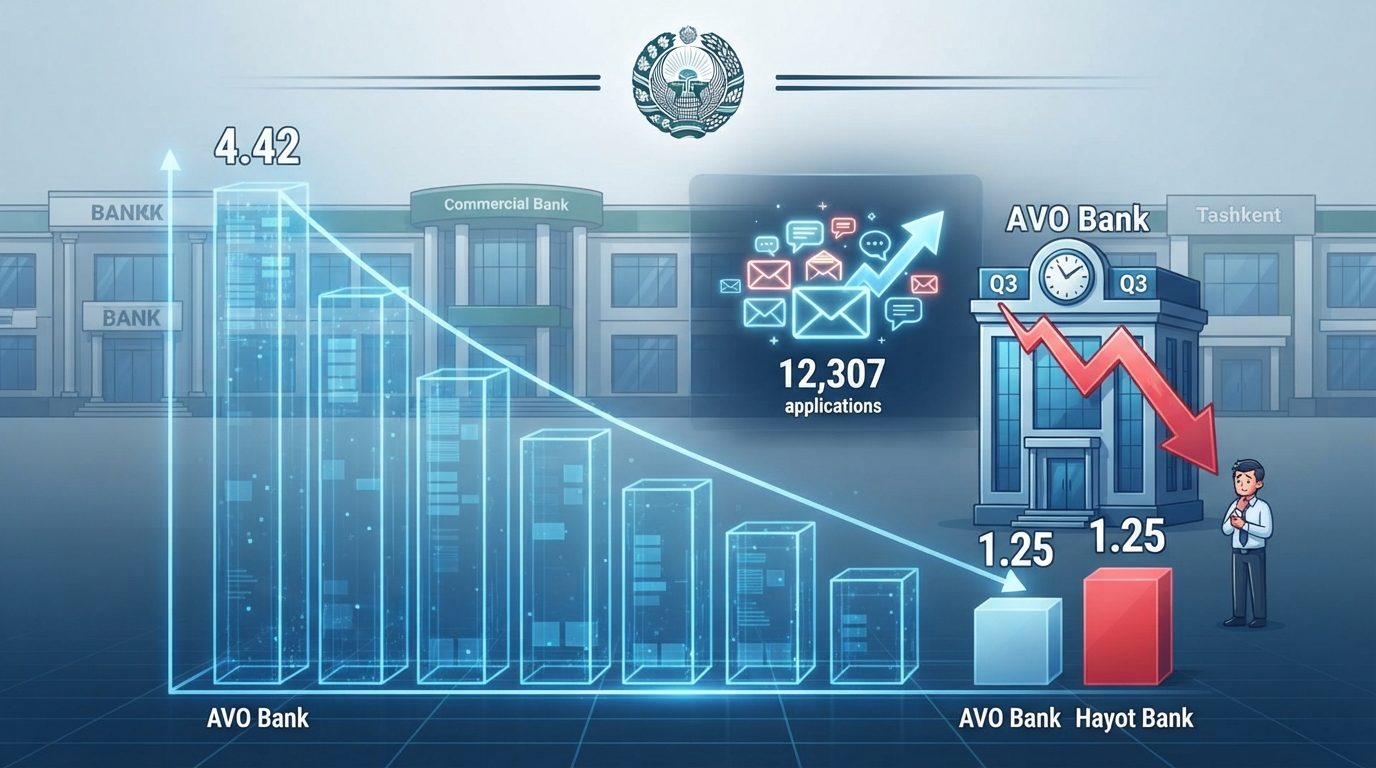
Central Bank releases banks' Q3 anti-rating based on customer appeals
The Central Bank of Uzbekistan has published the results of an analysis of customer appeals received regarding the activities of commercial banks for the third quarter of 2026 on its Telegram channel. This is the third edition of the appeal index, often informally referred to as the banks' anti-rating based on complaints.
The regulator has been calculating this index since this year in order to improve the quality of banking services and protect consumer rights. The index is published at the end of each quarter.
During the reporting period, in July–September, a total of 12,307 appeals regarding the activities of banks were received directly by the Central Bank and through other state bodies. In Q2, this figure stood at 11,331, meaning the number of appeals increased by 8.6 percent in one quarter.
The index shows how much higher a bank's share in the total number of appeals is compared to its share in the number of clients in the banking system. In the calculation, a bank's market share by number of appeals is divided by its market share by number of clients, taking into account individuals with open accounts, as well as legal entities and individual entrepreneurs. An indicator of 1.0 means that the appeals attributable to the bank are exactly proportional to its client base. The calculation includes only appeals sent directly to the Central Bank or through other state bodies: complaints submitted by the client directly to the bank itself are not included in the index.
As the regulator specifically emphasized, the index does not evaluate the financial stability or reliability of a bank and merely reflects the share of received appeals relative to the number of clients. Therefore, this list is not a bank reliability rating. The index is not calculated, and banks are not included in the list, if they received fewer than 100 appeals during the quarter.
Top ten for Q3: banks with the most negative performance in terms of appeals
According to Central Bank data, the highest index scores in Q3 were recorded for the following banks (in the media, this list is often referred to as the "most complained about banks" or the "banks' anti-rating"):
Compared to Q2, one bank, Hayot Bank, joined the list. Meanwhile, one bank left the list — Ipoteka Bank, which had an index of 1.09 in Q2. Six banks in the top ten saw their indicator decrease in one quarter, while four saw an increase. The regulator does not disclose the number of appeals for individual banks.
The most significant change in the top ten was observed at AVO bank. While the bank topped the list in Q2 with an index of 4.42, its indicator dropped to 1.25 in Q3, and the bank fell to ninth place with the same index value as InFinBank. The drop of 3.17 units was the largest among the banks on the list: it was followed by TBC Bank, whose index decreased by 0.67 units.
At the bank, the Q2 result was assessed as a signal indicating the need to make changes in handling appeals.
"AVO bank views this dynamic as an important benchmark for further improving service quality. Working with feedback allows us to identify problem areas, refine internal processes, and make communication with the bank even more convenient and clear for customers," commented Vitaliy Indin, head of the customer relations department at AVO bank.
According to the bank representative, AVO bank will continue to analyze incoming feedback and report on the results at the end of each quarter.
Based on the frequency of previous publications, the Central Bank is expected to present the next edition of the appeal index, covering the fourth quarter, in January 2027.