

The Central Bank expects interest rates on loans and deposits in Uzbekistan to decrease over the next 3–4 years
Interest rates on loans and deposits in Uzbekistan may gradually decrease over the next 3–4 years, stated Nodirbek Achilov, Deputy Chairman of the Central Bank. Average loan rates have already dropped by 2–3 percentage points over the past year. Banks are increasingly less likely to offer deposits with an annual rate above 18%.
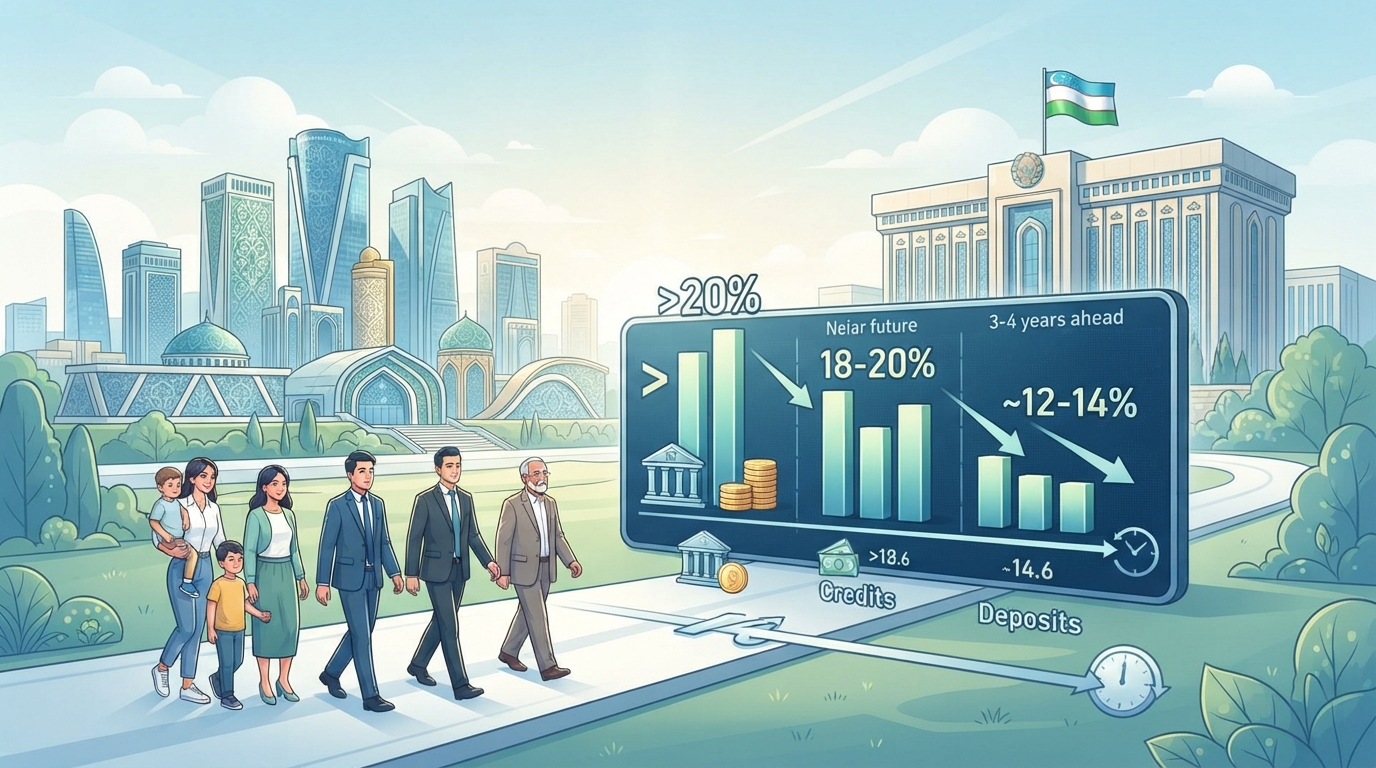
Central Bank forecasts a decline in loan and deposit rates in Uzbekistan over the next 3–4 years
At a press conference on November 4, Deputy Chairman of the Central Bank Nodirbek Achilov explained why interest rates on loans in commercial banks remain high despite the CB key rate being maintained at 14%, and when their reduction can be expected.
Answering a question from an UzA journalist about why banks still issue loans at 20–34% per annum, Achilov stated that in recent months a trend toward lower interest rates has already become noticeable in the market.
"If we look at the dynamics of rates, there is a downward trend. For example, compared to August 2025, average loan rates decreased by about 2–3 percentage points," he reported.
According to the deputy head of the CB, the cost of loans depends on their purpose, term, and lending conditions. In particular, rates on investment loans are usually lower than those on short-term consumer loans.
Achilov specifically pointed out a decrease in mortgage rates. While three to four years ago housing loans were issued at 24–25% per annum, now, according to him, there are offers on the market at around 18%.
At the same time, the highest rates remain on microloans, short-term unsecured loans, as well as loans processed on an expedited basis via online services. However, according to the regulator's assessment, rates in this segment are also gradually declining.
Achilov cited significant demand for loans that had accumulated prior to the start of economic liberalization in 2017 as one of the reasons for high interest rates.
According to him, the ability of the population to obtain bank loans was previously limited. After the liberalization of the financial sector, this demand began to be realized through commercial banks, which contributed to maintaining the high cost of borrowed funds.
"Prior to 2017, a very large demand for loans had accumulated in the economy. After the start of economic liberalization, this demand began to flow into the banking system. Previously, individuals had very limited opportunities to get a loan. High interest rates reflected, among other things, this high demand," explained the Deputy Chairman of the CB.
Now, according to the regulator, the credit market is gradually becoming saturated, and the demand for borrowed funds is becoming more balanced.
Achilov named the insufficient volume of domestic savings in previous years as another reason for expensive loans.
He explained that to issue loans, banks need to attract funds — primarily through deposits from the population and businesses or through external financing. For a long time, the deposit base of banks remained relatively small, while the need for loans grew rapidly.
"In the previous decade, the level of savings in the economy was very low... Banks need resources to issue loans. They must be attracted either through internal channels, deposits, or from abroad. At the same time, the volume of resources in banks was not high enough compared to the accumulated demand," Achilov noted.
According to him, in recent years the deposit base of banks has been actively increasing, creating additional sources for lending. The growth in the supply of financial resources, in turn, should contribute to lower interest rates.
The deputy head of the CB also stated that deposit offers with yields above 18% per annum are becoming increasingly rare.
"Therefore, we observe a downward trend in deposit rates as well. Today, banks extremely rarely offer deposits with a yield above 18% per annum. Rates are mostly within 18%. We expect them to fall further," he noted.
The Central Bank expects that over the next three to four years, the decline will affect not only the key rate, but also the cost of bank loans and deposits.
"The economy is in a transition period, and liberalization led to a rapid increase in demand for financial resources; the market needed time to adapt to these changes. This process continues. We expect that in the next three to four years, interest rates will approach their balanced levels. That is precisely what we are striving for," said Nodirbek Achilov.
At the same time, he stressed that further reduction of the key rate will depend primarily on a sustainable slowdown in inflation and inflation expectations.
"If inflation does not fall, if inflation expectations do not decline, we will not be able to reduce the key rate. Inflation and inflation expectations will always be determining factors for us," stated the Deputy Chairman of the CB.
For further rate reductions, the Central Bank is cooperating with the International Monetary Fund and the European Bank for Reconstruction and Development. According to him, the regulator also relies on increased competition in the banking sector, expansion of the supply of credit products, and the development of financing instruments with floating interest rates.
However, Achilov noted that even with a general decline in rates, unsecured and fast-issued loans may remain relatively expensive.
According to the latest published data from the Central Bank, in August 2026, the weighted average rate on national currency loans for individuals was 21.3% per annum compared to 22.1% in January. For legal entities, the rate fell from 23.4% to 22.3% over this period.
At the same time, deposit rates declined faster. The average yield on time sum deposits decreased from 18.9% in January to 17.2% in August, and for the population — from 20.6% in January to 18.4% (-2.2 p.p.). For legal entities, the indicator fell from 16.3% to 15.5%. Thus, over eight months, rates on retail deposits dropped more noticeably than on loans for individuals — by 2.2 versus 0.8 percentage points.
On November 4, the Board of the Central Bank kept the key rate at 14% per annum. The regulator explained the decision by high domestic demand and ongoing inflationary risks. At the same time, the CB allows for the possibility of a gradual reduction of the key rate to a single-digit level in 2027–2029 if inflation sustainably declines to the target 5% and inflation expectations continue to decrease.