

In Uzbekistan, the key rate may fall below 10% before 2029 — Central Bank
The Central Bank of Uzbekistan allows for a reduction of the main rate to a single-digit level before 2029, provided there is a sustained slowdown in inflation. At the last meeting, the regulator's board also discussed the possibility of lowering the rate from 14% to 13.5%, but the majority supported keeping it unchanged.
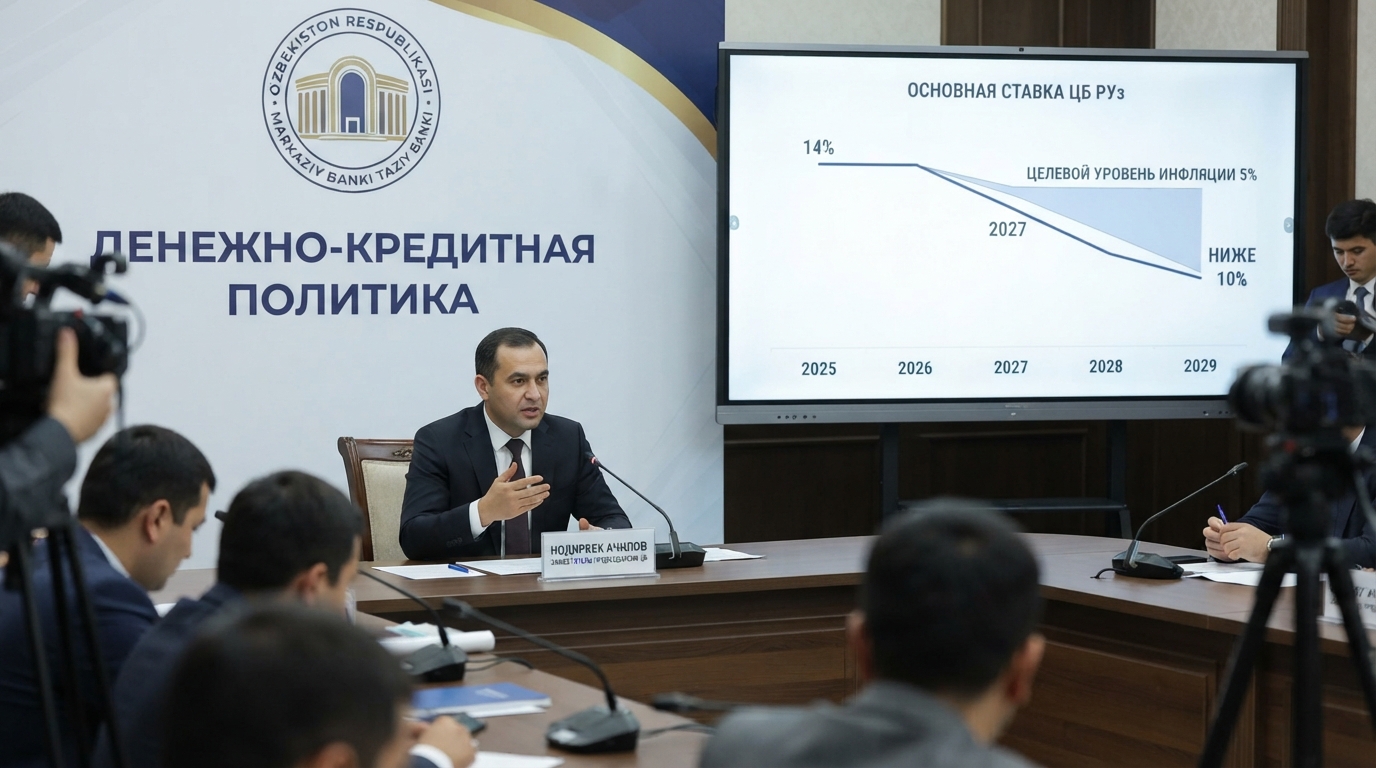
In Uzbekistan, the key rate may drop below 10% by 2029 — Central Bank
The Central Bank of Uzbekistan does not rule out a gradual reduction of the key rate below 10% in the 2027−2029 period. This was announced on November 4 at a press conference on the key rate decision and the main directions of monetary policy for the next three years by the Deputy Chairman of the regulator, Nodirbek Achilov.
According to him, the transition to a single-digit rate level will become possible with a sustainable slowdown of inflation to the target 5% and a further decline in inflation expectations among the population and businesses.
"If we come to the final conclusion that inflation has dropped to the target level, and inflation expectations continue to decline, an opportunity may arise to reduce the key rate to a single-digit level within the horizon of the main monetary policy guidelines," Nodirbek Achilov stated.
The Deputy Chairman of the Central Bank stressed that this does not refer to a predetermined rate cut schedule. Decisions on easing monetary policy will be made based on the actual dynamics of inflation, inflation expectations, and economic risk assessments.
Under the Central Bank's baseline scenario, in the second half of 2027, inflation should approach the target level of 5%, and in 2028–2029, anchor around this value. Core inflation, which stood at 5.5% in September, is expected to drop to 4−5% in 2027, and then to approximately 4% in subsequent years.
As inflation stabilizes, the regulator also allows for a gradual transition from tight monetary conditions to neutral ones. The Central Bank's preliminary calculations assume the formation of a real interest rate at the level of 4−5%.
At the same time, Achilov noted that it is necessary to maintain positive real interest rates: they support the attractiveness of savings in sum and help restrain excessive growth in consumer demand.
At the press conference, Nodirbek Achilov also reported that at the Board meeting on November 4, two options for the key rate decision were considered: leaving it at 14% or reducing it to 13.5%.
"Today, at the Board meeting, two scenarios were considered. The first was to keep the key rate unchanged at 14%, and the second was to reduce it to 13.5%," the Deputy Chairman of the Central Bank reported.
According to him, the decrease in inflation expectations and the stabilization of core inflation were important arguments in favor of the second option.
In September, inflation expectations of the population for the next 12 months dropped to 8.7%, and those of entrepreneurs to 9.2%. Core inflation remained at 5.5%.
The Deputy Head of the Central Bank also pointed to positive trends in the dynamics of the national currency and other macroeconomic factors that allow considering the possibility of easing monetary policy.
However, according to him, the issue of cutting the rate requires additional discussion. As a result, the majority of the Board members supported keeping the rate at its current level.
"The issue of maintaining the key rate at 14% received more votes from the Board members," Achilov reported.
Despite the slowing of inflation expectations, the Central Bank considers it necessary to maintain a tight monetary policy due to high domestic demand and ongoing external inflationary risks.
In September, annual inflation accelerated to 6.4% after 6.2% in August. This was influenced by price increases for certain food products, fuel, and services. Inflation in the services sector reached 7%.
The regulator also takes into account the risks associated with changes in global food and energy prices, as well as secondary effects from increases in regulated prices.
As part of improving monetary policy for 2027–2029, the Central Bank also intends to review the current interest rate corridor, which is plus or minus 2 percentage points from the key rate. At the current rate of 14%, this corresponds to a range of 12% to 16%.
According to Achilov, in the event of a transition to reducing the key rate, the current corridor may prove to be too wide. Therefore, the regulator is considering the possibility of its gradual narrowing simultaneously with the easing of monetary policy.
The Central Bank believes that improving operational mechanisms will allow for more effective transmission of changes in the key rate to interest rates in the money and financial markets.
It should be recalled that the key rate in Uzbekistan has been at 14% since March 2025, when the Central Bank raised it from 13.5%. At subsequent meetings, the regulator kept the rate unchanged, pointing to the need to contain inflationary pressure and achieve the 5% inflation target.