

The burden on a child's shoulders: how much should a schoolbag weigh?
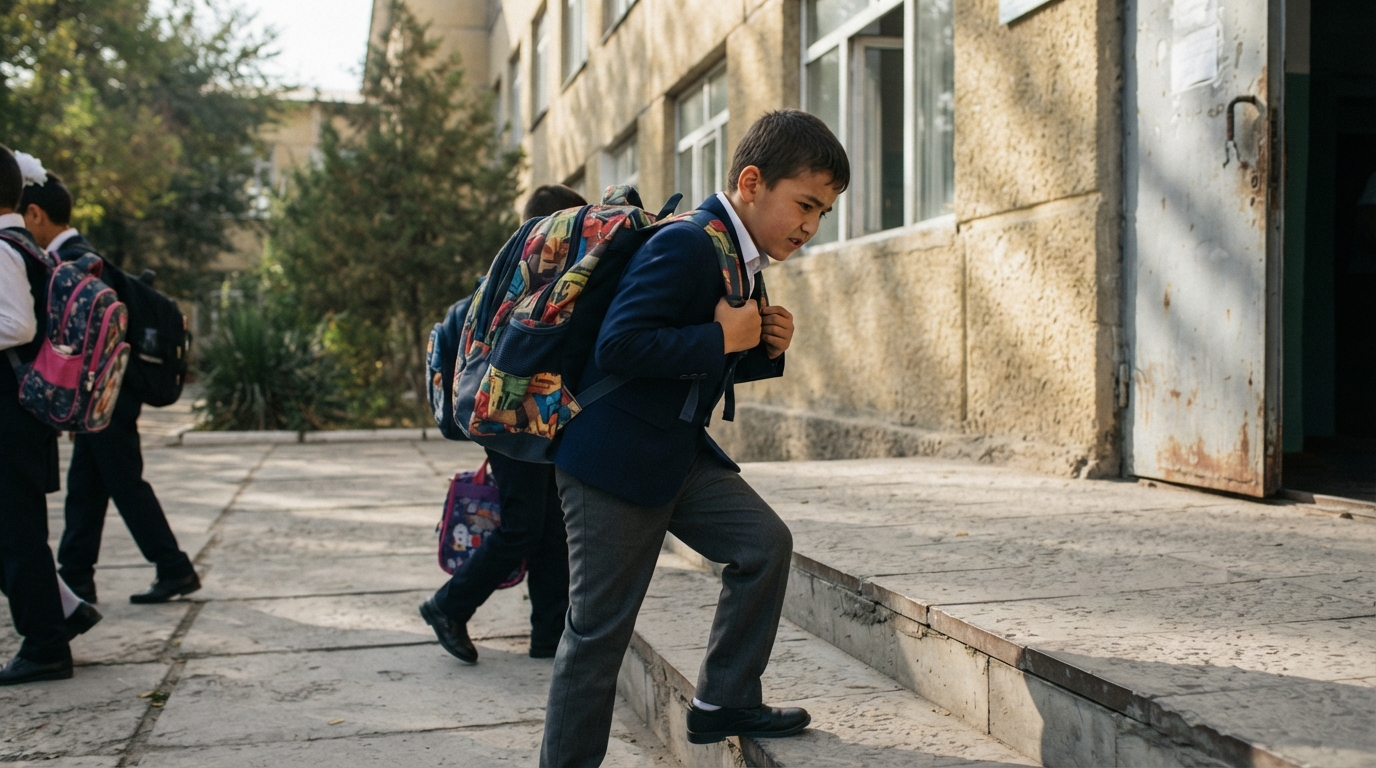
**The burden on children's shoulders: How much should a school bag weigh?**
Experts say that the total weight of a school bag should not exceed 10-15 percent of a child's body weight. This norm is approximately 1.5-2 kilograms for younger students, and 3-4 kilograms for middle school children.
However, in Uzbekistan, the increasing weight of school bags is causing serious dissatisfaction among parents. Children are forced to carry heavy bags to school disproportionately for their age. "Daryo" has compiled information on the problems that can be caused by bags being heavier than the norm and measures to eliminate them.
**The bag should not weigh more than 10-15 percent of the child's weight!**
Experts emphasize that the weight of the bag should be 10, and if it exceeds 15 percent of the body weight. However, parents who spoke with the "Daryo" correspondent complain that their children's bags are much heavier than the established norm. According to them, the new textbooks are heavier than the previous ones. This leads to shoulder and neck pain and deformity in children.
"It was said that the updated textbooks would be lighter, which would put an end to the problem of children's backpacks being heavier than normal. But in practice, this did not happen. Along with the textbooks, there are also exercise books. They are also quite thick. What we achieved was two manuals instead of the old textbook. This has led to the fact that our children's backpacks have become even heavier.
I sometimes have difficulty carrying my son's backpack, who is in the 3rd grade. It's a burden. Because in addition to textbooks and exercise books, there are other educational materials. There are notebooks for each subject. Several notebooks are kept for some subjects. As a result, the total weight of the backpacks increases even more. Such a heavy load is cruel for a growing child. That's why we have to carry the backpacks ourselves when taking the children to and from school," she says. One of the fathers interviewed by "Daryo".
In Uzbekistan, children start school at the age of 7, and at this time their average body weight is 23 kilograms. So, for them, carrying an average of 2.3 kilograms of a backpack is considered the norm. A 10-year-old child (a 4th grader) weighs an average of 32 kg. His backpack should weigh around 3.2 kg.
In the process of preparing the article, we were interested in the opinions of many parents. One of them said that his 11-year-old child weighs 33 kg, and his backpack weighs about 7 kg. Another parent said that his eight-year-old child, who is in second grade, has a backpack weighing more than 4.5 kg. Our calculations showed that the backpack of primary school students weighs an average of 3-5 kg, and that of secondary school students weighs 5-7 kg.
According to the Sanitary Rules and Standards of Uzbekistan (No. 0341-16, 2017), the total weight of a student's daily textbook and exercise book should not exceed:
* 1.5 kg in grades 1-2,
* 2 kg in grades 3-4,
* 2.5 kg in grades 5-6,
* 3.5 kg in grades 7-8,
* 4 kg in grades 9.
In accordance with the Government Resolution "On Approval of the Technical Regulations for Establishing Safety Requirements for Printed Materials for Educational Institutions", the publication weight for textbooks is determined as follows:
* 300 (± 10 percent) g for grades 1-4;
* 400 (± 10 percent) g for grades 5-6;
* 500 (± 10 percent) g for grades 7–9;
* No more than 600 (± 10 percent) g for grades 10–11 and general secondary and secondary specialized and vocational education.
Let's look at the lesson schedule of a 5th grader. Children in this class attend classes for an average of 5 hours a day. The books they bring weigh 2 kg alone. Some textbooks have workbooks (mathematics, foreign language). You need to carry a separate notebook for these lessons, as well as a diary. When you add up the weight of a water bottle, school supplies, and a backpack, the total weight reaches 4-5 kg.
**The harm of carrying bags heavier than the norm**
Children carrying heavy bags poses a serious threat to their physical development and health. Studies show that students experience pain in the body as a result of regularly carrying bags that are heavier than 10-15 percent of their body weight, and the continuous continuation of this process can lead to various diseases.
Akbar Tilyakov, director of the Republican Children's Orthopedic Center, noted that carrying bags that are heavier than normal increases the risk of developing diseases such as scoliosis in students.
"Incorrectly selected and used backpacks cause excessive strain on the spine and muscles of school-age children. This can increase the risk of developing diseases such as scoliosis in the future.
In addition, the use of large, heavy and uncomfortable backpacks increases the risk of children falling on stairs and sidewalks. Placing school supplies and equipment in a backpack is also an important process. In particular, it is better to place heavy items in the middle of the backpack, and light ones on both sides.
It is recommended to hang backpacks evenly on both shoulders. This will help to distribute the weight evenly throughout the body and prevent the development of pathologies associated with spinal curvature. It is advisable to wear a school bag not below the waist, but at least 5 centimeters longer than it," the expert emphasizes.
A 2018 study in India found that 65 percent of schoolchildren complained of back pain. Most of them attributed the problem to the weight of their backpacks.
According to the American Academy of Orthopaedic Surgeons (AAOS), heavy backpacks can increase the risk of spinal deformities such as scoliosis among adolescents. Another study found that one in three children give up sports or other physical activities due to back strain.
Heavy backpacks put extra pressure on a child’s neck and shoulders, which can lead to muscle strain and abnormal neck development. The uneven weight of the backpack can cause the body to tilt to one side, which in the long run can lead to asymmetrical muscle development.
"The daily lifting of heavy loads that are not appropriate for their age by schoolchildren has a negative impact on their still developing body, especially on the curvature of the spine and the distortion of their stature. It can also affect the functioning of internal organs," says Ma'mura Hasanova, associate professor of the Tashkent Pediatric Medical Institute, candidate of medical sciences.
Choosing uncomfortable bags for children is also part of the problem. If the shoulder straps of the bag are too narrow or tight, the weight is distributed incorrectly and can cause damage to the back and shoulders. Also, the habit of carrying a bag on one shoulder or in one hand is widespread among students, which also leads to improper pressure on the spine.
According to the American Chiropractic Association, the comfort of the backpack and the habit of wearing it correctly can reduce the negative effects of heavy backpacks by 40 percent.
**Impact on the psychological state of children**
Heavy backpacks also affect the psychological state of children. Studies have revealed the effects of this problem on the mental health of students. According to them, a student does not want to go to school and listens to lessons without interest due to the pain and fatigue in his body due to the weight of the backpack.
A social survey conducted in India in 2021 found that 40 percent of students did not want to go to school. They cited the pain and fatigue caused by carrying heavy backpacks as the main reason.
A study conducted in the United States also found that more than 50 percent of children aged 12-15 reported being late to class or not wanting to come to class at all because of the weight of their backpack.
A heavy load reduces a child's overall energy, which reduces their ability to participate in sports or extracurricular activities.
**Why are backpacks heavy?**
The main reason why schoolchildren have heavy backpacks is the use of too many books and notebooks during the learning process. In some schools, the curriculum is structured in such a way that it is required to carry a separate book, workbook, and notebook for each lesson. This is especially a heavy burden for primary school students, since their physical capabilities are not yet fully developed.
According to studies, in Uzbekistan, the weight of schoolbags has been observed to exceed 20 percent of a child's body weight, which is much higher than the recommended maximum.
The lack of personal lockers or special places to store books in many schools forces students to take all their materials home and bring them back again.
**Solution**
The current modern education system offers many opportunities to reduce the burden of students with the help of technology. E-books, tablets, and digital platforms can be a perfect solution to replace heavy books.
* **E-books**: Many schools are introducing digital textbooks, offering students to carry only one tablet instead of several books. According to the American Academy of Pediatrics, electronic educational materials can significantly reduce the burden and facilitate the learning process.
* Schools can provide students with access to online textbooks through Google Classroom, Moodle, and other digital systems. This not only reduces the weight of the bag, but also makes the learning process more interesting.
* It is also possible to lighten their load by providing children with handouts. Then the student will not carry books as a burden.
* **Introduction of school lockers**: In some countries (for example, in the USA and Canada), schoolchildren are allocated personal lockers. This method reduces the need to carry luggage between home and school. In India, this system is also being successfully tested in some urban schools.
* In Uzbekistan, private schools have also organized special shelves in classrooms, and these shelves serve to reduce the weight of children.
* A study conducted in India showed that students who had places to store bags in schools helped to reduce the weight of their bags by an average of 30%.
* In addition, organizing clean drinking water and meals on school grounds also reduces the weight carried by students.
Not only the Ministry of Education, teachers, but also parents are required to pay special attention to the weight and comfort of a backpack when choosing a backpack, taking into account the health of the child.
Doctor Ma'mura Hasanova gives the following recommendations to parents in order to avoid harm to children:
* be careful when buying school supplies, school bags (backpacks) to carry them;
* get used to not putting unnecessary things in a school bag, for example, leaving paints, plasticine, etc. in the classroom;
* teach and monitor children in the correct use of backpacks.
In 2020, a law was passed in India controlling the weight of backpacks, and it was decided that the weight of students' backpacks should not exceed 10% of their body weight. In addition to reducing the weight of books, students were required to bring them on certain days of the week (not every day).
In addition, measures have been developed to reduce the amount of homework assigned to students. It is time for us to take these measures. For children to grow up healthy, it is necessary to reduce the burden on their shoulders.
There are 6.5 million students in Uzbekistan, and it would be more beneficial for these young people to spend the energy they spend on carrying their bags on reading and physical education.
Prepared by Erkin Gaybullayev.