

"The builder's easiest source of financing is the people's money" – A look at the Imarat event
Money saved over years to buy a house is handed over to the builder. In return, nothing is guaranteed: it is possible to end up both homeless and penniless. The problem that has resurfaced in the example of Imarat Development is systemic in nature. Despite this, the escrow system, which was supposed to come into force mandatorily from January 1, 2026, to protect buyers' interests in the market, was in practice applied only to the secondary market.
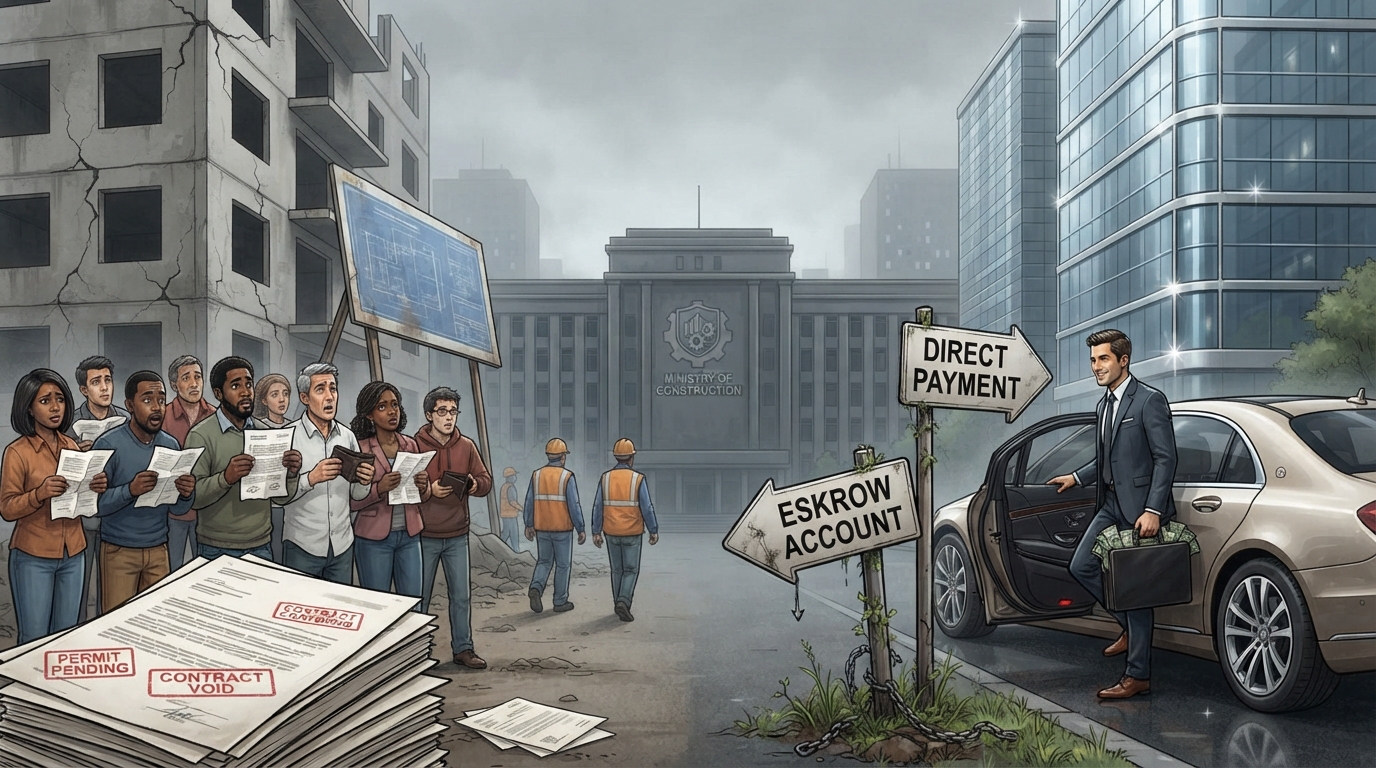
"The developer's easiest financial source is the people's money" - A look into the Imarat incident
"The Ministry of Construction is unable to fulfill its duties"
Abdurakhmon Tashanov:
- The disease here is new, but its causes are old. There is a large organization called the Ministry of Construction within the government, and significant funds are allocated for its maintenance. However, neither the ministry nor the structures of the Cabinet of Ministers responsible for this sector are able to fulfill their duties.
This issue was raised three or four years ago as well; back then, the president intervened and issued a separate decree. The decree dated January 27, 2025, specified that transitioning to the escrow system in shared-participation construction would be voluntary starting July 1, 2025, and mandatory from January 1, 2026. 2027 is approaching, yet the issue has still not been fully resolved.
The Ministry of Construction and other agencies responsible for executing the decree are failing to accomplish this task. As a result, the market remains unregulated. It contains both speculators and their victims.
The issue related to consumer rights hardly worries anyone. When a bigger fish like Imarat gets caught in the net, there is a sensation among the public, and then we move on to discussing the weather or the personal lives of artists. However, there is a legal basis for transitioning to the escrow system – the decree has been signed, but the responsibility and work of the authorized body that should implement it are not clearly visible.
"The buyer's money should not go directly into the developer's pocket"
Umid Gafurov:
- One of the main problems is selling houses that have not yet been built and the fact that buyers' money remains unprotected. These problems can be seen both in the example of Imarat and in other cases. If I am not mistaken, I have been talking about this for six years. In many situations, there are cases where construction does not meet technical requirements. They make the advertising so beautiful that when you look at it, it creates an impression as if you are going to live in Dubai. After the construction is finished, you look at the advertisement and the finished house, and they do not match. For example, the construction project must be attached to the contract. The house must be built strictly according to that project.
I have even gone to the Construction Inspection several times regarding this issue. Do you know what they said? According to the law, the exterior appearance of buildings can allegedly change by up to 30 percent. Supposedly, this is a normal condition. How so? In that case, let them return 30 percent of my money as well. Does that mean it can be up to 30 percent worse in quality, uglier, or left incomplete?
The developer makes promises about underground and above-ground parking lots, children's playgrounds, and open areas. If you look at Imarat's advertisements, see how many promises were made. People believe this. But controlling this is in the hands of the state. To do this, first of all, one must start with the contracts.
There are model recommendations regarding contracts on the website of the Ministry of Construction. But since it is advisory, no one complies with it. The state must set minimum requirements: what conditions should be in the contract, what the amount of late payment interest should be – these must be clearly defined.
Most importantly, the buyer's money should not transfer directly from their pocket into the developer's pocket. Whether the payment is made in installments or as a lump sum makes no difference. The money must remain in a protected account. Because after receiving the money, the developer might make calculations based on their own self-interest. For instance, they might think that if they currently do not return the money to the buyer, delay the completion of the house a little, and then return the money and sell that house at a higher price, they will make more profit. In practice, such schemes exist. That is, even if it is possible to build the house on time, instances of dragging out the process to inflate the price may occur.
The state has the capability to control this here. How many people work at the Ministry of Construction? Is it not their duty to control such processes? A lot is being said about escrow accounts, but they are not being put into practice. Escrow accounts work even when buying an ordinary car or in the secondary housing market, but they do not work in the primary market.
"The problem is not just with the developer, but in the entire system"
Abdurakhmon Tashanov:
- We are talking here about shortcomings in the state's policy regarding the construction sector. Right now, we are bypassing the core of the problem. In reality, the main issue is that there is no system itself that comprehensively enforces the laws. For example, who should carry out the policy in this sector? This in itself is confusing.
The second issue – when there is no control from above, conditions for corruption arise down below. Corruption does not mean only taking bribes. It is also a state of organized lawbreaking. Currently, we are directing most of our anger at the developers. But in reality, they themselves might be among the victims of this system. For example, some companies that newly entered the market have been wandering around frustrated for four or five years just to obtain documents. Their houses are completed, people are living there, but the necessary documents are not being issued. At the same time, there are well-known developers with great opportunities in the market – it seems as though no one has the power to stop their work or revoke their licenses.
Some are currently advising people not to buy houses. But this is not a solution. People need housing. Someone wants to marry off their son, someone wants to marry off their daughter, someone wants to live separately with their family. The population is growing, and the urbanization process is ongoing. As long as there is a need for housing, the government must work in this area. And to make the government work, there is the parliament. In parliament, faction leaders also receive a salary; they should not limit themselves to merely signing documents, but should raise these problems. They should summon the Ministry of Construction and ask, "Why has the situation in this sector reached this level? Why didn't you control it?"
There are talks that there are such developers that even the Minister of Construction himself cannot visit them or knock on their office door. This also indicates problems within the system.
"There are those who count prison as a business expense"
Umid Gafurov:
- For some developers, even criminal liability is failing to be a deterrent. Because even before starting construction, they can calculate how much money they will collect, how much they will spend on various expenses, and even how much funds will remain with them after serving a prison sentence. There is also the possibility of evading responsibility by registering property not in their own name, but in the names of relatives.
Imagine an entrepreneur starting construction and collecting millions of dollars from people. Then the project is not executed, and the buyers are left without houses and without money. Meanwhile, the entrepreneur views serving a sentence as part of their advance calculation. This is a sad, even ridiculous-sounding situation. But in reality, it is a very serious problem: if the profit gained from a violation outweighs the risk of punishment, the punishment itself cannot stop such situations.
Therefore, one cannot limit oneself to merely punishing certain developers. The system that allows acquiring wealth through lawbreaking and evading liability must change. Otherwise, one entrepreneur will be punished, another will come in their place, and buyers will continue to face the exact same problem.