

The battle that decided the fate of Europe: How the Ottoman troops were stopped at the gates of Vienna?
**The Battle That Decided the Fate of Europe: How the Ottoman Forces Were Stopped at the Gates of Vienna**
Vienna is a city located in the heart of Europe. Rising along the Danube, this place has for centuries been one of Central Europe's most important political and cultural centers. However, Vienna is etched in history not only as a city of emperors and palaces, but also by one of the battles that determined the fate of Europe.
Nearly three and a half centuries ago, in 1683, the Ottoman army arrived under the walls of Vienna. The city was besieged. Had Vienna been captured, the Ottoman Empire's march into Central Europe could have gone even deeper. But the city did not surrender. In the battle at the gates of Vienna, the Ottoman army was defeated.
This clash later became a major turning point in the Ottoman expansion in Europe. But what actually happened under the walls of Vienna? Why was the Ottoman army defeated, and how did a siege that lasted several months turn into one of the most important battles in European history? This is discussed below.
### Austrian and Ottoman Rivalry
The roots of the conflict go deep into history. By the 16th century, the Ottoman Empire had become a global empire ruling over three continents—Europe, Asia, and Africa. In 1529, the forces of Sultan Suleiman the Magnificent (1520–1566) besieged Vienna for the first time, but due to unfavorable weather and brave resistance, they could not capture the city.
A century and a half later, Ottoman banners began to flutter before the walls of Vienna once again. But this time, the situation was completely different. In the second half of the 17th century, Hungarian lands lay at the center of the rivalry between the Habsburgs and the Ottomans.
Due to conflicts over the throne and religious persecution, the Hungarian aristocracy rose in rebellion against the Habsburgs. The leader of the rebels, Count Imre Thököly, sought military assistance from the Ottoman Empire to escape Austrian oppression. This very factor served as a pretext for the Ottomans to launch a major campaign into Central Europe.
### The Ottomans at the Gates of Vienna Again
Sultan Mehmed IV (1648–1687) mobilized the entire military potential of the empire for the campaign against Austria. Grand Vizier Merzifonlu Kara Mustafa Pasha was appointed commander-in-chief.
According to various sources, the total size of the army reached up to 150,000–175,000 men. It included Janissaries, the Tatar cavalry of Crimean Khan Murad Giray, and troops gathered from territories fully subject to the empire.
Kara Mustafa's initial plan was to capture the Austrian fortress of Győr and strengthen the Ottoman position in Hungary. However, seeing the Austrian army retreating, the vizier took responsibility upon himself and decided to march directly on the imperial capital—Vienna.
In July 1683, Ottoman forces arrived at the gates of Vienna. Panicking, Emperor Leopold I fled the capital with members of his court. On July 14, Kara Mustafa officially besieged the city and sent a letter to the besieged, calling on them to surrender.
"Our goal is to capture this city... If you hand it over without a fight, by the will of Allah, no one will be harmed in the slightest, and you will all live in safety and peace..."
The city's defenders rejected this proposal. Following this, the Turks began a fierce siege. Heavy cannons were fired, and mined tunnels were dug under the city walls. The Vienna garrison heroically defended the capital, but due to running out of food and the spread of diseases, the city came to the brink of ruin. However, the two-month-long grueling siege also drained the strength of the Ottoman army.
### A United Europe for Vienna and Jan Sobieski
Vienna was defended by an 11,000-man garrison and 5,000 volunteers under Count Ernst Rüdiger von Starhemberg. The Austrian commander-in-chief, Duke Charles of Lorraine, was forced to retreat beyond the Danube to preserve his main forces and await help from allies.
Left in a difficult situation, Austrian envoys appealed to King John III Sobieski of the Polish–Lithuanian Commonwealth (Rzeczpospolita). Sobieski enjoyed high prestige in Europe, having defeated the Turks before. He immediately gathered a select army of 26,000 men and rushed to help.
Coming through Silesia and Moravia, the Poles united with the forces of Charles of Lorraine and the German principalities (Bavaria, Saxony). The combined volunteer army reached 74,000 men.
The composition of the army was as follows:
— 25 troops of heavily armed hussars;
— 77 armored cavalry troops;
— 31 light cavalry troops; infantry; dragoons;
— 250 artillerymen with 28 cannons;
— approximately 150 Zaporozhian Cossacks.
A total of about 26,000 soldiers were gathered. On the way, another Lithuanian force of nearly 10,000 men was also coming.
According to the plan, the imperial forces were to move along the Danube, while the Poles were to bypass through the Vienna Woods and unexpectedly strike the Turkish camp from the hills.
The Crimean Tatars could have obstructed this major operation of the allies. Grand Vizier Kara Mustafa Pasha had ordered them to strictly control the strategic crossings on the Danube and not allow the enemy to cross.
However, political animosity and internal conflicts played their part: Crimean Khan Murad Giray, due to a personal grudge against the Ottoman vizier, took a negligent attitude toward this order. As a result, the khan turned a blind eye to the enemy forces building a bridge over the Danube River and crossing to the other bank without any resistance. This strategic mistake gave the European allies a huge advantage.
Hope of approaching help lifted the spirits of Vienna's defenders, and they continued their resistance. And help was already near. On September 11, the Polish and imperial forces approached Vienna and occupied the Kahlenberg and Leopoldsberg heights near the city. Countless tents in the Turkish camp appeared before the eyes of the allies.
### The Decisive Day
On the morning of September 12, 1683, the battle that decided the fate of Europe began. However, in preparing for the battle, Grand Vizier Kara Mustafa Pasha made his most serious and strategic mistake.
He was firmly convinced that Vienna would surrender soon. For this reason, hoping not to interrupt the siege and to capture the city, he left his most combat-ready forces—more than 10,000 select Janissaries—in the trenches around Vienna. As a result, the most experienced and disciplined part of the Ottoman army was missing to repel the allies' attack in the open field.
The long-lasting siege, exhausting labor, and infectious diseases had significantly thinned the Ottoman ranks. On the day of the battle, the number of the Turkish army on the field did not exceed 55,000–60,000 men (another 10,000 sick and wounded remained in the camp). Against them stood the militarized and morally superior 74,000-strong European allied forces.
On the morning of September 12, 1683, they lined up in battle formation. In the center stood the imperial forces under the command of the Duke of Lorraine, reinforced by several troops of Polish hussars. On the right wing, the Poles under Hetman Stanisław Jabłonowski took position. On the left wing stood the Bavarians and Saxons.
The battle began at dawn with a fierce attack by the allies on the center and left wing. The imperial and German forces gradually began to push the Turks' left wing out of their positions. The Polish cavalry and infantry, having traversed the difficult terrain of the Vienna Woods, joined the battle a bit later—around noon.
According to Sobieski's initial plan, the decisive blow was to be delivered from the right wing the next day, and the battle was to last two days. However, the development of events, which was faster and more successful for the allies than expected, forced the king to change the plan immediately.
Initially, Sobieski sent several cavalry troops for reconnaissance to determine the enemy's line and positioning. The Turkish cavalry repelled their attack and set off in pursuit, but the disciplined fire of the German and Polish infantry blocked their path.
After hours of fierce clashes, both sides were extremely tired. Around 18:00, the decisive moment of the day and the entire war arrived.
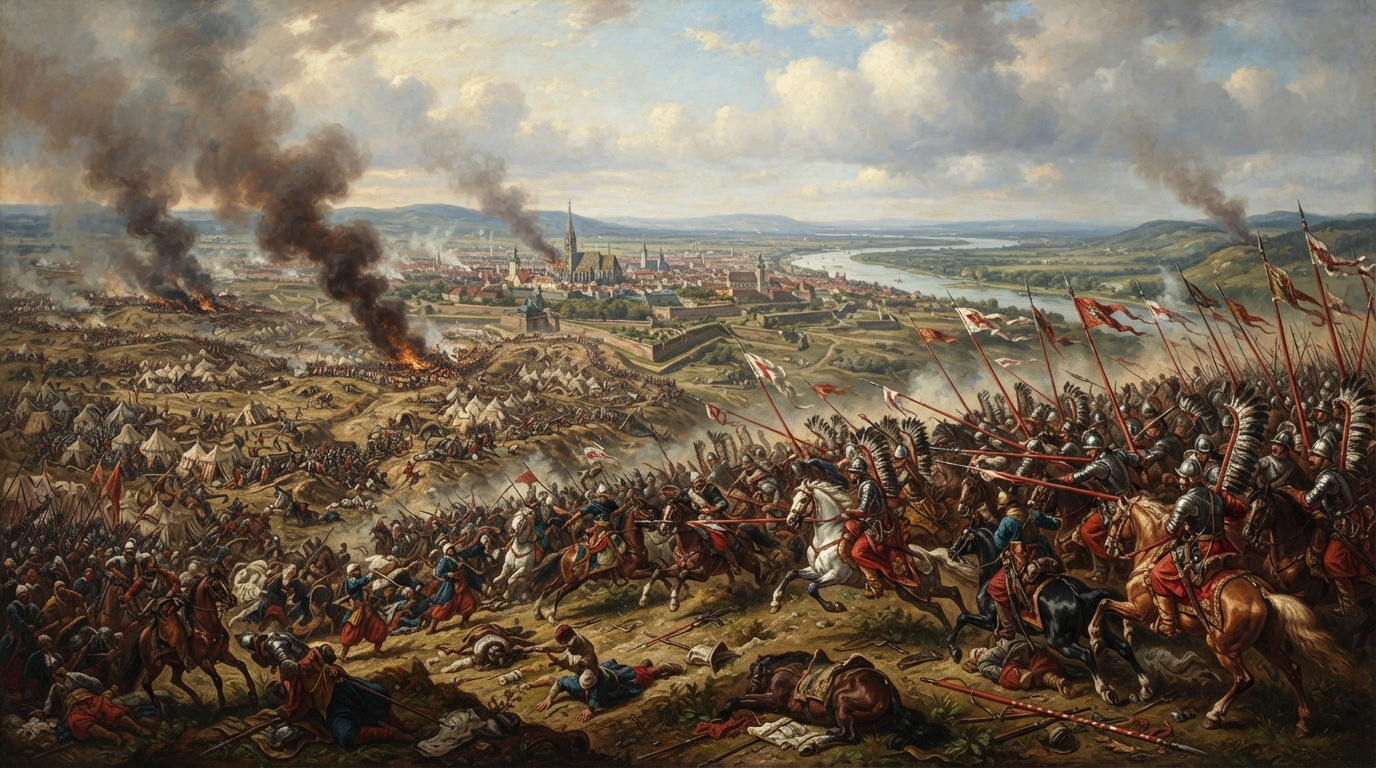
John Sobieski ordered a general charge of the massive cavalry division waiting in reserve on the hills. A steel wave of 20,000 men—the legendary Polish "winged hussars" and German heavy cavalry—swept down from the hill. This was recorded as the largest and most terrifying cavalry charge in the history of world military art.
The blow, delivered with terrifying force and speed, turned the Ottoman ranks into ashes. Before the cavalry rushing like a storm, the Turkish line broke, and mass panic and flight began. Only in the center, Vizier Kara Mustafa Pasha gathered 5,000–6,000 loyal warriors around his banner and resisted until his last breath—by doing so, he bought some time for the rest of the army to retreat and escape. (By this time, the Crimean Tatars had already left the battlefield, leaving the Ottomans to their fate).
By evening, the allies liberated the city from the siege and broke into the Turkish camp. The rules of war in the 17th century were extremely brutal: about 10,000 sick, wounded, and servants left in the camp were mercilessly put to the sword.
In this bloody clash, the total losses of the Ottoman side exceeded 15,000 men. Only a third of them died directly on the battlefield, while the rest fell victim to the retreat and the massacre in the camp.
### The Tragedy of the Grand Vizier and the Fading Star
The defeat at the gates of Vienna was not just a single lost battle, but a huge historical turning point that fundamentally changed the map of Europe and the Near East. It was precisely here that a permanent end was put to the Ottoman Empire's military expansion into the heart of Europe, which had been going on uninterruptedly for three centuries.
This victory gave European monarchies a moral and strategic advantage. In 1684, at the initiative of the Pope, the "Holy League" military alliance was formed against the Ottomans. It was joined by Austria (the Habsburgs), the Polish–Lithuanian Commonwealth, the Republic of Venice, and later the Tsardom of Russia.
Faced with the combined forces, the Ottomans were forced to retreat one after another: in 1686, the strategically important city of Buda was liberated, and within a few years, the Turks were completely expelled from the entire territory of Hungary and Transylvania.
Although the Ottoman Empire occasionally achieved local victories over Europe in the early 18th century, the military-political power and hegemony of the empire were coming to an end. After the Battle of Vienna, a period of decline began for the empire, which started to be called the "sick man of Europe."
The fate of Vizier Kara Mustafa Pasha, who was found to be the main culprit of the defeat, ended tragically. Sultan Mehmed IV did not forgive his vizier's risky campaign toward Vienna without the ruler's permission and the destruction of the empire's finest army.
On December 25, 1683, at his headquarters in Belgrade, as Kara Mustafa Pasha was preparing for the noon prayer, there was a knock on his door. The sultan's special messengers—armed Janissaries and an executioner—entered the room. Seeing the sultan's death warrant in the messengers' hands, the vizier resigned himself to fate and understood everything.
According to Ottoman tradition, as a high-ranking statesman, his blood was not spilled. He was executed by strangulation with a silk cord brought by the executioners. Thus, a tragic end was brought to the powerful vizier who had set out with the dream of Vienna, and with him, to the era of the empire's absolute dominance in Eurasia.