

The balance between Kandahar and Kabul: What is the division in the Taliban related to?
The Taliban leader, Haibatullah Akhundzada, who does not appear publicly and is said to live in Kandahar, defines the orthodox nature of religious-ideological politics and keeps the armed structures under his control. In Kabul, Interior Minister Sirajuddin Haqqani and his close circle are placing greater emphasis on expanding economic opportunities and overcoming international isolation to alleviate the country's crisis.
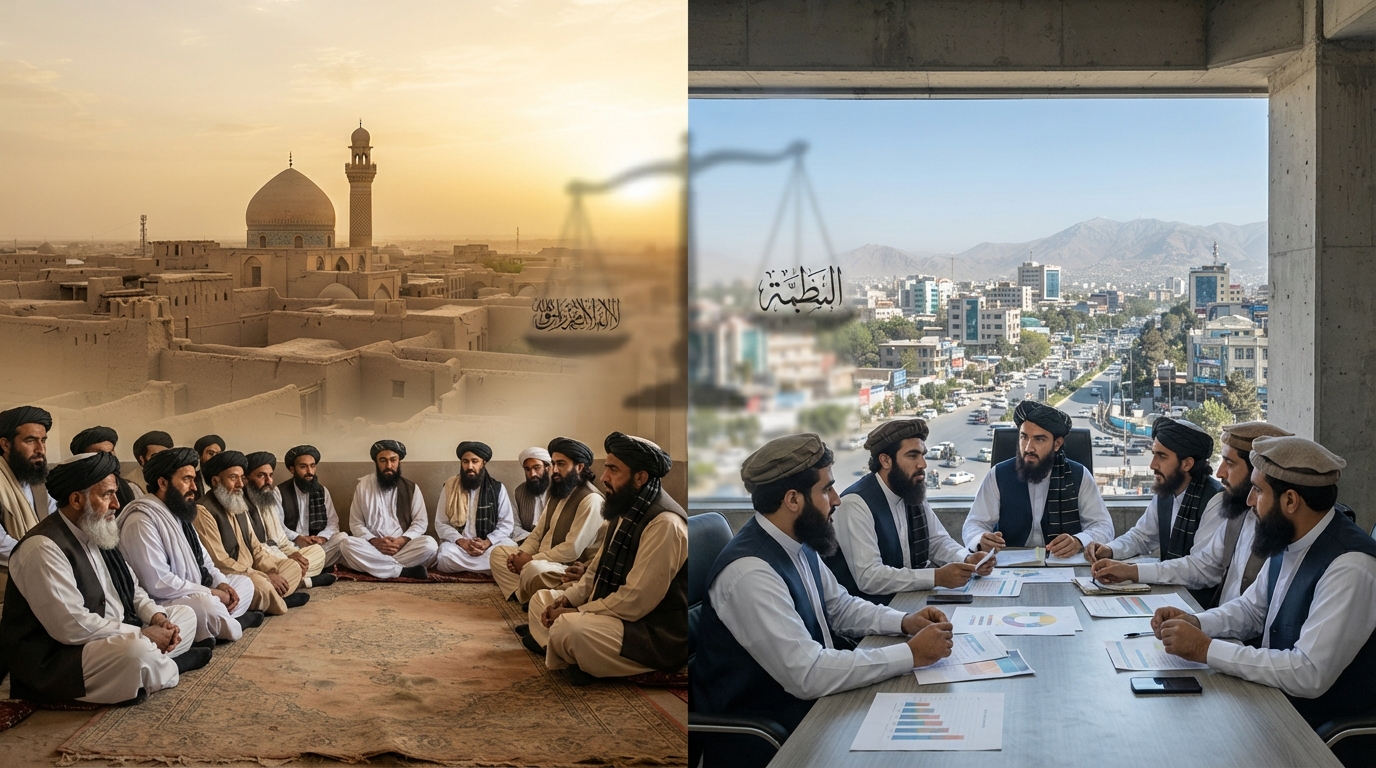
**Balance between Kandahar and Kabul: Reasons for the split in the Taliban**
Five years after the Taliban took power in Afghanistan, the contradictions between Kandahar and Kabul in the governance of the country are becoming increasingly apparent. In the "Geopolitics" program of Kun.uz, political analysts reflected on the causes and consequences of these internal differences.
**Two poles in the leadership**
The supreme leader of the Taliban, Haibatullah Akhundzada, who is not visible to the public and lives in Kandahar, determines the religious and ideological direction of the movement and controls the armed structures. His views are orthodox and conservative, and he prioritizes maintaining strict religious principles in state governance.
In Kabul, Interior Minister Sirajuddin Haqqani and his entourage are focusing more on improving the country's dire economic situation, expanding economic opportunities, and overcoming international isolation. Haqqani is a proponent of a relatively pragmatic approach, considering it important to develop Afghanistan's economy, attract foreign investment, and establish active relations with other countries.
**Ideological superiority and pragmatic needs**
Political analyst Hamza Boltayev notes that there are internal differences within the Taliban on ideological issues, the development of the national economy, and attitudes to foreign policy. Kandahar has a dominant role in ideological and domestic policy issues. The main reason for this is that most of the ideological founders and main leaders of the Taliban movement came from this region and still hold high positions in the movement. Therefore, Kandahar has a great influence on determining the ideological image, identity, and main directions of the state's domestic policy.
The state-building of the Taliban today is based on fundamental Islamic ideas. This approach is aimed at forming a model of statehood based on Islamic principles, rather than tribalism. In order to implement this ideological policy and ensure its implementation throughout the country, strict control has been established over the security system. In Afghanistan, the security, intelligence and defense structures are the mainstay of this policy. In this regard, the influence of Kandahar is particularly strong. A large part of the Taliban's armed forces and the mujahideen serving in the security system are ideologically based in Kandahar.
Even the fact that security forces are assigned from Kandahar to government offices in Kabul, including the Foreign Ministry building or checkpoints in the city, indicates Kandahar's influence in this regard.
Therefore, Kandahar has a decisive position in matters of ideological policy and security. However, it would not be correct to explain this situation with a simple bipolar model, where Kandahar is the “ideological capital” and Kabul is the “political capital”. The essence of the matter is that within the “Taliban” there is a balance between ideological priority and the needs of pragmatic governance. In particular, the influence of supporters of a pragmatic approach is strong in matters of foreign policy and national economic development. In this regard, the position of Kabul is of great importance. Because the long-term stay of the “Taliban” in power and ensuring its legitimacy is not limited only to ideological superiority. It is necessary to develop the economy, find financial resources, establish foreign trade and choose international partners.
Therefore, the current “Taliban”, unlike the previous “Taliban”, is forced to take into account not only ideological goals, but also the issues of the economic survival of the state and strengthening its position in the international arena.
It is at this point that the voice of the pragmatic wing, especially the political and economic circles in Kabul, is becoming stronger. Therefore, it is appropriate to view the division within the Taliban not simply as a confrontation between Kandahar and Kabul, but as an internal balance between ideological priorities and the need to govern the state, develop the economy, and expand foreign relations.
**The role of the Haqqani network**
According to political analyst Anvar Yuldoshev, the main internal conflict within the Taliban is between the Kandahar wing, that is, the supporters of the supreme religious leader Haibatullah Akhundzada, and the Haqqani group from Khost and Paktika. Sirajuddin Haqqani is one of the influential leaders of the Taliban. His father, Jalaluddin Haqqani, was one of the most influential field commanders during the wars in Afghanistan. Sirajuddin worked with his father from a young age, received religious education in Pakistan, and later rose to a prominent position in the leadership of the Haqqani network.
Sirajuddin succeeded Jalaluddin Haqqani in 2018. Sirajuddin Haqqani was long wanted by the United States, and a $10 million reward was offered for his capture. However, the United States revoked this reward in March 2025. Despite this, Haqqani and the Haqqani network remain subject to international anti-terrorism sanctions and other restrictions.
There are also reports that the Haqqani wing is supporting a softer position than Akhundzada on women's rights. These issues are seen as one of the main reasons for the conflict between Akhundzada and Sirajuddin Haqqani.
Haqqani emphasizes that the previous political conditions of Afghanistan are over, and that cooperation with foreign countries is necessary for the survival and development of the country. Akhundzada, on the other hand, does not want to compromise on ideological issues. This conflict is not limited to political views, but also affects the distribution of power and authority. At times, there have been reports of attempts to limit Haqqani's authority, including the influence of the structures he controls.
Sirajuddin's age and political ambitions are also an important factor in this. Akhundzada is older, while Haqqani is much younger and may see himself as the next supreme leader of the Taliban. In addition, the Haqqani network has extensive connections and great influence throughout Afghanistan. Therefore, his potential in the political and security spheres is a serious balancing factor for Akhundzada.
This conflict may intensify over time. Especially as Haqqani seeks to develop relations with Western countries, European countries and Russia, his pragmatic image in the international arena is likely to grow. Therefore, in the event of a future change of power in the Taliban leadership, Sirajuddin Haqqani may be seen as one of the possible successors to Haibatullah Akhundzada. However, this is not a clear political scenario at this time, but rather one of the possibilities arising from the balance of power within the Taliban.