

The artificial intelligence market and national debt in the global economy
This international economic news digest covers the strengthening position of Chinese manufacturers in the AI chip market, as well as trends related to growing budget deficits and public debt burdens in developed countries.
**Artificial Intelligence Market in the Global Economy and Public Debt**
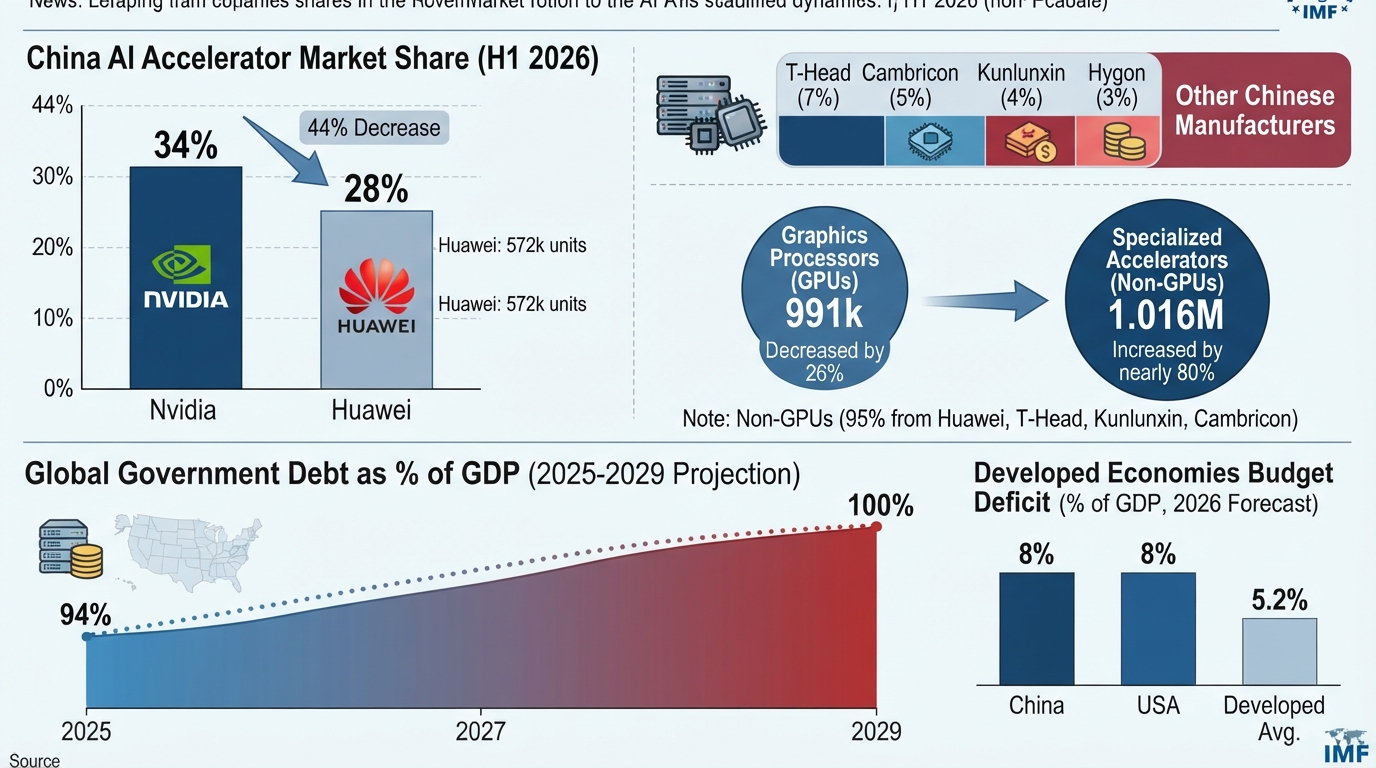
Chinese manufacturers are increasingly strengthening their position in the artificial intelligence chip market. According to IDC (International Data Corporation) data, in the first half of 2026, the volume of Nvidia's AI accelerator shipments to China decreased by 44 percent, amounting to 678 thousand units. The American company's market share stood at 34 percent. This decline is explained by export restrictions imposed by the US and the expanded use of alternative products manufactured in China.
According to IDC estimates, 9 out of 11 Chinese companies increased their shipment volumes compared to the same period last year. Huawei more than doubled its shipments, reaching 572 thousand units and capturing 28 percent of the market. Among other manufacturers, T-Head's (Alibaba) market share was 7 percent, Cambricon — 5 percent, Kunlunxin (Baidu) — 4 percent, and Hygon — 3 percent.
The total volume of AI accelerator shipments in China reached 2.008 million units. At the same time, graphics processing unit (GPU) shipments contracted by 26 percent to 991 thousand units, while specialized accelerators (Non-GPU) grew by nearly 80 percent to reach 1.016 million units, surpassing GPU shipments for the first time.
Four Chinese companies — Huawei, T-Head, Kunlunxin, and Cambricon — accounted for 95 percent of the Non-GPU segment. The primary consumers of these products are state institutions, internet companies, and telecom operators. According to IDC estimates, the focus of competition is shifting from individual processor performance to the efficiency of computing clusters.
Budget deficits in advanced economies will reach their highest level since the COVID-19 pandemic. According to International Monetary Fund (IMF) data, in 2026, net public debt borrowing by advanced economies is expected to reach 5.2 percent of GDP. This represents the highest figure since 2021, when budget expenditures rose sharply due to the COVID-19 pandemic.
According to the Fund's forecasts, the highest levels of budget deficits are expected in the US and China. In these countries, the deficit could reach or exceed nearly 8 percent of GDP. The increase in budget deficits is accompanied by rising public debt service costs and a growing need to raise new debt funds.
According to IMF estimates, global public debt, which constituted nearly 94 percent of global GDP in 2025, could reach 100 percent by 2029. This figure approaches the highest levels recorded since the end of World War II.
The IMF warns that the growing public debt burden and borrowing volumes will limit governments' ability to finance additional spending and take measures against economic crises. The Fund recommends pursuing consistent fiscal consolidation to ensure the sustainability of public finances.