

The 2026 ranking of the most livable countries has been announced
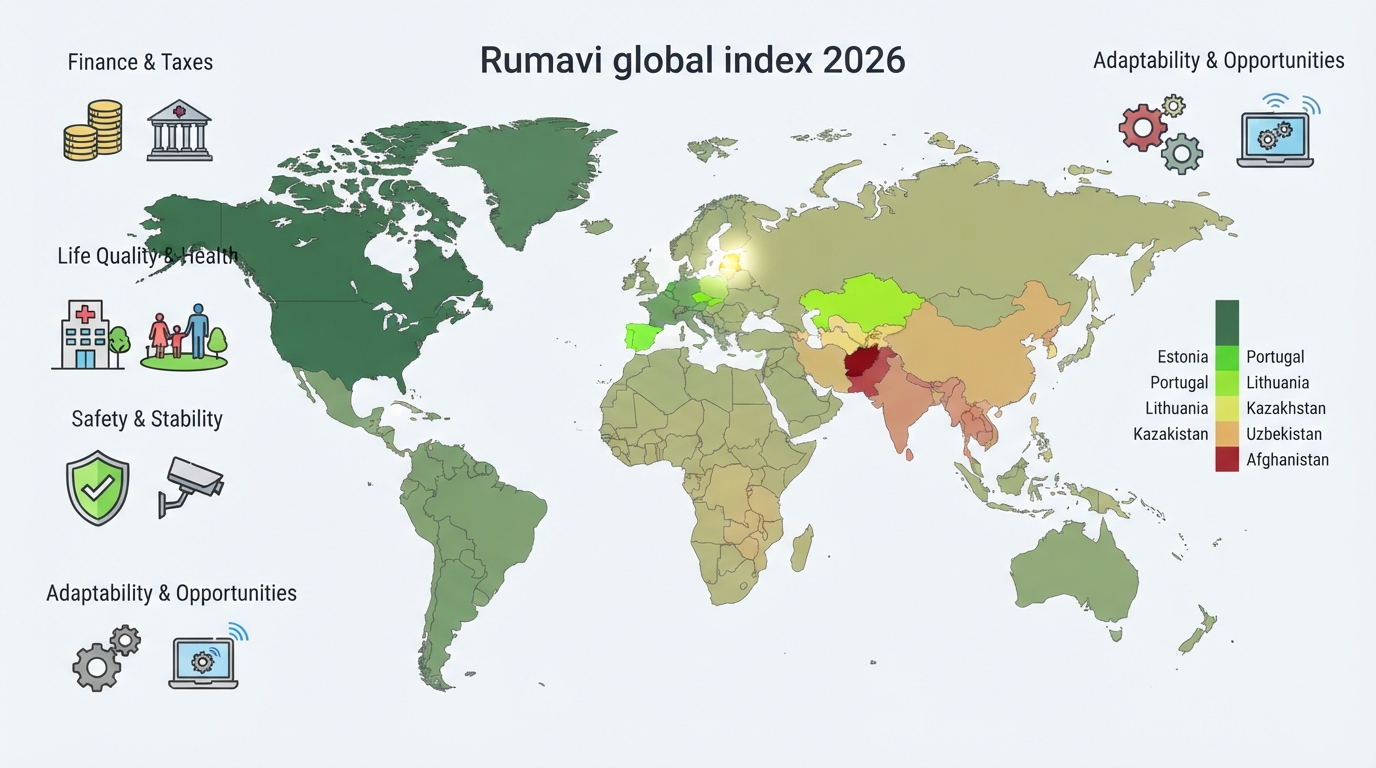
The 2026 ranking of the most suitable countries to live in has been announced
The ranking of the best countries to live and relocate to in 2026 has been published. A Baltic state led this list compiled worldwide. Euronews reported on this.
Estonia took first place in the Rumavi global index due to its banking infrastructure, business opportunities, and guarantees of property rights for foreigners.
The index is published annually at the end of the second quarter. In it, 192 countries are evaluated based on 24 indicators divided into four groups: finance and taxes, quality of life and health, safety and stability, as well as adaptation and opportunities.
A large amount of data and expert assessments are used in preparing the document. For example, in calculating the overall level of affordability, the independent consulting firm Rumavi took into account World Bank price data and the Mercer Cost of Living Survey. In assessing political stability, the Global Peace Index 2025 and the World Bank's Government Effectiveness indicator were used at 50 percent each.
Countries are evaluated on a 100-point system for each indicator. Estonia received 99 points for its currency and banking system, 96 points for business opportunities, 82 points for housing affordability, 86 points for green spaces, and 77 points for street safety. The lowest result was climate comfort: only 20 points were given due to cold and dark winters.
Five European countries entered the top ten of the global index. Following Estonia, Portugal took fourth place. Portugal received high scores for its currency and banking sector, foreign property rights, and low risk of conflict. However, it was given only 48 points for personal income tax.
Another Baltic state, Lithuania, took sixth place. Rumavi notes its abundance of green spaces and developed banking infrastructure. The top ten was rounded out by the Czech Republic (9th place) and Malta (10th place).
Uzbekistan ranked 110th among 192 countries in the Rumavi index. The country offers an affordable cost of living, but the infrastructure for business development is insufficient. The most favorable conditions here are for digital nomads (85th place). Those relocating with families face difficulties (113th place). In particular, there are issues with the quality of education and climate comfort.
Kazakhstan took 77th place in the overall list with 62.9 points, placing in the middle tier, but became first among Central Asian countries. The country attracts digital nomads (60th place). Very affordable housing prices were noted as a positive aspect. However, a low level of English proficiency, a weak startup ecosystem, and harsh winters were listed as negative sides.
Kyrgyzstan ranked 118th in the global index.
The country stands out for its low cost of living, but it is not without problems. Although this country is convenient for digital nomads (105th place), political instability, a weak startup system, and a harsh climate were noted as drawbacks.
Turkmenistan took 155th place. Prices here are very cheap, but there are serious problems in the governance system. This is a relatively acceptable option for digital nomads (149th place), while the ecosystem for entrepreneurs is very weak (144th place). It was noted that when moving here, one must take into account the limitations of the rule of law.
Tajikistan was recorded in 137th place. Prices in the country are cheap, but there are major problems with air quality and the protection of property rights. Conditions are better for digital nomads. Nevertheless, the indicators are below average.
Afghanistan took the very last place on the list with 39.5 points. Although housing is very cheap, political instability, the banking system, and climate issues pose problems for those relocating.
Uzbekistan is recorded in 98th place among 181 countries. In forming this list, factors such as inclusion — women's participation in education, employment, financial services, communication, and political life; justice — legal protection of women and access to the judicial system; and security — domestic violence, sense of safety in public, political violence against women, and proximity to armed conflicts were taken into account.