

Tashkent's office market is entering a more mature phase. What is happening with supply, rates, and demand — a study by CMWP Uzbekistan
Over six years, the volume of office space for rent in Tashkent has increased more than fourfold. Now, supply growth is slowing down. Analysts at CMWP Uzbekistan believe that the market is transitioning into a more mature phase. What led to these changes is detailed in the overview of the company's study.
Tashkent's office market is entering a more mature stage. What is happening with supply, rates, and demand — a study by CMWP Uzbekistan
It currently includes 138 operating, under-construction, and reconstructed business centers, including properties not previously tracked by the company — mostly Class B and C.
To more accurately interpret local market changes, experts have added the Prime category — in the company's new classification, this designates Class A+, which combines the capital's key office properties with the highest requirements for the quality of engineering systems (including a 4-pipe air conditioning and humidification system), parking space availability, and single-ownership structure.
"Singling out business centers in the premium segment allows for a more accurate determination of the upper price range of the market and increases the comparability of properties within each class," the report says.
The total volume of Tashkent's office stock also includes Built to Suit (BTS) properties — business centers constructed for a specific user.
Since they are not represented on the open rental market, analysts did not include them when calculating market vacancy and average rental rates.
As of September 2026, the total gross leasable area (GLA) is 1,074,946 sq. m, including 282,270 sq. m of BTS.
Since the beginning of 2026, the Summit and BoMI business centers, Infinity Tower 2 (Class A and Prime), as well as Sapphire and Chust (Class B) have been commissioned. Their combined area is 125,457 sq. m of GBA and 85,389 sq. m of GLA.
Analysts emphasize that further market development will be driven primarily by the implementation of already announced projects.
"In the next four years, according to developers' announcements, it is planned to commission another 13 business centers: four Class A and nine Class B. The cumulative volume of new supply, including the return of one property to the market after reconstruction, will exceed 112,000 sq. m of GLA — about 14% of the current volume of leasable area. This indicates a slowdown in the growth rate of supply," the report says.
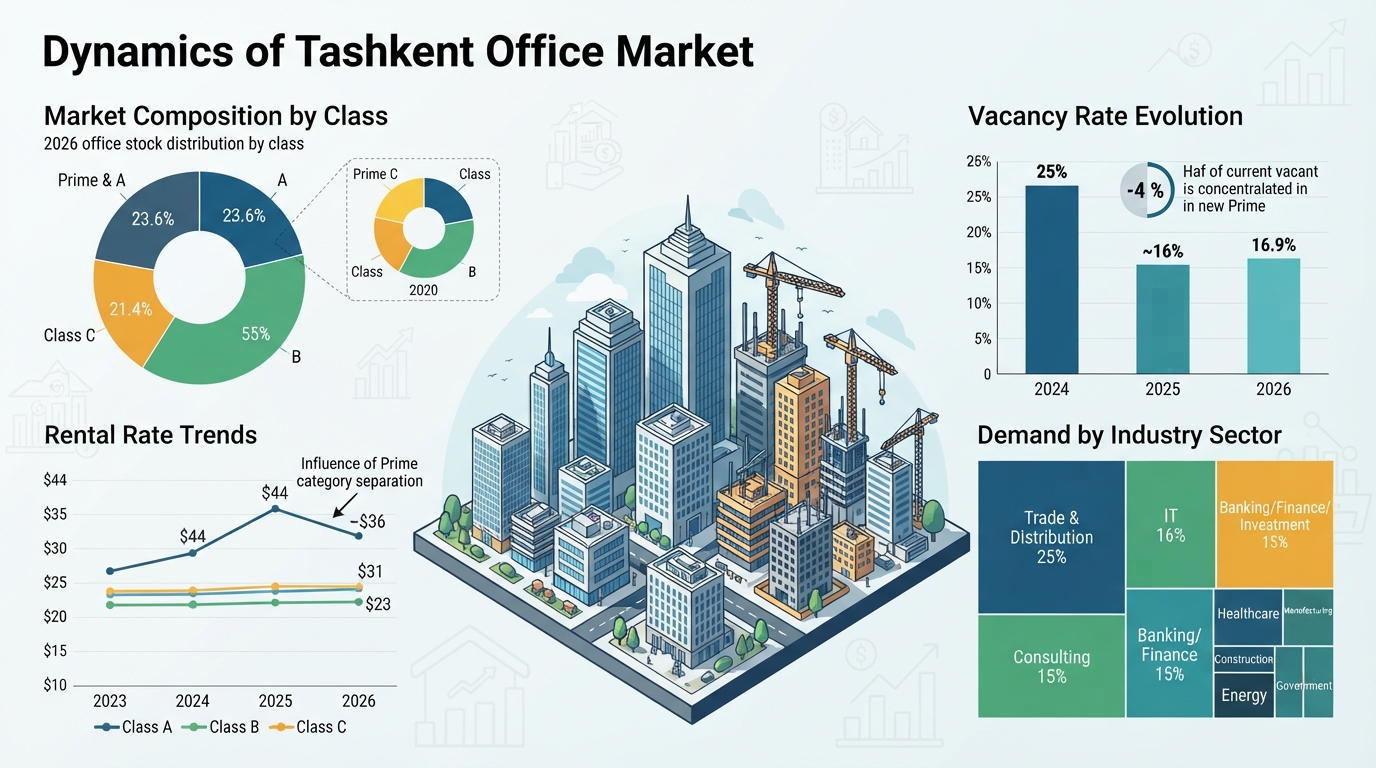
In the structure of existing supply, excluding BTS properties, Class B business centers dominate — their share in the total stock grew from 43% in 2020 to 55% in 2026.
Until 2021, Class C business centers formed the basis of the office stock, but by 2026 their share had decreased from 57% to 21.4%.
The formation of the high-end office segment began in 2021 with the appearance of the first Class A business centers. In 2023, the first Prime category properties entered the market. By 2026, the combined share of Class A and Prime category properties reached 23.6%.
The vacancy rate of the existing office real estate market in 2026 is about 16.9%. This is slightly higher than the 2025 figure (~16%), but noticeably lower than the 2024 level (25%). About half of all vacant space is in Prime category properties. The high concentration of vacant space in the Prime category is primarily associated with the commissioning of the new Summit and BoMI business centers. In Classes A and B, approximately 23% of space is vacant in each.
In 2023–2026, rates in Classes B and C almost returned to the 2023 level, which indicates the stability of the price level in these segments.
Currently, the average marketed rate in Classes B and C, including VAT and operating expenses, ranges from $23 to $31.
In Class A, on the contrary, a noticeable adjustment occurred: after reaching a peak of $44 per sq. m in 2025, the rate decreased to ~$36. The report notes that the decline is due not only to market correction but also to the separation of Prime properties into a distinct category, which affected the average rate. CMWP Uzbekistan notes that the presence of office fit-out increases the final market rate by about 15–35% compared to the net rental rate.
Actual demand is characterized by a broad industry structure. The largest share belongs to trade and distribution (25%), followed by IT companies (16%), consulting (15%), and the banking, finance, and investment sector (about 15%). Together, they generate more than 55% of demand, confirming that business centers are primarily oriented toward commercial and technologically advanced industries.
In aggregate, a notable share is occupied by healthcare, manufacturing, and the construction/development sector (about 5% each). Smaller shares belong to raw materials and energy companies (4%) and government structures (about 3%).
CMWP Uzbekistan believes that the market is transitioning into a more mature phase: the pace of new construction is slowing down, and competition is increasingly determined by quality rather than the volume of supply. The emergence of the Prime category, combined with the limited commissioning of new Class A and B properties in the coming years, will, according to analysts, intensify competition in the upper segment of the market. Another factor is the high share of BTS properties in the structure of the stock. This shows that some large companies already prefer to build offices for themselves rather than rent them, which in the future could shift the balance between renting and owner-occupier construction even further.