

Tashkent lacks about 1000 hectares of large green areas — khokim
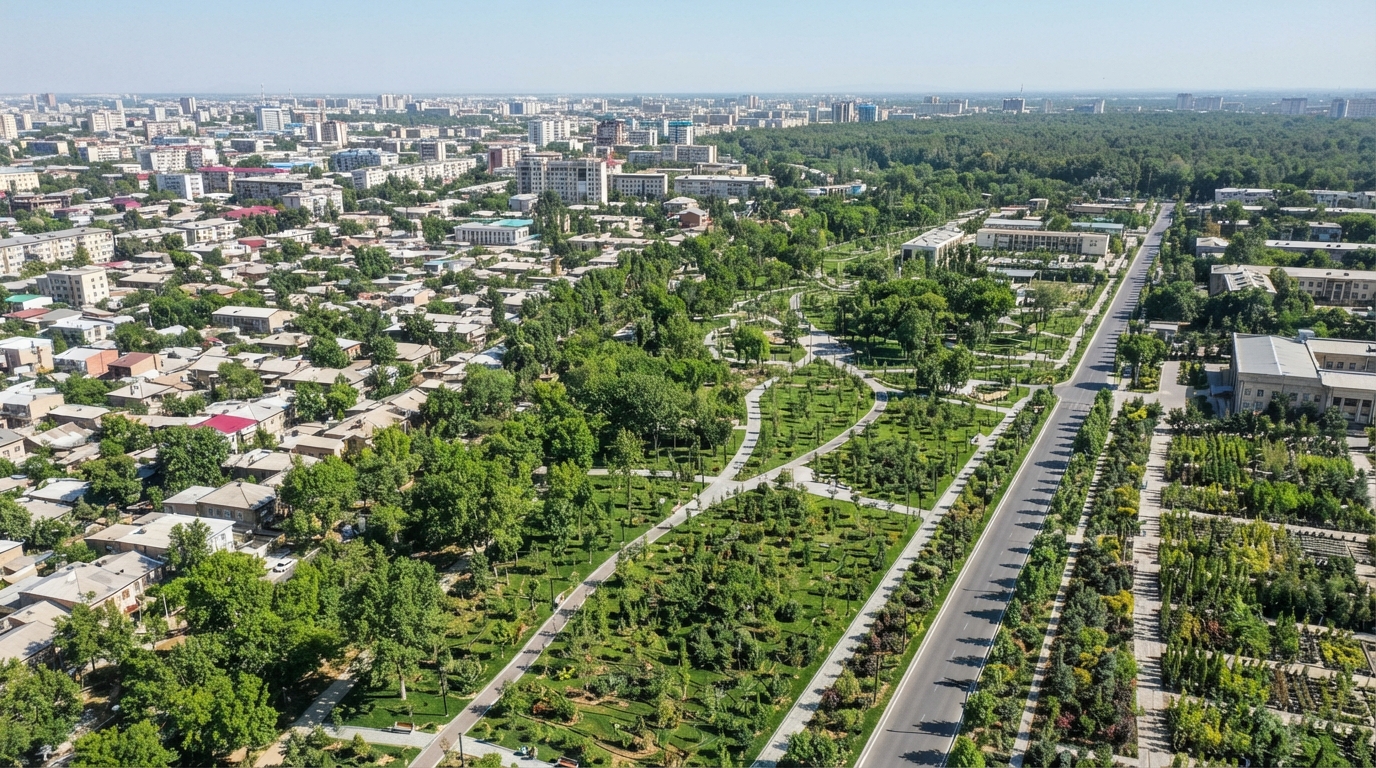
To approach the level of greening of Almaty, Tashkent needs to add about 1,000 hectares of large green and forest park areas, stated the khokim of the capital, Shavkat Umurzakov. By 2035–2040, the authorities are targeting approximately 3,000 hectares of green areas within the existing city boundaries.
Tashkent lacks about 1000 hectares of large green areas — khokim
To bring Tashkent's level of greening closer to Almaty, the capital needs to add about 1000 hectares of large green and forest park areas. The khokim of Tashkent, Shavkat Umurzakov, shared this in an interview.
"If we talk about the needs of today's Tashkent, then, to get closer, for example, to the level of Almaty, we lack at least about 1000 hectares of large green, forest park areas," he said.
When asked to clarify whether this meant a need to approximately double the current area of such territories, which stands at about 1000 hectares, the khokim replied:
"We need to add about 1000 hectares. If we talk about the long-term goal, then, God willing, by 2035–2040 for the current territory of Tashkent — I am not talking about New Tashkent right now — we have set a target of approximately 3000 hectares of green areas," he noted.
Umurzakov linked the emergence of new green zones to the future renovation of low-rise neighborhoods. According to him, currently about 60–70% of the city's territory is occupied by low-rise buildings or plots that could potentially fall under renovation.
"During renovation, about 30% of this territory can be built up — we are talking about 8000–9000 hectares. According to the calculation I am presenting now, about 15 thousand hectares remain; approximately 10 thousand of them can be allocated for green areas, and the rest for infrastructure," the head of the city administration stated.
According to the khokim, the authorities have already identified specific plots with a total area of approximately 1000 hectares where they plan to create the corresponding infrastructure.
The khokimiyat is also establishing its own nursery for about 120 million shrubs. The authorities intend to reduce the use of large quantities of flowers and lawns in favor of mass planting of shrubs and drip irrigation.
For urban greening, it is planned to use trees that are at least eight years old.
"To reach a conveyor system, in the first three years the nursery must have saplings of different ages — five-, six-, seven-year-olds, in order to replant those that have reached eight years of age annually," he explained.
According to Umurzakov, the average target is about 10 thousand such trees per district annually, taking into account its area, which means "about 120 thousand trees annually across the city."
According to the khokimiyat's calculations, up to 120 million shrubs can be grown simultaneously on 100 hectares of the nursery. It is proposed to use some of them for greening the city, and sell some to the private sector, directing the revenue back into maintaining the system.
"If the nursery grows 120 million shrubs, why not sell a portion — conditionally 40, 50, or 60 million? Even 50–60 million shrubs a year for Tashkent itself is a huge volume of greening," said the head of the capital's khokimiyat.
On the president's instructions, more than 100 hectares were allocated to the khokimiyat for forestry. According to Umurzakov, currently a total of about 300 hectares in the Bektemir and Yangikhayot districts is being assigned to the forestry enterprise, where a forest area is being created. About 100 hectares are expected to be used for the shrub nursery.
The khokim noted that one of the reasons for the death of trees in the past was planting in areas without an irrigation system or improper planting.
According to the city authorities' calculations, up to 100 million shrubs can be placed along approximately 741 km of central streets of district, city, and republican significance. At the same time, a separate team must prepare the soil and the irrigation system beforehand.
Separately, the khokim spoke about plans to develop already existing parks and green zones.
On the instructions of the head of the Presidential Administration, Saida Mirziyoyeva, the authorities are working to connect about 800 hectares of Tashkent's park and green areas with each other.
"The task is not only to physically connect these zones, but also to properly create an interesting and convenient infrastructure for people there. We ourselves do not have enough of such experience. You can just put a bench, but even where exactly to put it is important. Therefore, we want to do this according to a project," he stated.
Foreign and local designers, including Buro Happold and the SAD architectural studio, have been involved in developing the concept. According to Umurzakov, specialists in micro-mobility, pedestrian routes, traffic lights, retail, events, road infrastructure, greening, and irrigation systems are working separately within the consortium.
Today, there are about 893 hectares of public parks in Tashkent, but there are only about 2 sq. m of green zones per resident, compared to the standard of 17–19 sq. m, the head of the urbanization committee, Sherzod Kudbiev, reported in March. To solve the problem, it is planned to create nine parks on an area of 140 hectares.
They are planned to be created through infrastructure payments paid by developers and other contributions. The "Tashkent Invest" company under the capital's khokimiyat will build parks with a total area of 139.6 hectares as a matter of priority. After creation, they will be transferred to a conservation zone.
Also, there are 91 illegal structures (7600 sq. m / 0.76 hectares) in 18 parks, and 1248 illegal amusement rides are installed in 98 parks. In addition, the practice of seizing park lands for the reserve fund of government bodies, their privatization, or alienation is common.
Respondents — more than 400 people — also noted a lack of parks and green zones in general.