

Suspect linked to Monaco bomb attack on millionaire breaks silence to BBC
Vitalii Zhykovych gives his own account of the attempted assassination of Ukrainian-born businessman Vadym Yermolayev.
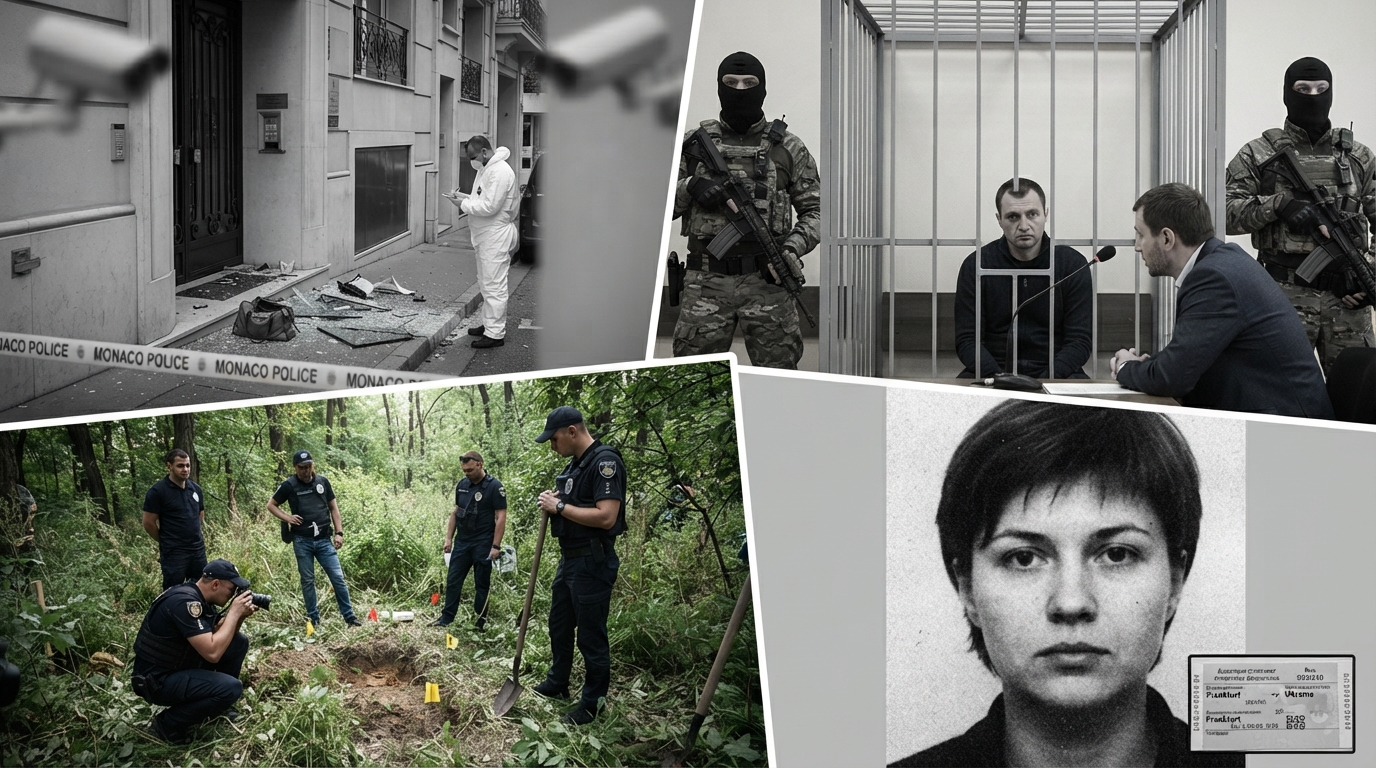
Suspect tied to Monaco bomb attack on millionaire speaks out to BBC
Vitalii Zhykovych appeared in open court over the summer and has now spoken to the BBC from prison
A former Ukrainian security services officer connected to a bomb attack in Monaco in June that targeted a multi-millionaire says he thought it had been ordered by senior figures in HUR, Ukraine's military intelligence agency.
In an exclusive interview with the BBC from a prison in Kyiv, arranged through his lawyer, Vitalii Zhykovych has for the first time given his version of the attempted assassination.
Ukrainian-born businessman Vadym Yermolayev and his 13-year-old son were badly injured in the blast, while his partner suffered catastrophic injuries. Yermolayev later said their survival was "nothing short of a miracle".
Zhykovych describes himself as a "freelancer" for Ukraine's SBU security service and says Anastasia Berezovska, the woman filmed planting the bomb in Monaco, was his "agent".
A week after the bombing, Berezovska's body was found in woods west of Kyiv with gunshot wounds to the head.
Zhykovych, however, insists he did not send her to kill, and says he did not kill her either.
He was arrested and accused of her murder alongside an active-duty HUR intelligence officer named Vladyslav Reut.
Reut first confessed to investigators and led them to the shallow grave. But days later in court, he changed his account and blamed Zhykovych.
Zhykovych himself remained silent for a long time.
Now, answering BBC questions, he claims Reut - whom he calls "The Boss" - had "proposed the operation" in Monaco against Vadym Yermolayev.
He says he understood it to be an official assignment.
"As Reut informed me, this operation […] had been authorised and approved by Reut's superiors, who served in the Main Intelligence Directorate of the Ministry of Defence [HUR]," he says.
Separating himself from the blast itself, he alleges that Reut wanted to use Berezovska for the bombing and that when Zhykovych refused - saying she was not fully trained - Reut agreed to send her only for reconnaissance.
According to Zhykovych, Reut then dealt directly with Bereszovska without involving him, and he also alleges that Reut supplied her with the explosives.
The BBC asked HUR to respond to the latest allegations. The agency has previously said it is "committed to a full investigation" and to providing "comprehensive support" to law enforcement bodies.
The SBU has referred to Zhykovych in a statement only as a "former law enforcement officer".
Yermolayev was attacked in Monaco as he and his family were returning from an evening meal on the seafront. Surveillance footage shows Berezovska walking slightly ahead of the group, then leaving the device in a bag on their doorstep.
It explodes just as they draw near, apparently shocking even Berezovska with its force.
Yermolayev later said he believed serving HUR officers, "individuals close to the agency's current and former leadership", were involved in the attack.
He called for "the truth, protection, and justice".
Berezovska was quickly identified as the suspected bomber and on 2 July her image, taken from CCTV footage, was circulated by Interpol.
She had already fled, first driving through Italy and Germany, then taking a bus from Frankfurt to Ukraine.
Before she could be detained and questioned, she was taken to the woods by Reut and Zhykovych and killed. Each accuses the other of shooting her.
The extraordinary case has fuelled heavy speculation, including over who may have wanted Yermolayev dead and why, and whether this was a state-ordered assassination attempt, a rogue operation or some kind of criminal settling of scores.
The businessman himself, who gave up his Ukrainian passport some years ago and now holds Cypriot citizenship, has rejected several theories.
These include the suggestion that the attack could be tied to a conflict between organised crime groups involved in highly profitable scam call-centres in Ukraine.
Earlier this year, a court in Estonia convicted Yermolayev's son, Artur, of defrauding its citizens out of millions of euros through such "offisy", as the scam networks are known in Ukraine.
Vadym Yermolayev told the Ukrainska Pravda newspaper that he "never had anything to do with anything" in the case.
Now Zhykovych has offered his own explanation to us.
He alleges that Reut told him the bombing was revenge for "funding the annexation of Crimea", which he understood to mean Yermolayev was paying taxes to Russia from businesses in Russian-occupied Crimea.
"In my view, this constitutes grounds for the operation," he communicated from prison.
Yermolayev has repeatedly denied having any remaining business interests connected to Russia.
But could the story be even more complicated?
At his latest custody hearing in Kyiv, surrounded by heavily armed guards, Zhykovych spoke publicly for the first time since his arrest. The BBC was the only media outlet present.
At one point Zhykovych said Reut had in fact told him the Monaco attack was not "authorised".
"Someone had ordered this target from the civilian side," Zhykovych said, without elaborating.
Vadym Yermolayev and his 13-year-old son were badly hurt in the blast and his partner suffered catastrophic injuries
The judge then cut in, reminding him that he was speaking in open court.
Zhykovych also disclosed that Reut had originally spoken of two targets.
When asked, he said he could not reveal the second name. Other sources strongly indicate it was a pro-Russian blogger tried and convicted in absentia last year by Ukraine of treason.
As the investigation continues - into both the Monaco bombing and the killing in Ukraine - Berezovska's family still have many questions.
The 39-year-old had been in Germany since early 2022, when she left Ukraine as a refugee with her young son.
Zhykovych now says she was living a double life, working with him as an agent "against Muscovy" - meaning Russia.
He said they had met online and told us the pair were working to "repel the armed aggression of the Russian Federation".
Berezovska's husband told the BBC that the claim was "nonsense". He believes she was drawn, unknowingly, into the entire affair.
Zhykovych says Berezovska phoned him the day after the Monaco attack, and when he asked why she had done it, she said Reut had promised her a large payment. "$50,000 doesn't just lie on the streets," she supposedly said.
People in her village have told us that Berezovska was saving to buy a flat. But when she travelled to Ukraine to collect the money, she was lured into the woods and shot.