

Sukuk, futures, and new bonds. What the capital market law will change in Uzbekistan
Sukuk, Futures, and New Bonds. What Uzbekistan's Capital Market Law Will Change
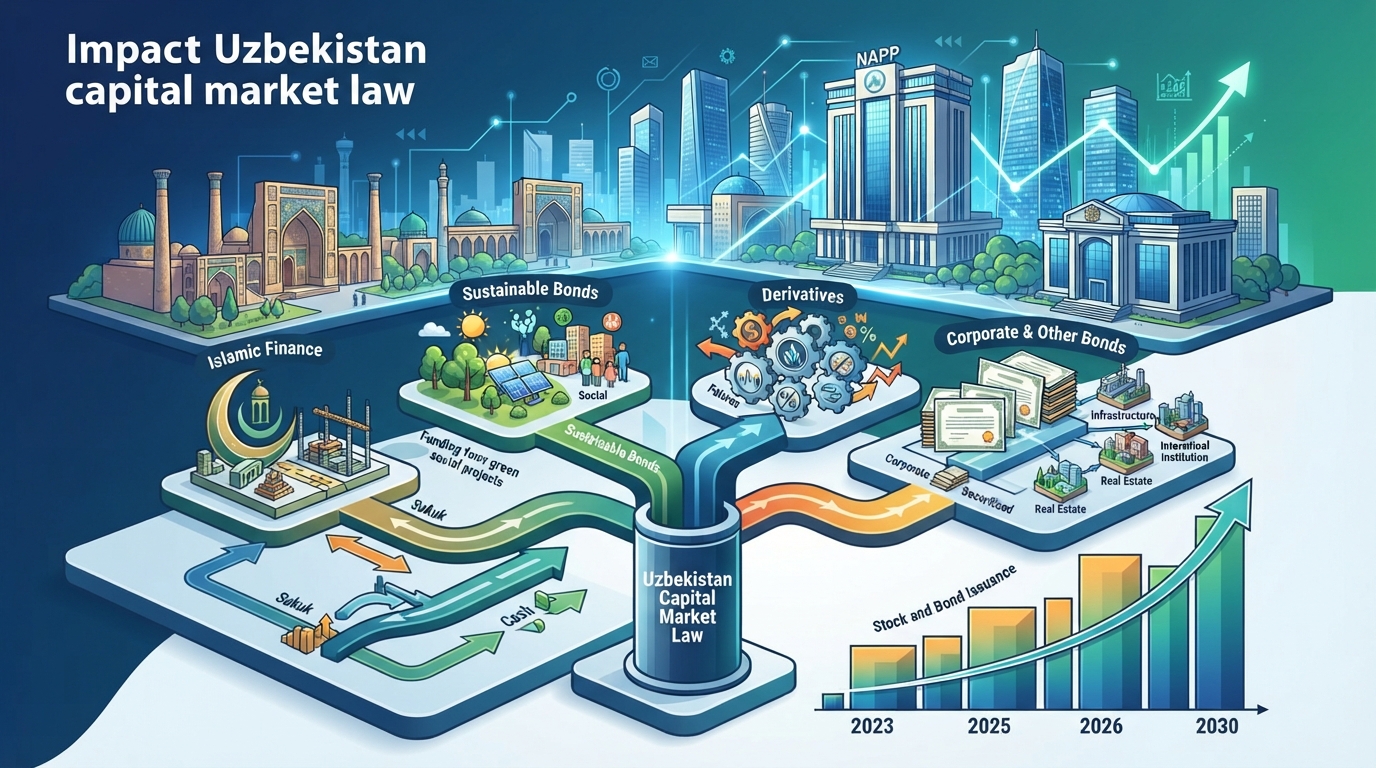
A new law on the capital market is being prepared in Uzbekistan, which is designed to expand business opportunities for attracting investment and open access to new financial instruments. Among them are Islamic sukuk securities, the yield on which is formed according to the rules of Islamic finance rather than through traditional interest payments.
On October 14, the bill was presented at the National Agency for Perspective Projects (NAPP). The document includes 16 chapters and 123 articles; it has already passed the first reading in the Legislative Chamber of the Oliy Majlis and is now being prepared for the second reading.
One of the main innovations will be the regulation of sukuk. Unlike conventional bonds, where the investor receives interest on the loan provided, income from sukuk can consist of project profits, lease payments, or other asset operations in accordance with the principles of Islamic finance.
For example, a company can raise funds for the construction of a facility, while investors receive income from its use under the terms of the security issuance.
The bill also provides for the issuance of sustainability bonds, which will be aimed at financing environmental and social projects.
In addition, it is proposed to regulate the use of options, futures, forwards, swaps, and contracts for difference. These instruments help manage financial risks and utilize various investment strategies, but at the same time they may carry additional risks.
A separate section is dedicated to covered and securitized bonds. The former are backed by a specific asset pool, while the latter allow financing to be raised through assets or related cash flows. It is also proposed to regulate the issuance of bonds by international financial institutions.
Expanding the list of instruments is expected to give investors more opportunities for investing funds, and companies additional ways to raise financing beyond bank loans.
NAPP explains the need for reform by the development of the financial market and the emergence of instruments that require separate regulation. The bill was prepared on the basis of a review of current legislation on the securities market adopted in 2015.
For comparison, the current law contains 64 articles, whereas the new document has 123. International financial organizations and specialized entities, including the European Bank for Reconstruction and Development, the International Finance Corporation, and the Asian Development Bank, participated in its development.
According to NAPP, the volume of share emissions grew from 189.7 trillion sums in 2023 to 265.1 trillion sums in 2025. As of July 1, 2026, the indicator reached 269.4 trillion sums.
The volume of corporate bond issuances over the same period increased from 1.06 trillion to 3.93 trillion sums. Trading volume on the stock exchange also grew: from 2.9 trillion sums in 2023 to 17.6 trillion sums in 2025.
NAPP expects that the introduction of new instruments will make it possible to attract an additional 10 trillion sums in investments by 2030. However, this is a target figure rather than funds already raised.
The bill also provides for changes in the market infrastructure. In particular, it is proposed to introduce the institution of a central counterparty, expand the powers of the Central Securities Depository, and improve the regulation of the activities of rating agencies and management companies.
In addition, the document provides for the creation of self-regulatory organizations and the introduction of the institution of bondholders' representatives. This mechanism is intended to protect the common interests of debt security holders.
However, all the listed changes remain proposals for now. The bill has yet to undergo further consideration in parliament, so the final list of instruments and the rules for their application may change.
The practical effect of the reform will depend on how the new mechanisms operate and what conditions are created for investors and companies.