

Stuck between superpowers: How Australia navigates the China-US rivalry
Australia is increasingly concerned about China's military might - but Beijing is also its biggest trade partner.
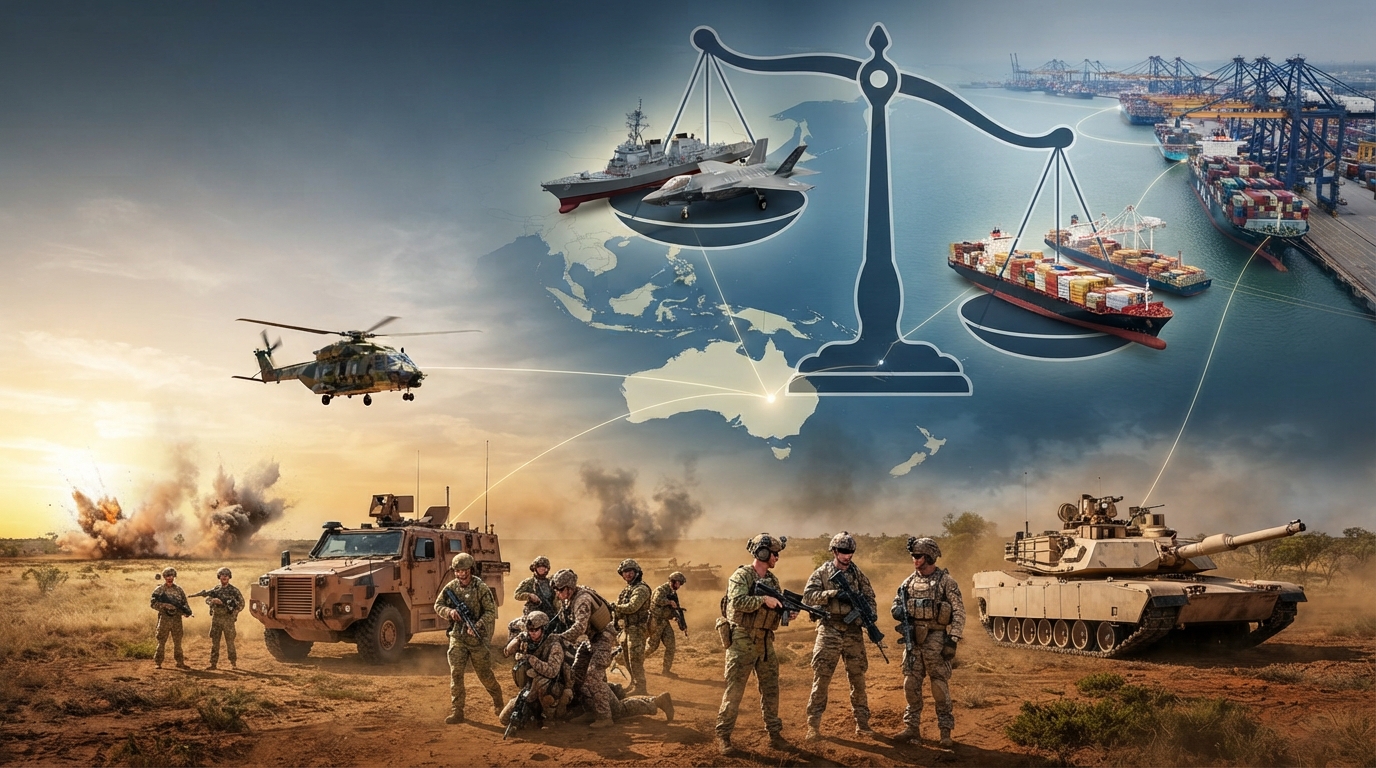
**Stuck between superpowers: How Australia navigates the China-US rivalry**
**Relations between the two countries have been rocky in recent years**
Snipers break the stillness of the Australian outback. Then missiles strike, and smoke lifts in the distance. Drone noise begins, only to be overtaken by helicopters passing overhead.
Every kind of equipment is being used, with no expense spared. Yet this is not an actual battlefield — the last time Townsville experienced conflict was in World War Two. This is a display of military power.
" We live in a volatile world," says Australian Army Brigadier Ben McLennan.
"Training an army to be prepared to fight a war that is potentially more likely than it has been previously, [is] very important."
For Australians, who often feel far removed from crises elsewhere, war is no longer an abstract idea. Thousands of miles from any active fighting, the country, like the rest of the world, is feeling the ripple effects of Iran and Ukraine, including higher fuel costs and rising inflation.
With China’s military strength also growing and its influence in the Pacific expanding, concern is increasing about the threat it poses. Australia has answered by strengthening its ties with the US, its security partner and China’s rival superpower.
But that also leaves Australia in a difficult spot, because China’s rise has made it Australia’s largest trading partner.
Australian Army Brigadier Ben McLennan says Australia is rehearsing for "the worst type of war"
It is a contradiction that most people understand well — which is likely why we were invited to report on what Australia is doing to defend itself, while no one is prepared to say who they are training to fight.
"We're rehearsing for a war - the worst type of war - a World War Two-like war, a World War One-type war, a total war," says Brigadier McLennan, choosing to stay vague when asked who the enemy is.
The conflict scenario unfolding before us is part of a major joint exercise called "Southern Jackaroo" — a training programme involving the Australian, American and Japanese armed forces designed to strengthen defence cooperation across the Indo-Pacific.
"We like to call ourselves America's 911 response force," US Marine Kevin Hicks says.
By the numbers, they are more ready than ever. In 2012, only 200 US Marines were sent to Australia for an annual six-month deployment. Today, that number has climbed to about 2,500.
A quick look at Australia's 2026 National Defence Strategy makes the reason for that growth clear.
"Intense competition between major powers – principally the United States and China – will be an enduring feature of our strategic environment," it said.
"China continues to undertake the largest military build-up in the world today, without the transparency or strategic reassurance the region expects."
These military arrangements are being reflected not only in troop numbers but also in bases — most notably in the north of the country, including RAAF Tindal air base in the Northern Territory, which has been upgraded to support long-range American B52 bombers.
But the security partnership between the US, the UK and Australia — Aukus — which will arm Australia with nuclear submarines, is arguably the clearest sign of the deepening relationship.
Australia’s approach is different from that of other middle powers. While Canada’s Prime Minister Mark Carney has spoken about middle powers reshaping their priorities in response to an increasingly unreliable US, Australia appears determined to bind itself even more closely.
The Southern Jackaroo exercises are intended to improve defence cooperation in the Indo-Pacific
Yet this comes as Australians themselves are increasingly questioning their relationship with the US.
"Only 31% of Australians trust the United States to act responsibly in the world, and a mere 28% of Australians trust China to do the same," says Charles Lyons-Jones, a research fellow at the Lowy Institute, citing the institute’s annual poll.
"Those are striking findings when you consider the level of trust that the Australian government has with the United States."
As Australia’s alliance with the US evolves, its relationship with China is changing too.
The armed forces may be preparing for a possible military clash, but the reality remains that China is Australia’s most important economic partner.
Australia and China have had diplomatic relations since 1972, but it was only in the early 2010s that China became Australia’s biggest trading partner, eager for the commodities Australia could supply.
Australia opened its economy and encouraged business and trade, Chinese President Xi Jinping was invited to address parliament, and the process culminated in the signing of a free trade agreement in 2015.
That golden period did not last long. When Australia called for an investigation into the origins of Covid in 2020, China rejected the questioning and responded with tariffs.
Then in 2021, Australia became the first country to reverse course on China’s Belt and Road Initiative — its huge global infrastructure plan — when it cancelled the state of Victoria’s agreement with the Chinese government three years after signing on.
Several Australians have also been detained in China, including journalist Cheng Lei, who was freed in 2023 after more than three years.
Relations have improved in recent years under Anthony Albanese’s Labor government, but difficulties remain.
For example, in June this year China imposed 55% tariffs on beef to protect its domestic market, despite the free trade agreement.
China is Australia's biggest export market
Even with these setbacks, this year’s Lowy Institute Poll found that a majority of Australians, 61%, viewed China more as an economic partner than a security threat. That was an 11-point rise from last year. But when it comes to Chinese investment in Australia, people are more cautious.
"There are a number of European countries which are larger investors in Australia than China, and that is because our jurisdictions are much more similar, and there is a greater level of trust between our governments," says Lyons-Jones.
This year’s Lowy Institute Poll also found that, for the first time, a majority of Australians, 51%, believed Australia’s relationship with China was more important than its relationship with the US.
Earlier this month, former Prime Minister Kevin Rudd — a fluent Mandarin speaker — delivered an address in which he spoke about "radical changes" now reshaping Australia’s national security, including "the rise and rise of China at a time when America continues to debate what sort of global power it wants to be".
Dr Marina Yue Zhang, an Associate Professor at the University of Technology Sydney, agrees that Australia’s relationship with its closest ally is shifting.
"The US is really doing something dramatic and more and more people in Australia - and I think globally - have realised 'is this the big brother we can all trust and put all our faith in?' " she says.
Australians have cooled on their relationship with the US under Trump
But old rivalries remain. With Australia caught between two superpowers, every exchange between their leaders matters. And in Beijing earlier this year, when Xi met Trump, the Chinese president raised the idea of the "Thucydides Trap", the theory that conflict can become nearly unavoidable when a rising power challenges an established one.
"This is, if not the transition of great powers, at least [it's] power struggles of great powers, says Zhang.
And in that rivalry, Australia is inevitably affected. The US is a security ally that, while less reliable than before, is still its foundation. But China is also economically essential. It is not a choice between one or the other — it is a balancing act.
"There's no way Australia will choose one side and [dump] the other- it's not in their interests," Zhang says.
"It's getting harder and harder to maintain, but Australia has to do it."