

Strategy for mass sports and a healthy nation
The health of the nation is one of the most important criteria for the development of a country. Because only a healthy person can receive a quality education,
**Mass Sports and Healthy Nation Strategy: An Important Criterion of Development**
The health of the nation is one of the main indicators of the development of any country. After all, only a healthy person can receive a quality education, work effectively, and make a worthy contribution to the development of his family and society. Therefore, in today's Uzbek politics, it is becoming increasingly important to view sports not only as a field for medals and records, but also as a means of raising a healthy generation, strengthening human capital, and forming a healthy lifestyle in society.
As we celebrate 35 years of independence, if we look at the work done in the field of sports in our country, especially in the last ten years, an important trend is clearly visible: sports are no longer just the work of professionals, but are becoming a "mass movement and a strategy for ensuring the health of the population."
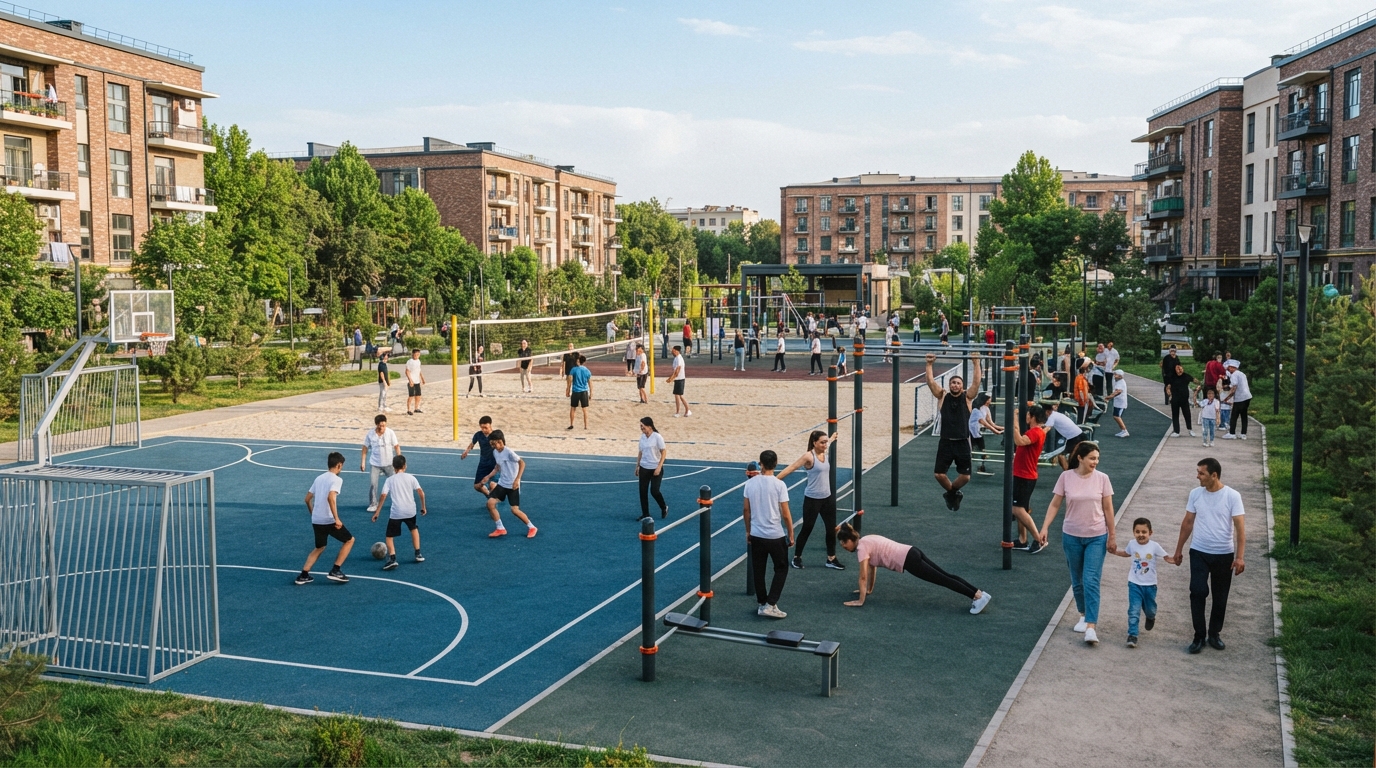
Over the past nine years, 1,774 modern sports grounds have been built in more than 1,500 neighborhoods. More than 200 large sports facilities and about 4 thousand private sports clubs have started operating in the regions. These figures show that sports infrastructure is now becoming more accessible not only for central cities or professional athletes, but also for ordinary citizens.
The most important aspect of this process is the deep penetration of sports into the life of the neighborhood. Because for the development of mass sports, convenient and open sports fields in the area where a person lives are more effective than huge stadiums. The goal is precisely this: to create conditions so that a person does not have to travel long distances to play sports, but can run in his neighborhood, play football, volleyball, basketball or other sports.
This direction is also defined with clear goals in the "Uzbekistan - 2030" strategy. According to the strategy, it is planned to build at least 5 thousand sports grounds for physical education and mass sports in neighborhoods, and to increase the level of coverage of young people aged 7-30 in mass sports events to 60%. Today, workout sports grounds can be seen in every neighborhood and in front of every apartment building.
One of the most important indicators of changes in mass sports is the coverage of the population with sports. By the end of 2025, the number of people involved in mass sports in Uzbekistan reached millions. The number of people regularly involved in sports has increased by almost 1.5 times in recent years. The task ahead is to bring this indicator to 17 million in the near future.
These figures alone show how much the approach to sports policy has changed. If earlier the main focus of sports policy was on high results and the training of champions, today the population itself is becoming the main participant in the sports process. That is, the logic of the strategy is simple: "if more people do sports - a healthy lifestyle is popularized; if a healthy generation increases - the human capital of the country is strengthened."
Mass competitions also play an important role in attracting young people to sports. In particular, the "Five Initiative Olympics" has become one of the most effective mechanisms for promoting a healthy lifestyle and popularizing sports among young people. In the 2024 season alone, more than 442 thousand students of higher educational institutions participated in competitions in mini-football, volleyball, streetball, athletics and table tennis. In 2025, it is planned to cover 700 thousand pupils and students within the framework of this system. The important point here is not the competition itself. The main goal is to regularly involve young people in sports, to form in them the skills of teamwork, discipline, competition and a healthy lifestyle.
Popular sports and professional sports are not two separate directions. On the contrary, popular sports are the foundation of high-performance sports. In recent years, the number of young people involved in professional sports has doubled. The number of athletes on Olympic teams has doubled, and the number of Paralympic athletes has tripled. In 2025, Uzbek athletes won 452 gold, 418 silver and 501 bronze medals in international competitions. So, the attention paid to popular sports is also bearing fruit in professional sports.
Today, the approach aimed at forming a chain of "neighborhood - school - sports institution - federation" also serves this purpose. Early identification of a gifted child, directing him to a sport appropriate to his abilities, and systematically organizing the path to professional sports are one of the most important conditions for training future champions.
One of the most important new approaches in sports policy is the desire to measure the result not only by medals, but also by human health. At a videoconference meeting held in April 2026, the task was set to assess the effectiveness of mass sports in the neighborhood also by the health indicators of the population. It was planned to form a "health balance" in each region, to organize a corps of "healthy life volunteers" from among the population actively involved in sports. This is also a philosophically important turn in sports policy. Because the greatest victory in sports is not always on the podium. Sometimes its greatest result is a person who has prevented a disease, a young person who has given up a bad habit, a citizen who has made a habit of running every morning, or a neighborhood united by sports.
Uzbekistan's development experience during the years of independence shows that investment in sports is not only an investment in sports. A new sports ground is a new opportunity for young people. A new sports club is a new healthy environment for the population. A mass competition is a school of teamwork and discipline. The system for identifying gifted children is the path to future champions. In this sense, the work carried out over the past decade has not only radically changed the sports sector, but also serves to renew the attitude towards sports in society.
Most importantly, this process is no longer limited to the capital or large cities. Neighborhoods, schools, higher education institutions, private sports clubs and sports federations are becoming parts of a single system. On the eve of the 35th anniversary of Uzbekistan's Independence, this process can be viewed from one perspective: at a new stage of the country's development, "the formation of a healthy nation is becoming an important condition for economic, social and spiritual development." Therefore, the development of mass sports is not a simple task of today. It is a long-term national strategy. After all, medals show the country's potential in sports. A healthy generation determines the future of the country.